


Featured ChoiceSave 31%

Save 29%

Sold out

About this collection
BMI Machine: Uses, Accuracy, Body Composition & Professional Buying Guide
Learn what a BMI Machine is used for, how BMI is calculated, how body-composition devices work, what BMI can and cannot tell clinicians, and what hospitals, clinics and home users should check before buying.
A BMI Machine is a digital device that helps calculate or display Body Mass Index by using a person's height and weight. Some models combine weight measurement with BMI calculation, while advanced systems may also estimate body fat, skeletal muscle, visceral fat and other body-composition values.
In clinical and wellness settings, BMI is mainly used as a quick screening measure. For example, healthcare professionals may use it to identify whether an adult falls within a lower-weight, healthy-weight, higher-weight or obesity-related BMI range. However, BMI does not directly measure body fat or diagnose disease.
Therefore, a BMI result should not be interpreted on its own. Medical history, blood pressure, laboratory findings, physical examination and waist measurements may provide important additional context.
In addition, modern body-composition monitors can provide more information than a basic BMI scale. Some devices use bioelectrical impedance analysis, or BIA, to estimate body fat, skeletal muscle and body water.
However, those values remain estimates. Hydration, food intake, recent exercise and measurement timing can influence the result.
As a result, a BMI Machine can support screening and progress tracking, but it should not replace professional clinical assessment.
This guide explains BMI-machine uses, accuracy, limits, adult BMI ranges, body-composition features, current pricing and professional buying factors.
For current options, buyers can browse BMI machines available on Meddey.
What Is a BMI Machine?
A BMI Machine is a weighing or body-measurement device that calculates Body Mass Index automatically or provides the measurements required for the calculation.
BMI follows a simple formula:
BMI = weight in kilograms ÷ height in metres²
For example, a person weighing 70 kg at a height of 1.75 m has a BMI of approximately 22.9.
Some machines require height to be entered manually. By contrast, advanced ultrasonic systems may measure both height and weight automatically.
Therefore, the exact measurement process depends on the device.

What Is a BMI Machine Used For?
The main purpose of a BMI Machine is quick screening of weight relative to height.
Adult Screening Helps identify a person's BMI range from height and weight.
Progress Tracking Supports repeated weight and BMI monitoring over time.
Clinic Assessment Provides one measurement that can be considered with other clinical information.
Fitness & Wellness Advanced models may provide estimated body-composition trends.
For instance, a clinic may record BMI together with blood pressure and medical history during a general health assessment.
Meanwhile, a wellness centre may use a body composition monitor to follow changes in estimated body fat or muscle over time.
Therefore, the usefulness of the result depends on the setting and the other information available.
What Is BMI Mainly Used For?
BMI is mainly used as a screening tool for body weight relative to height.
For adults, standard numerical ranges help classify BMI into lower-weight, healthy-weight, higher-weight and obesity-related ranges.
| Adult BMI Range | BMI Value |
|---|---|
| Lower-Weight Range | Below 18.5 |
| Healthy-Weight Range | 18.5 to below 25 |
| Higher-Weight Range | 25 to below 30 |
| Obesity Range | 30 or above |
| Class 1 Obesity | 30 to below 35 |
| Class 2 Obesity | 35 to below 40 |
| Class 3 Obesity | 40 or above |
However, BMI is only one health indicator. Therefore, clinicians should interpret it alongside other clinical findings rather than using it as a stand-alone diagnosis.
Do BMI Machines Work?
Yes, BMI machines can calculate BMI correctly when the height and weight measurements are accurate.
However, accurate BMI calculation does not mean BMI perfectly describes a person's body composition or overall health.
For example, BMI does not separate fat mass from muscle mass. As a result, a muscular person may have a relatively high BMI even when body-fat level is not excessive.
Likewise, two people with the same BMI can have different waist measurements, muscle mass and patterns of fat distribution.
Therefore, a BMI Machine works well for BMI calculation and tracking, but it should not be expected to provide a full diagnosis of metabolic or cardiovascular health.
Is BMI Used by Doctors?
Yes. Doctors and other healthcare professionals commonly use BMI as one part of weight and health-risk assessment.
For example, BMI may contribute to discussions about nutrition, weight management, cardiovascular risk or metabolic health.
However, professional assessment usually includes more than BMI alone.
Depending on the patient, clinicians may also consider:
- Waist circumference
- Waist-to-height ratio
- Blood pressure
- Blood glucose
- Lipid profile
- Medical history
- Family history
- Physical examination
- Activity patterns
- Dietary factors
Therefore, a BMI value works best as part of a broader health assessment.
What Are the Limits of BMI?
BMI has several important limitations.
First, it does not directly measure body fat. Instead, it compares body weight with height.
Second, BMI does not show where body fat is stored. However, central abdominal fat can carry different health implications from fat stored elsewhere.
Third, people with high muscle mass may have a higher BMI without having a high body-fat percentage.
In addition, older adults may require more careful interpretation because changes in muscle mass, frailty and other health factors can affect the meaning of BMI.
Clinical point: BMI is useful for screening, but healthcare professionals should interpret it together with other measures when making individual decisions.
BMI and Waist-to-Height Ratio
Waist-to-height ratio can add useful information about central body fat.
For adults with BMI below 35 kg/m², waist-to-height ratio may provide additional information about central adiposity and related health risk.
| Waist-to-Height Ratio | General Interpretation |
|---|---|
| 0.4 to 0.49 | Lower central adiposity |
| 0.5 to 0.59 | Increased central adiposity |
| 0.6 or above | Higher central adiposity |
In simple terms, one commonly used public-health message is to keep waist circumference below half of height.
Therefore, BMI and waist measurements can provide complementary information.
BMI Machine vs Normal Weighing Scale
| Feature | BMI Machine | Normal Weighing Scale |
|---|---|---|
| Weight measurement | Yes | Yes |
| BMI calculation | Usually available | Usually not available |
| Height input | Manual or automatic | Usually not available |
| Body composition | Available on selected models | Usually not available |
| Data tracking | May include memory or app support | Usually limited |
Therefore, users who only need body weight may not require a BMI device.
Meanwhile, clinics and wellness centres may benefit from automatic BMI calculation or body-composition features.
BMI Machine vs Body Composition Monitor
A BMI Machine and a body composition monitor are not always the same device.
A basic BMI model mainly uses height and weight. By contrast, a body composition monitor may estimate several additional values.
Depending on the model, these can include:
- Body-fat percentage
- Skeletal muscle
- Visceral fat
- Body water
- Resting metabolism
- Body-age estimate
However, consumer body-composition values are estimates. Therefore, tracking trends is generally more useful than focusing on one isolated reading.
How Do Body Composition BMI Machines Work?
Many advanced body-composition devices use bioelectrical impedance analysis, commonly called BIA.
The machine sends a very small electrical signal through the body. Because body tissues differ in electrical resistance, software can estimate body composition from the measured impedance.
However, hydration affects electrical resistance. As a result, readings can vary after exercise, meals or changes in fluid intake.
Therefore, users should measure under similar conditions when comparing results over time.
Are Body-Fat Readings Exact?
No. Consumer body-fat readings are estimates rather than exact measurements.
For instance, hydration, food intake, recent exercise and skin contact can influence the result.
Meanwhile, different machines may use different sensor designs and calculation methods.
Therefore, body-composition scales are generally most useful for trend monitoring under consistent conditions.
When Should BMI Be Interpreted With Caution?
Healthcare professionals should interpret BMI carefully in several situations.
For example, adults with high muscle mass may have a BMI that does not accurately reflect body-fat level.
In addition, adults aged 65 and over may require consideration of muscle loss, frailty, functional status and other health conditions.
Children and teenagers also need a different approach because BMI is interpreted in relation to age and sex.
Therefore, one BMI value does not have identical meaning in every population.
What About BMI in Children?
Children and teenagers use BMI differently from adults.
The basic calculation still uses weight and height. However, clinicians interpret the result using age- and sex-specific growth references.
Therefore, adult BMI ranges should not simply be applied to children.
In clinical settings, paediatric BMI should be assessed using appropriate growth charts and professional interpretation.
How to Get More Consistent BMI and Body Composition Readings
Body weight can vary from day to day, while body-composition estimates may vary even more.
For more consistent tracking:
- Measure at a similar time of day
- Use the same device
- Place the device on a hard, level floor
- Follow the manufacturer instructions
- Avoid comparing readings taken under very different hydration conditions
- Keep user-profile information accurate
In addition, trends across several readings are usually more useful than one isolated result.
Therefore, consistent measurement conditions can improve the value of follow-up data.
BMI Machine for Clinics and Hospitals
Clinics may use a BMI Machine during routine health screening and general examinations.
For example, staff can record weight and BMI alongside blood pressure and other basic observations.
Meanwhile, nutrition clinics and wellness centres may prefer systems that also estimate body fat and muscle mass.
Professional buyers may value:
- Higher weight capacity
- Easy-clean surfaces
- Clear display
- Automatic BMI calculation
- Automatic height measurement
- Multiple-user support
- Data storage
- Bluetooth connectivity
Therefore, the best device depends on patient volume and the measurements the facility actually requires.
BMI Machine for Home Use
A home BMI scale can make regular weight monitoring more convenient.
For example, the device may calculate BMI automatically instead of requiring a manual calculation each time.
In addition, connected models may store results or send them to a mobile app.
However, users should avoid treating every small daily change as medically important.
Therefore, long-term patterns usually provide more useful information.
How Much Does a BMI Machine Cost?
The BMI Machine price varies according to the type of device and the available features.
Current Meddey Price Examples
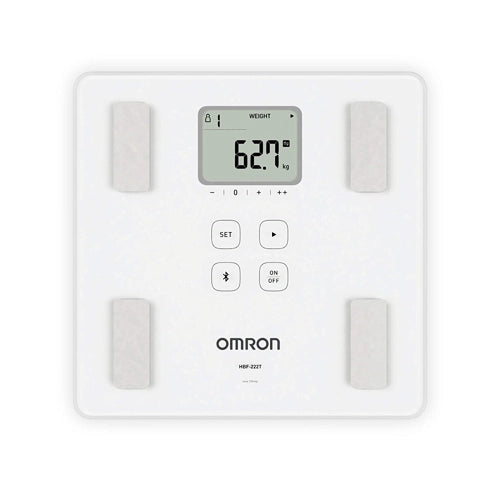
Compact body-composition option: Omron HBF-222T is approximately ₹4,250.
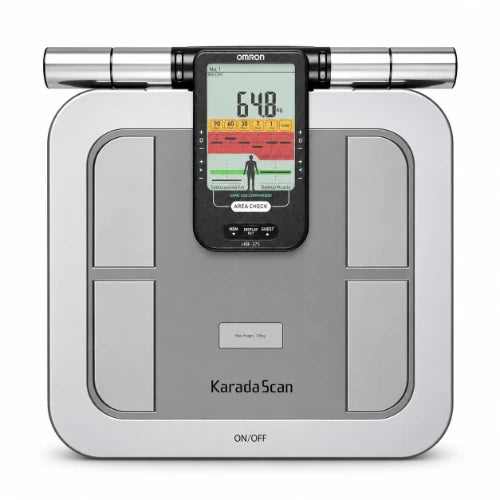
Full-body analyser option: Omron HBF-375 Karada Scan is approximately ₹8,849.
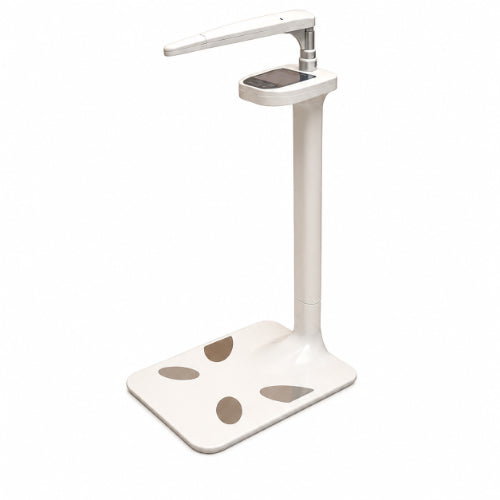
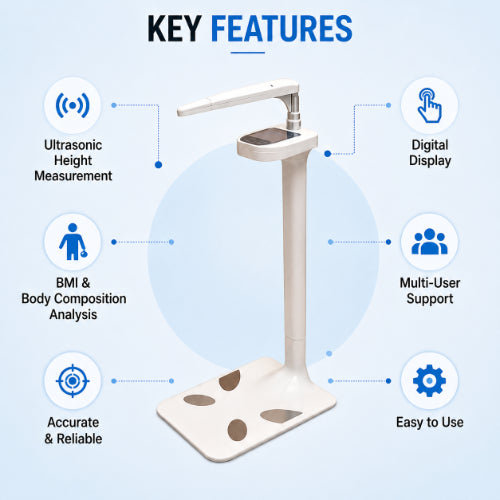
Professional ultrasonic system: Ultrasonic Digital BMI Body Fat Scale is approximately ₹24,000.
Basic home devices generally cost less than advanced professional systems.
However, live prices may change with stock and offers. Therefore, buyers should check the current product page before ordering.
What Affects BMI Machine Price?
Several features can influence the final cost.
- Maximum weight capacity
- Automatic height measurement
- BMI calculation
- Body-fat analysis
- Muscle estimates
- Visceral-fat estimates
- Segmental analysis
- Bluetooth connectivity
- Multiple-user profiles
- Display size
- Warranty
- After-sales support
Therefore, buyers should pay for features that match their actual needs.
For example, a home user may not require the same level of equipment as a busy clinic or wellness centre.
Omron HBF-222T Body Composition Monitor
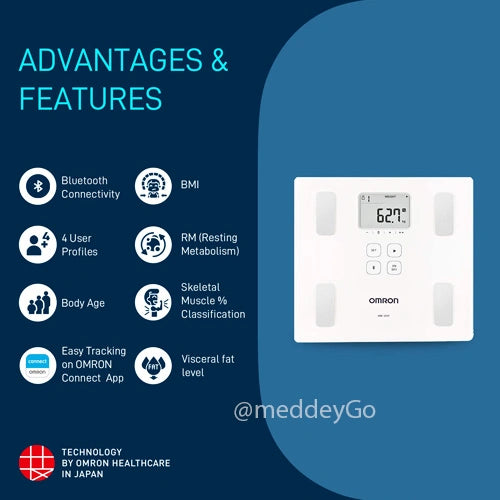
Meddey currently lists the Omron HBF-222T as a compact body-composition option.
Current product information includes measurements such as weight, BMI, body fat, skeletal muscle, visceral fat, resting metabolism and body-age estimate.
In addition, Bluetooth support can make digital trend tracking easier.
Therefore, this type of device may suit home users who want more information than body weight alone.
View BMI MachinesOmron HBF-375 Karada Scan
The Omron HBF-375 is another body-composition option available through Meddey.
Unlike simple foot-only scales, full-body systems may use sensors at both the hands and feet.
As a result, selected devices can provide more detailed body-composition estimates.
However, users should still treat BIA results as estimates rather than direct laboratory measurements.
Ultrasonic Digital BMI Body Fat Scale
Meddey also lists an Ultrasonic Digital BMI Body Fat Scale for professional measurement settings.
This category can combine automatic height measurement with body weight and BMI calculation.
Therefore, it may suit clinics, gyms or wellness centres that need faster measurement without manually entering height for every user.
Before purchase, professional buyers should check height range, weight capacity, available measurements and warranty.
Can Several People Use One BMI Machine?
Yes. Many modern devices support multiple user profiles.
For example, household body-composition scales may save data separately for several family members.
However, staff should select the correct user profile because stored details can influence some body-composition calculations.
Therefore, correct user identification becomes important when one device serves several people.
BMI Machine and Pacemaker Safety
A simple weight-and-BMI scale does not always use electrical impedance.
However, many body composition monitors use BIA and send a weak electrical signal through the body.
Therefore, people with pacemakers or other implanted electronic medical devices should check the exact manufacturer instructions before using body-composition functions.
Safety point: always distinguish a simple BMI scale from a BIA body-composition analyser when checking whether a device is suitable.
How to Choose a BMI Machine
1. Define the Main Use
First, decide whether the device is for home, clinic, gym or wellness-centre use.
2. Check BMI Function
Next, confirm that the device calculates or clearly displays BMI.
3. Review Weight Capacity
Then, make sure the supported range suits the intended users.
4. Check Height Measurement
Afterwards, decide whether automatic height measurement is required.
5. Review Body Composition
In addition, consider whether body-fat or muscle estimates are useful for the setting.
6. Check Data Storage
Meanwhile, clinics may value memory and trend tracking.
7. Review Connectivity
Bluetooth can help when app-based records are useful.
8. Check Warranty
Finally, compare warranty, service and technical support.
BMI Machine Buying Checklist
- Confirm intended use
- Check BMI calculation
- Review weight capacity
- Check height measurement
- Review body-fat features
- Check muscle and visceral-fat estimates
- Review display readability
- Check multi-user support
- Consider Bluetooth connectivity
- Review cleaning requirements
- Check warranty
- Confirm after-sales support
- Compare current BMI Machine price
Overall, buyers should choose a BMI Machine that provides the measurements they need without unnecessary complexity.
Common Mistakes When Using a BMI Machine
A digital device can still lead to poor decisions when the result is interpreted incorrectly.
Common mistakes include:
- Treating BMI as a diagnosis
- Ignoring muscle mass
- Ignoring waist measurement
- Comparing BIA readings taken under very different conditions
- Using adult BMI ranges for children
- Ignoring age-related clinical context
- Assuming body-fat estimates are exact
- Focusing on one result instead of trends
Therefore, correct interpretation matters just as much as device quality.
Frequently Asked Questions About BMI Machine
What is a BMI machine used for?
A BMI Machine is mainly used to calculate or display Body Mass Index from height and weight. Some models also estimate body composition.
Do BMI machines work?
Yes. They can calculate BMI correctly when height and weight measurements are accurate. However, BMI remains a screening measure rather than a complete health assessment.
How much does a BMI machine cost?
Current Meddey examples range from approximately ₹4,250 for a compact body-composition monitor to around ₹24,000 for an ultrasonic professional system.
Is BMI used by doctors?
Yes. Doctors commonly use BMI as one part of weight and health-risk assessment. However, they also consider other clinical information.
What is BMI mainly used for?
BMI is mainly used to screen body weight relative to height and support broader assessment of weight-related health risk.
Does BMI measure body fat?
No. BMI compares weight with height. Body-fat percentage requires a different measurement or estimation method.
Is BMI accurate for muscular people?
BMI can be less informative in people with high muscle mass because the calculation does not distinguish muscle from fat.
Can a BMI Machine be used at home?
Yes. Many compact digital BMI and body-composition scales are designed for household use.
Is body-fat data from a BMI scale exact?
No. BIA-based body-fat values are estimates and can vary with hydration, meals and recent exercise.
Is BMI enough to judge overall health?
No. BMI should be considered together with other information such as waist size, blood pressure, medical history and laboratory findings.
Where to Buy a BMI Machine Online in India?
Hospitals, clinics, gyms, wellness centres and home users can purchase BMI and body-composition equipment through medical-device suppliers.
Before ordering, compare weight capacity, BMI calculation, height measurement, body-composition features, user profiles, connectivity, warranty and price.
Meddey currently offers compact home-use body composition monitors as well as larger professional BMI systems.
Browse BMI Machines View Body Analysers Visit MeddeyConclusion
A BMI Machine provides a convenient way to calculate and track Body Mass Index from height and weight.
For clinics and healthcare professionals, BMI can support basic weight-status screening. However, the result should never be treated as a complete diagnosis.
Meanwhile, modern body-composition devices can estimate body fat, skeletal muscle and visceral fat. These values may provide useful trend information, although they remain estimates.
In addition, waist-to-height ratio and other clinical measures can provide important context when BMI alone is less informative.
Price varies widely depending on the device's features. Therefore, buyers should choose between a simple BMI scale and a more advanced body analyser according to actual needs.
Ultimately, the best BMI Machine is one that provides reliable basic measurements, practical controls and suitable features for the intended setting.
For current options, buyers can explore BMI machines available on Meddey.
Medical & Professional Disclaimer
This article provides general healthcare education and buying guidance only. BMI is a screening measure and does not provide a complete assessment of body fat, nutrition or overall health. Healthcare professionals should interpret BMI alongside medical history, physical findings and other relevant clinical measures. Users of BIA body-composition devices should also follow the manufacturer's safety instructions, especially when implanted electronic medical devices are present.
Explore Medical Collections
All Categories
Abdominal & Maternity Support

Accessories

Accu-Chek Instant Strips: Use, Compatibility, Price & Blood Sugar Testing Guide
Accu-Chek Instant Strips: Uses, Features & Complete Guide

Accupressure Products for Pressure Point Therapy, Pain Relief & Wellness

accupuncture

Acupuncture Needles & Supplies

Advanced Physiotherapy Machines & Lumbar Physiotherapy

Airways

Ambulance

Anatomy Models
Anesthesia Machine

Anesthesia Products
Ankle Support, Braces & Walker Boots for Recovery
Ankle Weights & Exercise Weights for Home & Rehab
You may also need
FOR YOURecommended for you
Save 31%
Save 29%