


Featured ChoiceSave 39%
About this collection
Hand Tools: Types, Uses, Surgical Instruments and Buying Guide for Healthcare Professionals
This guide explains what hand tools are and how many types there are. It lists basic examples and uses, shows how they link to surgical instruments and medical instruments, and covers price, care and the latest guidance.
Key Takeaways
- First, hand tools are tools that are powered by hand and not by a motor, such as hammers, pliers, scissors and screwdrivers.
- Most hand tools fall into four groups, so it is easy to sort them: driving tools, cutting and gripping tools, striking tools and struck tools.
- In healthcare, the same ideas therefore appear as surgical instruments and medical instruments, such as forceps, scissors, towel clips and reflex hammers.
- According to the FDA, reusable medical devices must be reprocessed with the maker's validated cleaning and sterilization steps before the next use.
- Finally, Meddey lists hand-held surgical instruments from ₹183 to ₹1,977, as of 1 October 2026.
Contents
- What are hand tools?
- How many types of hand tools are there?
- What are the basic hand tools?
- Five uses of hand tools
- An example of a hand tool
- Hand tools in healthcare: surgical instruments
- Medical instruments for examination
- Surgical instruments vs medical instruments
- Hand tools in occupational therapy
- Ergonomics and hand health
- Hand tools set: what to include
- What are the best hand tools?
- Cleaning, sterilization and care
- Safe use of hand tools
- Hand tools price
- Meddey hand tools and instruments
- Buying checklist
- Frequently asked questions
First, every clinic, ward and operating theatre depends on simple, manually operated tools. Therefore, hand tools are a basic part of daily care, from a pair of scissors to a pair of forceps. However, many students and buyers are unsure how general hand tools relate to surgical instruments and medical instruments.
This guide is for doctors, healthcare professionals, medical students and buyers of clinic and hospital supplies. Moreover, it uses simple words and answers the questions people search for most. To see Meddey's range, you can also visit the medical instruments collection at Meddey.
Latest guidance note: The US Food and Drug Administration states that reusable medical devices need validated reprocessing, and the maker's instructions for use must be followed. This includes cleaning, then disinfection or sterilization, depending on the risk of the item. Meanwhile, the Spaulding classification still guides most hospitals, because instruments that enter sterile tissue must be sterilized. Therefore, buying a hand-held instrument is only the first step, and reprocessing is part of its use.
What Are Hand Tools?
Hand tools are tools that people power by hand, because they do not use electricity, fuel or air pressure. The US Occupational Safety and Health Administration (OSHA) describes them as tools that are powered manually. For example, common ones are wrenches, hammers, pliers, screwdrivers, knives and saws.
In healthcare, the same idea also applies. For instance, a pair of forceps, a pair of scissors and a reflex hammer all work only through the hand of the user. As a result, they are simple, durable and easy to carry, and they give the user direct control.
No power source First, they work by hand force alone.
Direct control Next, the user feels the force and the result.
Portable Also, they are easy to carry and store.
Reusable In addition, many can be cleaned and used again.
Low running cost Moreover, they need no fuel or battery.
Wide range Finally, they cover cutting, holding, striking and measuring.

How Many Types of Hand Tools Are There?
There is no single official count, because different sources group tools in different ways. However, a common method puts non-powered hand tools into four main classes. Because an Ohio State University safety guide uses this method, you can read it on the Ohioline fact sheet.
| Class | What it does | General examples | Healthcare examples |
|---|---|---|---|
| Driving tools | Turn or drive a part | Screwdrivers, wrenches | Bone screwdrivers and instrument keys |
| Cutting, pinching and gripping tools | Cut, hold or squeeze | Scissors, pliers, snips | Surgical scissors, forceps, clamps |
| Striking tools | Deliver a blow | Hammers, mallets | Reflex hammers, percussion hammers |
| Struck tools | Receive a blow | Chisels, punches | Osteotomes and bone chisels |
Other ways to group hand tools include by trade, such as woodworking, plumbing and electrical tools. Meanwhile, in healthcare, instruments are usually grouped by function, such as cutting, grasping, clamping and retracting. As a result, the number of types depends on how you count.
What Are the Basic Hand Tools?
Since a basic toolkit covers the main actions of cutting, holding, driving and striking, the list below shows the basic hand tools and a matching healthcare use.
| Basic hand tool | General use | Matching healthcare tool |
|---|---|---|
| Hammer | Strike and drive | Reflex hammer for nerve checks |
| Screwdriver | Drive screws | Orthopaedic screwdriver |
| Pliers | Grip and bend | Forceps and clamps |
| Scissors or snips | Cut | Surgical and suture scissors |
| Knife or saw | Cut or saw | Scalpel and plaster cutter |
| Measuring tape or rule | Measure | Measuring tape and stature meter |
| Wrench | Tighten and loosen | Instrument and equipment spanners |
| Tweezers | Pick up small items | Dressing and tissue forceps |
What Are 5 Uses of Hand Tools?
Hand tools serve many purposes. Therefore, for quick learning, five common uses are listed below with healthcare examples.
- Cutting. First, scissors and blades cut materials. For example, in healthcare, suture scissors cut stitches, and plaster cutters open casts.
- Holding and gripping. Next, pliers and clamps hold objects. Similarly, in surgery, forceps and towel clips hold tissue and drapes.
- Striking. Then, hammers deliver a blow. Likewise, in examination, a reflex hammer tests tendon reflexes.
- Driving and fastening. Also, screwdrivers and wrenches fasten parts. In orthopaedics, however, similar tools place and remove screws.
- Measuring and testing. Finally, rules and tapes measure. In clinics, for example, a stature meter measures height, and a hand tool test board checks hand skills.
What Is an Example of a Hand Tool?
A simple example is a pair of pliers, which grips and holds objects. In healthcare, a good example is a pair of artery forceps. Because they clamp a blood vessel to control bleeding, the user works them with the fingers and a ratchet lock.
- Everyday example: First, a hammer drives a nail with the force of the arm.
- Surgical example: Next, suture cutting scissors cut thread with the force of the fingers.
- Examination example: Also, a reflex hammer taps a tendon to check a reflex.
- Therapy example: Finally, a hand tool test board checks a person's skill in using ordinary tools.
Hand Tools in Healthcare: Surgical Instruments
Surgical instruments are hand tools made for use on tissue. Because most are made of stainless steel and grouped by what they do, learning the groups helps students recognise any instrument.
| Function group | Purpose | Examples |
|---|---|---|
| Cutting and dissecting | Cut or separate tissue and suture | Scalpels, scissors, suture scissors |
| Grasping and holding | Hold tissue, drapes or items | Tissue forceps, towel clips, needle holders |
| Clamping and occluding | Compress vessels to control bleeding | Artery forceps, haemostats |
| Retracting and exposing | Hold tissue aside for a clear view | Retractors, specula |
| Probing and dilating | Explore or widen openings | Probes, dilators |
| Suturing | Close tissue | Needle holders, suture needles |
However, a few simple rules apply to all of them. First, choose an instrument whose length and tip suit the task. Next, never force an instrument, and do not use a cutting instrument for blunt work. In addition, count instruments before and after a procedure to prevent retained items.

Medical Instruments for Examination
Medical instruments are the tools clinicians use to examine and assess people. Because many are hand-held and manual, they help doctors collect findings at the bedside. For example, the group includes the following items.
- Reflex hammer: First, it elicits tendon and plantar reflexes in neurological examination.
- Tongue depressor: Next, it holds the tongue down to view the throat.
- Speculum: Then, it opens a passage for viewing, such as in a vaginal examination.
- Torch: Also, it lights the throat, ears and pupils.
- Measuring tools: In addition, a stature meter and a tape help measure height and body size.
- Stethoscope and otoscope: Finally, they help listen to and view body structures.
Surgical instruments and medical instruments overlap, and both groups are needed in most clinics. As a result, many buyers plan them together.
Surgical Instruments vs Medical Instruments
People often use the two terms in the same way, but they differ in use. Surgical instruments act on tissue during a procedure, while medical instruments help examine and assess a person. Therefore, a clinic may buy both groups for different needs.
| Feature | Surgical instruments | Medical instruments |
|---|---|---|
| Main purpose | Cut, hold, clamp or close tissue | Examine, measure or assess |
| Typical examples | Forceps, scissors, towel clips, needle holders | Reflex hammer, stethoscope, torch, tongue depressor |
| Tissue contact | Often enter sterile tissue, so sterilization is needed | Often contact skin or mucous membrane, so cleaning or disinfection may be enough |
| Material | Mostly stainless steel | Metal, plastic or a mix |
| Setting | Operating theatre, minor procedure room | Outpatient clinic, ward, examination room |
Hand Tools in Occupational Therapy and Assessment
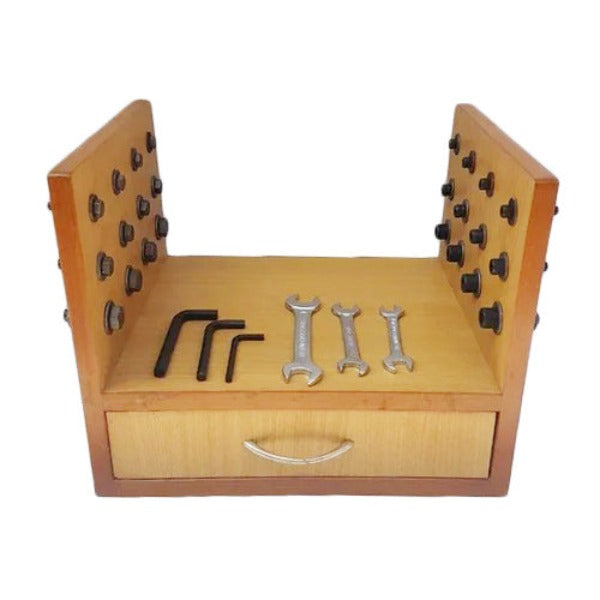
Hand tools also appear in rehabilitation. For example, occupational therapists use tool-based tasks to check hand strength, coordination and work readiness. For example, a hand tool test board asks a person to remove bolts from one upright and fit them on another. As a result, the therapist can watch grip, hand-eye coordination and the use of ordinary mechanics tools.
- Work hardening: Tool tasks help people prepare to return to manual jobs after an injury.
- Dexterity checks: Also, timed tasks show progress over weeks of therapy.
- Safe practice: Finally, the therapist guides posture, grip and rest breaks.
Ergonomics and Hand Health for Users
Since clinicians use hand tools many times a day, poor grip and long, repeated use can strain the hands, wrists and shoulders. In addition, ring-handled instruments need good finger control, and a poor fit can cause fatigue.
- Choose the right size: First, ring sizes and instrument length should suit the user's hand.
- Use a relaxed grip: Next, avoid squeezing harder than needed.
- Keep wrists neutral: Also, bend the wrist as little as possible during long tasks.
- Take short breaks: Rest the hand during long procedures when the team allows it.
- Keep tools sharp and smooth: Finally, because dull or stiff tools need more force, they raise the risk of slips.
Hand Tools Set: What to Include
A hand tools set groups the items needed for a task in one tray or kit. Therefore, the right set depends on the procedure and the setting. For example, a basic set for a minor procedure tray in a clinic may include the following.
| Item | Use |
|---|---|
| Artery forceps (haemostats) | Clamp small vessels |
| Tissue forceps | Hold tissue gently |
| Needle holder | Hold the needle during suturing |
| Surgical scissors | Cut tissue or dressings |
| Suture cutting scissors | Cut or remove thread |
| Towel clips | Secure drapes |
| Cheatle or transfer forceps | Handle sterile items |
| Kidney tray and bowls | Hold instruments and fluids |
Meddey also lists a Vasectomy NSV Instruments Set. Because procedure sets vary, please check the contents of each set with your surgeon before you buy.
What Are the Best Hand Tools?
There are no universal best hand tools. Instead, the best tool is the one that suits the task, gives good control and lasts through repeated use. Therefore, for a quick answer, use the checklist below.
| Feature | What to look for |
|---|---|
| Material | Corrosion-resistant stainless steel for instruments that are cleaned and sterilized often |
| Finish | A satin finish reduces glare under bright lights |
| Joint and action | A smooth box-lock joint, aligned jaws and a working ratchet |
| Tip and jaw design | Serrations, curves and tips that match the task |
| Size | Length that suits the depth and the hand of the user |
| Handle and grip | Ring or flat handles that give control and reduce fatigue |
| Reusable and sterilizable | Check that the maker states it can be sterilized |
| Maker details | Clear maker information, support and return policy |
In practice, test a sample before a bulk order. Check that jaws meet evenly, because uneven jaws slip, and make sure that locks hold. In addition, ask whether the supplier can replace faulty items.
Cleaning, Sterilization and Care
Reusable hand-held instruments need careful reprocessing after each use. For example, the FDA explains the process on its reprocessing of reusable medical devices page. In addition, a short guide from Hartmann summarises the cycle for surgical instruments on its equipment page.
The reprocessing cycle
- Point-of-use care. First, remove gross soil and keep instruments moist so that blood does not dry on them.
- Cleaning. Next, wash with a suitable detergent, brush the serrations and joints, and rinse well.
- Inspection. Then, check for damage, rust, loose joints and worn edges.
- Disinfection or sterilization. Also, choose the level by risk, because items that enter sterile tissue must be sterilized.
- Packing and storage. Finally, pack with an indicator, and store dry in a clean place.
Clean before you sterilize. Cleaning removes blood and tissue that can shield germs. Therefore, never skip it, even when the instrument looks clean.
Small clinics often use an electric instrument sterilizer for boiling. Meanwhile, Meddey lists several models, as shown in the next section. However, always follow your hospital's infection control policy and the maker's instructions for the exact method.
Safe Use of Hand Tools
OSHA notes that hand tools cause most injuries through misuse and poor upkeep. Therefore, safe habits protect both the user and the patient.
- Use the right tool: First, never use a tool for a task it was not made for.
- Inspect before use: Next, check for cracks, loose joints, blunt edges and worn jaws.
- Pass safely: Also, pass sharp tools handle-first, and name the sharp item as you pass it.
- Cut away from the body: In addition, keep the free hand out of the cutting path.
- Use sharps containers: Moreover, put blades and needles in a puncture-proof container at once.
- Replace damaged tools: Finally, take worn or damaged tools out of use.
Hand Tools Price: What Affects It?
The hand tools price depends on the material, the finish, the size, the type and the maker. For example, a simple stainless-steel scissor costs less than a long, specialised forceps with a ratchet and fine serrations.
- Material grade: First, better stainless steel resists rust and costs more.
- Design and precision: Next, fine tips, box locks and accurate jaws add to the cost.
- Size: Also, longer instruments often cost more, as the Cheatle forceps show.
- Set or single: In addition, a set may cost less per item than buying each item alone.
- Brand and support: Finally, established makers may charge more for quality checks and service.
As of 1 October 2026, Meddey's hand-held surgical instruments are listed from ₹183 for a percussion hammer to ₹1,977 for a plaster cutter spreader. Therefore, please see the next section for details.
Meddey Hand Tools and Instruments
Meddey lists hand tools and instruments in its hand tools collection and its medical instruments collection. The table shows prices as listed on 1 October 2026. However, prices and stock can change, so please check the live product page before you order.
| Product | Key detail | Meddey price |
|---|---|---|
| Taylor Percussion Knee (Reflex) Hammer | Chrome-plated handle, triangular rubber head for reflex testing | ₹183 |
| Plaster Cutter, Manual | 6 inch, half-circle serrated blade, loop handle | ₹276 |
| Suture Cutting Scissor, 6 inch | For cutting and removing sutures | ₹380 |
| Cheatle Forceps, Stainless Steel | Transfers sterile items, available in 8, 10 and 12 inch | ₹551 to ₹899 |
| Surgical Towel Clip, Pack of 2 | 9 cm, secures drapes and towels | ₹600 |
| Suture Cutting Scissor, Stainless Steel, 6 inch | Fine tips, ring handles | ₹649 |
| Right Angle Artery Forceps, 6 inch | Right-angled serrated jaws with ratchet lock | ₹749 |
| Vasectomy NSV Instruments Set | Procedure instrument set | ₹999 |
| Plaster Cutter Spreader, Orthopedic | Manual, stainless steel, curved tip, 15 cm | ₹1,977 |
| Hand Tool Test Board | Test frame with tools and bolted uprights for hand skill assessment | ₹3,049 |

Instrument care equipment
Meddey also lists Electric Sterilizer 14 inch at ₹1,999 and a 16 inch model at ₹2,199 for surgical and examination instruments. In addition, the Hand Tool Test Board is a skill test, and it checks how a person uses ordinary mechanics tools. Therefore, it is an assessment tool and not a surgical instrument.
Price note: Prices and offers change often. For bulk orders for a clinic or hospital, please contact Meddey for a quote.
Buying Checklist for Hand Tools and Instruments
Task First, list the procedures and the instruments each one needs.
Material Next, choose corrosion-resistant stainless steel for reusable items.
Action Also, test the joint, the ratchet and the jaw alignment.
Size In addition, match the length to the depth of use.
Reprocessing Since reuse needs sterilization, check the maker's advice.
Supplier Finally, confirm maker details, support and return policy.
Frequently Asked Questions About Hand Tools
What are hand tools?
Hand tools are tools that people power by hand and not by a motor. Examples include hammers, pliers, scissors and screwdrivers. In healthcare, forceps and scissors are hand tools.
What are the basic hand tools?
The basic hand tools are the hammer, screwdriver, pliers, scissors or snips, knife or saw, measuring tape, wrench and tweezers.
How many types of hand tools are there?
There is no single count. A common method uses four classes: driving tools, cutting and gripping tools, striking tools and struck tools. Healthcare instruments are grouped by function.
What are the best hand tools?
The best tools suit the task, give good control and last through repeated use. For instruments, look for stainless steel, accurate jaws, a smooth joint and a maker who states that the item can be sterilized.
What are 5 uses of hand tools?
Five common uses are cutting, holding and gripping, striking, driving and fastening, and measuring and testing.
What is an example of a hand tool?
A pair of pliers is a common example. In healthcare, artery forceps and suture scissors are good examples.
What are the hand tools price and set options at Meddey?
As of 1 October 2026, Meddey lists hand-held instruments from ₹183 for a reflex hammer to ₹3,049 for the Hand Tool Test Board, and it lists a Vasectomy NSV Instruments Set at ₹999. Please check the live listing for the latest price.
Where to Buy Hand Tools and Instruments Online in India?
Clinics, hospitals and training centres can buy hand tools and instruments from medical equipment suppliers. Therefore, before you buy, compare the material, finish, size, sterilization advice and price. Because Meddey lists surgical instruments, examination tools and instrument sterilizers, its support team can help you choose.
View Hand ToolsMedical InstrumentsVisit MeddeyDisclaimer
This article is for general education. Therefore, it does not replace hospital policy, the maker's instructions for use or the advice of a qualified professional. Also, prices and product details may change over time.
Explore Medical Collections
All Categories
Abdominal & Maternity Support

Accessories

Accu-Chek Instant Strips: Use, Compatibility, Price & Blood Sugar Testing Guide
Accu-Chek Instant Strips: Uses, Features & Complete Guide

Accupressure Products for Pressure Point Therapy, Pain Relief & Wellness

accupuncture

Acupuncture Needles & Supplies

Advanced Physiotherapy Machines & Lumbar Physiotherapy

Airways

Ambulance

Anatomy Models
Anesthesia Machine

Anesthesia Products
Ankle Support, Braces & Walker Boots for Recovery
Ankle Weights & Exercise Weights for Home & Rehab
You may also need
FOR YOURecommended for you
Save 39%