


Featured ChoiceSave 46%

Save 50%

Save 47%
Save 41%
Save 50%
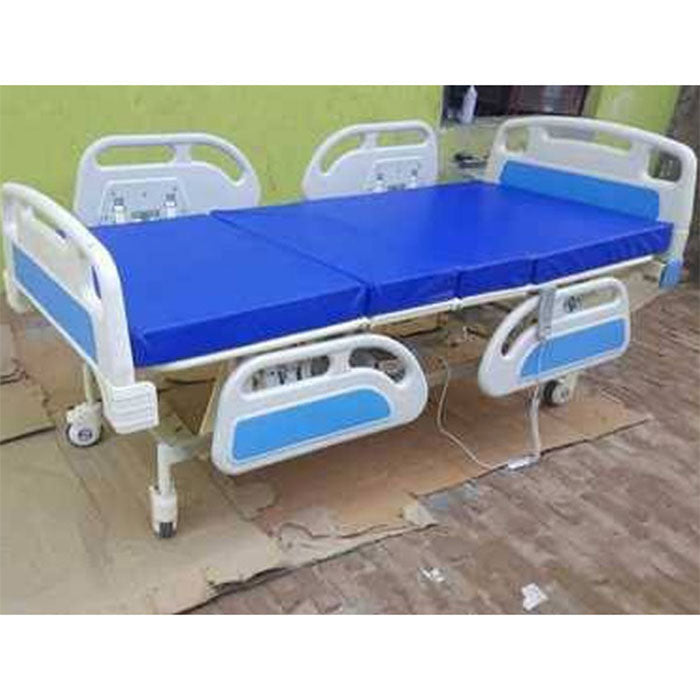

icu beds: types, functions, prices and buying guide
ICU Beds: Types, Functions, Price & Professional Critical Care Guide
Learn how ICU Beds support critical care, what a 5-function bed does, how mechanical and electric models differ, current ICU bed prices, critical-care levels and key buying considerations for hospitals.
ICU Beds are specialised hospital beds designed for patients who need close monitoring, frequent position changes or advanced nursing care. Unlike a basic ward bed, an ICU bed usually provides several adjustable positions that help healthcare teams manage comfort, procedures and routine bedside care.
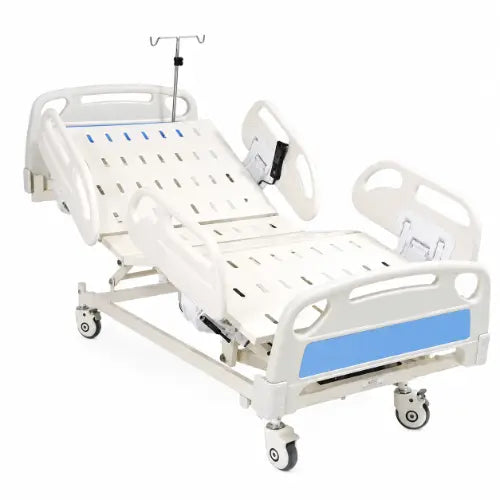
For example, many 5-function ICU beds provide backrest elevation, knee adjustment, height adjustment, Trendelenburg and reverse Trendelenburg positions. Meanwhile, electric models allow staff to make these changes using powered controls.
However, an ICU bed does not define how critically ill a patient is. Instead, ICU severity depends on the patient's condition, organ support requirements and treatment needs.
In addition, bed design can influence caregiver workflow. Height adjustment may improve access during nursing tasks, while wheels and brakes support controlled movement within the hospital.
Therefore, hospitals should not select ICU Beds only according to price. Frame strength, positioning functions, safe load, side railings, wheels, mattress compatibility and service support also matter.
This guide explains ICU-bed functions, mechanical and electric models, current pricing, critical-care levels, expected ICU stay and professional buying factors.
For current products, buyers can explore ICU Beds available on Meddey.
What Are ICU Beds?
ICU Beds are adjustable patient-care beds used mainly in intensive care, critical care and other high-dependency hospital areas.
The design allows healthcare professionals to change patient position without repeatedly lifting the person manually.
Depending on the model, common features include:
- Adjustable backrest
- Knee-rest adjustment
- Height adjustment
- Trendelenburg position
- Reverse Trendelenburg position
- Safety side railings
- Heavy-duty castor wheels
- Wheel brakes
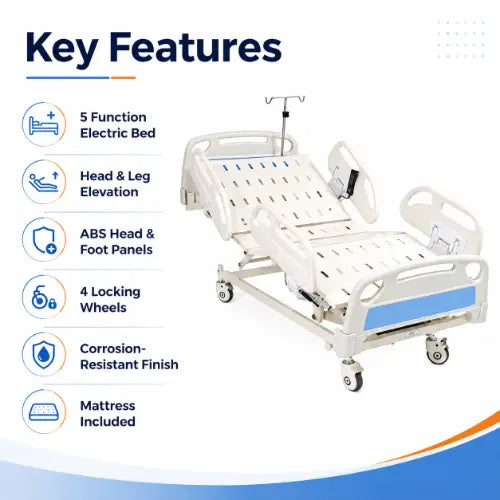
- ABS head and foot panels
- IV-pole provision
As a result, these beds provide considerably more flexibility than fixed or basic Fowler beds.
Why Are ICU Beds Important?
Critical-care patients may need frequent position changes during treatment and recovery.
For instance, staff may raise the backrest for selected respiratory or feeding situations. Meanwhile, changing bed height can improve caregiver access during nursing procedures.
Patient Positioning Allows several supported body positions during care.
Caregiver Access Height adjustment can make bedside tasks easier.
Patient Safety Railings and brakes help support safe bed use.
Mobility Hospital-grade castors support movement between care areas.
Therefore, an ICU bed is part of the wider critical-care environment rather than simply a place for the patient to sleep.
What Are the 5 Functions of an ICU Bed?
A 5-function ICU bed commonly provides five main position adjustments.
| Function | Purpose |
|---|---|
| Backrest Elevation | Raises the patient's upper body. |
| Knee-Rest Adjustment | Raises or bends the leg section for supported positioning. |
| Height Adjustment | Raises or lowers the entire bed platform. |
| Trendelenburg | Tilts the whole bed so the head end is lower than the foot end. |
| Reverse Trendelenburg | Tilts the whole bed so the head end is higher than the foot end. |
However, exact adjustment ranges vary by manufacturer. Therefore, hospitals should confirm the technical specification of the individual model.https://meddey.com/products/icu-hospital-bed-5-function-electric-with-wheels-abs-railings-and-mattress
What Is Trendelenburg Position?
Trendelenburg position tilts the entire bed with the head lower than the feet.
By contrast, reverse Trendelenburg raises the head end relative to the feet.
These positions can support selected clinical and nursing procedures. However, they should only be used when appropriate for the patient's condition and treatment plan.
Therefore, the availability of a position should not be confused with a recommendation to use it routinely.
Mechanical vs Electric ICU Beds
Mechanical and electric ICU Beds can provide similar positioning functions, but they operate differently.
| Feature | Mechanical ICU Bed | Electric ICU Bed |
|---|---|---|
| Adjustment | Manual crank mechanisms | Electric motors and controls |
| Power supply | Not normally required | Required for powered positioning |
| Caregiver effort | Higher | Lower for frequent adjustments |
| Position changes | Manual | Faster and powered |
| Maintenance | Generally simpler | Includes motors and electrical systems |
| Typical price | Lower | Higher |
Therefore, hospitals with frequent positioning needs may prefer electric operation. On the other hand, mechanical beds can provide multiple functions without relying on powered motors.
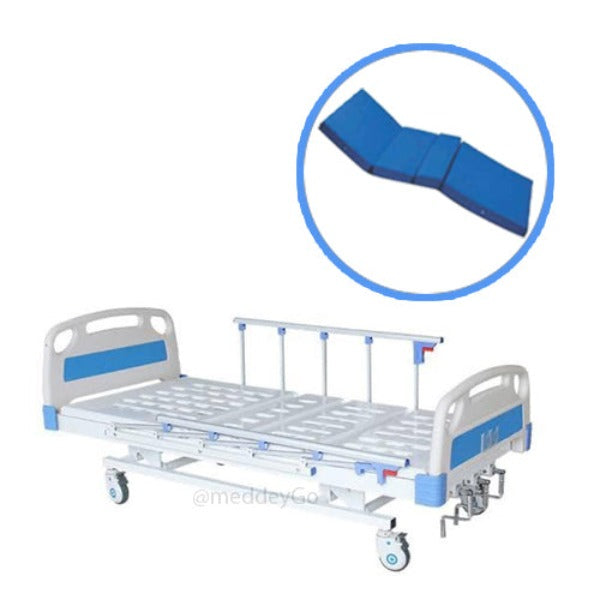
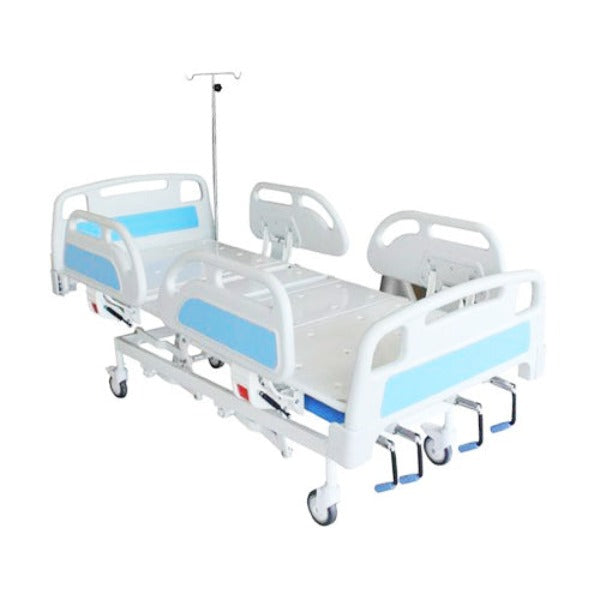
5-Function Mechanical ICU Bed
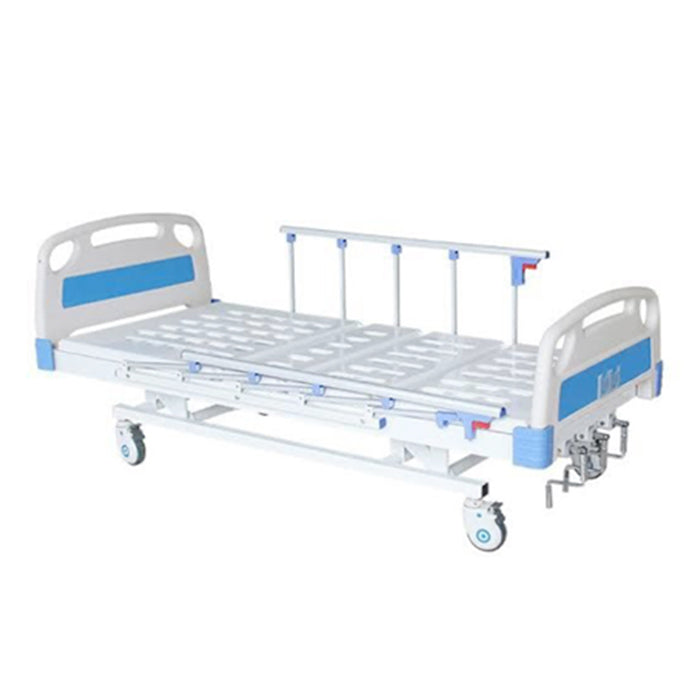
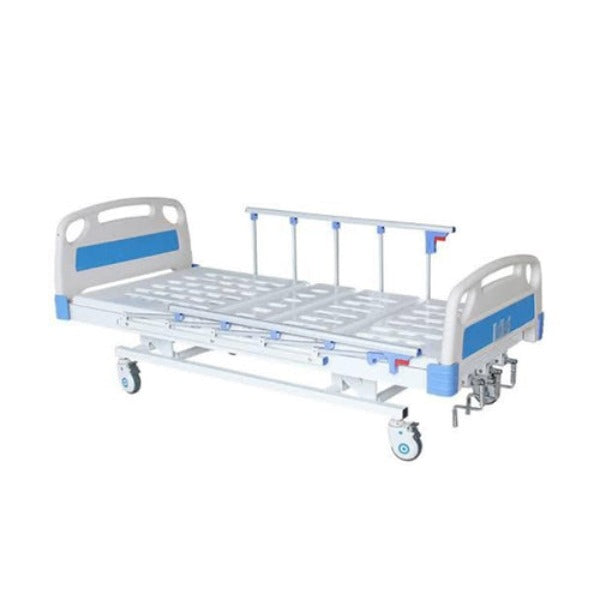
A mechanical 5-function bed uses crank mechanisms to adjust patient position.
For example, current Meddey models provide backrest, knee-rest, height, Trendelenburg and reverse Trendelenburg adjustments.
In addition, selected configurations include ABS panels, collapsible railings, wheels and a mattress.
As a result, mechanical models can provide advanced positioning at a lower initial cost than many electric versions.

5-Function Electric ICU Bed
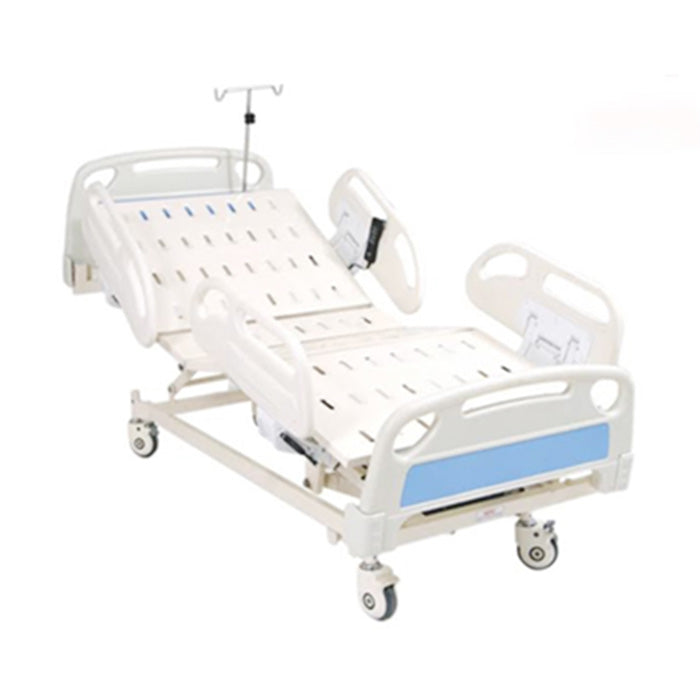
An electric 5-function ICU bed uses powered motors for position changes.
Instead of turning manual cranks, caregivers can operate selected functions through a handset or control panel.
Current Meddey electric models provide combinations of:
- Backrest elevation
- Knee-rest positioning
- Height adjustment
- Trendelenburg
- Reverse Trendelenburg
- ABS panels
- Safety railings
- Locking wheels
Consequently, electric ICU Beds can reduce repeated manual effort when frequent position changes are needed.

How Much Does an ICU Bed Cost?
The ICU bed price depends on whether the bed is mechanical or electric, which accessories are included and how the frame is configured.
Current Meddey ICU Bed Price Examples
Entry mechanical configuration: a 5-function mechanical ICU bed with wheels and collapsible railings is approximately ₹33,499.
Mechanical model with mattress: a similar 5-function configuration is approximately ₹37,999.
ABS mechanical configuration: a 5-function model with ABS panel, railing and mattress is approximately ₹46,499.
Electric 5-function option: selected models are approximately ₹68,200.
Another powered configuration: an electric ICU bed is listed around ₹73,200.
Higher electric configurations: selected ABS-panel electric models are approximately ₹84,499–₹84,999.
However, prices and offers can change. Therefore, buyers should check the current product listing before placing an order.
In addition, the final price may depend on mattress inclusion, rails, panels, installation and delivery requirements.
What Affects ICU Bed Price?
Several features can change the total cost of ICU Beds.
- Mechanical or electric adjustment
- Number of bed functions
- Frame construction
- Motor system
- ABS head and foot panels
- Side-railing design
- Castor size
- Brake system
- Mattress inclusion
- Safe weight capacity
- Battery backup on selected models
- Warranty
- Technical support
Therefore, hospitals should compare the complete supplied system rather than the headline price alone.
ICU Bed vs Fowler Bed
Fowler and ICU beds both provide adjustment, but ICU Beds generally offer more functions.
| Feature | Fowler Bed | ICU Bed |
|---|---|---|
| Backrest | Adjustable | Adjustable |
| Knee section | Available on Full-Fowler models | Usually available |
| Height | Often fixed | Commonly adjustable |
| Trendelenburg | Usually not available on basic models | Common on 5-function designs |
| Care complexity | General and recovery care | Critical and advanced patient care |
Consequently, a Fowler bed may be enough for many ward or home-care patients. ICU models become more useful when frequent and advanced positioning is required.
What Is a Level 4 ICU?
The term “Level 4 ICU” does not have one universal international meaning.
For example, the current UK Intensive Care Society adult critical-care framework describes Levels 1, 2 and 3. Older NHS coding used Levels 0 through 3.
Therefore, if a hospital describes a unit as “Level 4,” the term may come from a local, regional or country-specific classification system.
Healthcare professionals should check that hospital's own definition rather than assuming Level 4 always represents the same staffing, organ-support capability or patient severity.
Important: ICU level labels are not fully standardised worldwide. Always interpret the level using the healthcare system that issued the classification.
What Do Adult Critical Care Levels Usually Mean?
Although systems vary, widely used adult critical-care frameworks relate the level of care to monitoring and organ-support needs.
| Care Level | General Meaning |
|---|---|
| Enhanced / Level 1 Care | Patients need more observation or support than routine ward care. |
| Level 2 | Patients may need more detailed observation or support for a single failing organ system. |
| Level 3 | Patients may require advanced respiratory support or support for multiple organ systems. |
However, local definitions should always take priority. Therefore, clinicians should use their own national or hospital critical-care framework.
Which ICU Is More Critical?
The most critical patient is not identified simply by the name of the ICU.
Instead, severity depends on factors such as:
- Number of failing organ systems
- Need for mechanical ventilation
- Need for circulatory support
- Renal support
- Neurological status
- Haemodynamic stability
- Need for continuous monitoring
For example, a patient requiring advanced respiratory support plus support for other organ systems generally needs a higher level of critical care.
Therefore, “more critical” should refer to patient acuity and organ-support requirements rather than a simple ICU label.
How Long Do Patients Stay in an ICU Bed?
There is no standard ICU length of stay for every patient.
A person may spend less than a day in critical care after selected procedures, while someone with severe illness may remain for days or weeks.
Recent studies illustrate this wide variation. For example, published ICU cohorts often report median stays of several days, while patients with persistent or chronic critical illness may remain in intensive care for considerably longer.
Factors that influence ICU stay include:
- Reason for admission
- Number of organ systems affected
- Need for ventilation
- Infection or sepsis severity
- Response to treatment
- Major surgery
- Complications
- Availability of step-down care
Therefore, it is not clinically useful to promise a fixed number of ICU days.
What Happens When a Patient Improves?
As the patient's condition becomes more stable, the clinical team may reduce the level of support.
For example, someone may move from intensive care to a high-dependency or step-down area before returning to a general ward.
Meanwhile, rehabilitation may begin while the person is still in critical care, especially after prolonged illness.
Therefore, discharge from an ICU does not always mean immediate discharge from the hospital.
How ICU Beds Support Respiratory Care
Patients with serious respiratory illness may need supported positioning alongside oxygen therapy or mechanical ventilation.
For example, upper-body elevation can be useful during selected respiratory-care situations. Meanwhile, adjustable bed height gives staff easier access to ventilator tubing, monitors and other equipment.
However, position selection should follow the patient's clinical needs. Therefore, bed functions should support rather than replace professional respiratory care.
How ICU Beds Support Nursing Care
Nursing teams perform frequent assessments and procedures around critically ill patients.
An adjustable bed can support:
- Patient repositioning
- Hygiene care
- Feeding support
- Line and drain management
- Clinical examination
- Transfer preparation
- Pressure-care routines
In addition, height adjustment can reduce repeated bending during bedside tasks.
Therefore, bed ergonomics matter to both the patient and the care team.
Why Mattress Choice Matters for ICU Beds
Critically ill patients may spend long periods in bed, which can increase pressure-injury risk.
Therefore, the mattress should match both the bed platform and the patient's pressure-care needs.
Important considerations include:
- Correct dimensions
- Pressure redistribution
- Easy-clean cover
- Fluid resistance
- Patient weight
- Compatibility with bed movement
Meanwhile, selected high-risk patients may need specialised foam or powered pressure-relief systems.
As a result, hospitals should treat the mattress as part of the ICU-bed system rather than as a minor accessory.
ICU Bed Side Railings and Patient Safety
Side railings can help support patient safety, especially during transport or selected bedside situations.
However, railings should match the bed design and patient needs.
Modern ICU Beds often use collapsible or ABS safety rails. In addition, selected rail systems may contain integrated controls or indicators.
Therefore, hospitals should evaluate railing strength, locking action, gaps and ease of operation before purchase.
Why Wheels and Brakes Matter
ICU beds may need to move between care locations, imaging areas or procedure zones.
As a result, strong castors can improve controlled mobility.
However, movement also makes brake performance important. Therefore, staff should confirm that the bed remains stable when the brakes are engaged.
In addition, larger wheels may move more easily over hospital floors and small thresholds.
Electric ICU Bed Safety During Power Problems
Electric ICU Beds rely on powered actuators or motors for position changes.
Therefore, hospitals should review what happens during a power interruption.
Depending on the model, relevant features may include:
- Battery backup
- Manual emergency release
- Emergency CPR function
- Power-status indicators
- Electrical protection
However, these features vary considerably. Consequently, procurement teams should verify the exact manufacturer's specification.
How to Choose ICU Beds
1. Define the Care Setting
First, determine whether the bed is for ICU, HDU, recovery, ward or home critical care.
2. Choose Mechanical or Electric
Next, consider how frequently staff will adjust patient position.
3. Review the Functions
Then, confirm backrest, knee, height and tilt capabilities.
4. Check Safe Weight Capacity
Afterwards, ensure the bed suits the intended patient population.
5. Assess Railings
In addition, inspect railing construction and locking action.
6. Check Castors and Brakes
Meanwhile, confirm smooth movement and stable braking.
7. Review Mattress Compatibility
The mattress should fit correctly throughout bed articulation.
8. Confirm Service Support
Finally, compare warranty, motors, spare parts and technical service.
ICU Bed Buying Checklist for Hospitals
- Confirm intended clinical setting
- Choose mechanical or electric adjustment
- Review all five functions where required
- Check safe weight capacity
- Inspect frame construction
- Review ABS panels
- Check side-railing locks
- Review wheel size
- Check braking system
- Confirm IV-pole support
- Review mattress compatibility
- Check cleaning requirements
- Review electrical safety for powered models
- Check battery backup where required
- Confirm warranty
- Review installation
- Check technical support
- Compare current ICU bed price
Overall, hospitals should choose ICU Beds according to clinical workflow, patient safety and long-term service requirements.
Common Mistakes When Buying ICU Beds
An ICU bed is a major hospital-equipment purchase, so small specification differences can matter.
Common mistakes include:
- Choosing only by price
- Ignoring safe weight capacity
- Not checking motor quality
- Assuming mattress inclusion
- Ignoring rail-lock design
- Not checking brake performance
- Ignoring service availability
- Buying electric beds without reviewing power backup
- Not checking room or doorway dimensions
- Ignoring spare-part availability
Therefore, procurement teams should compare the entire lifecycle of the bed rather than only the initial purchase cost.
Current ICU Beds Available on Meddey
Meddey currently offers several mechanical and electric ICU-bed configurations for hospitals and advanced patient-care areas.
| Current Model Type | Example Current Price |
|---|---|
| 5-Function Mechanical with Wheels & Collapsible Railings | Approximately ₹33,499 |
| 5-Function Mechanical with Wheels, Railings & Mattress | Approximately ₹37,999 |
| Mechanical 5-Function with ABS Panel, Railing & Mattress | Approximately ₹46,499 |
| Electric 5-Function with ABS Panels & Safety Rails | Approximately ₹68,200 |
| Electric ICU Bed with 5 Functions | Approximately ₹73,200 |
| Electric 5-Function ABS Panel & Railing | Approximately ₹84,499–₹84,999 |
Prices and availability can change. Therefore, buyers should confirm the live listing before procurement.
Browse ICU Beds Hospital & ICU Beds View Electric ICU Bed View Mechanical ICU BedFrequently Asked Questions About ICU Beds
How much does an ICU bed cost?
Current Meddey examples range from about ₹33,499 for selected 5-function mechanical ICU Beds to roughly ₹84,999 for higher electric configurations. Prices can change.
What is a Level 4 ICU?
There is no universal Level 4 adult ICU definition. Some healthcare systems use different local classifications. Therefore, check the specific hospital or country's definition.
How long do patients stay in an ICU bed?
There is no fixed duration. Some patients remain for less than a day, while severe or prolonged critical illness can require many days or weeks of ICU care.
Which ICU is more critical?
Patient severity depends mainly on organ failure and support requirements rather than the unit's name. Patients requiring support for multiple organ systems usually need a higher intensity of critical care.
What are the five functions of an ICU bed?
A common 5-function design provides backrest adjustment, knee adjustment, height control, Trendelenburg and reverse Trendelenburg positioning.
Is an electric ICU bed better than a mechanical one?
Electric beds make frequent position changes easier. However, mechanical models can provide similar positioning functions at a lower initial cost.
Can an ICU bed be used at home?
Yes, selected ICU Beds may be used for advanced home care when adequate space, caregiver support and suitable clinical guidance are available.
Do ICU Beds include mattresses?
Some configurations include a mattress, while others do not. Therefore, buyers should confirm the exact product package before ordering.
Why do ICU Beds have wheels?
Wheels support controlled patient and bed movement. However, strong brakes are equally important when the bed remains stationary.
Why do ICU Beds adjust in height?
Height adjustment can improve caregiver access, transfers and selected nursing procedures.
Do all ICU Beds have Trendelenburg?
No. Many 5-function models provide this position, but buyers should verify the exact specification before purchase.
What mattress should be used on an ICU bed?
The mattress should fit the articulated platform and match the patient's pressure-care risk. High-risk patients may require specialised pressure-management surfaces.
Where to Buy ICU Beds Online in India?
Hospitals, nursing facilities and home critical-care buyers can purchase ICU Beds from specialist medical-equipment suppliers.
Before ordering, compare functions, dimensions, safe load, motors, railings, wheels, mattress, electrical features, warranty and after-sales support.
Meddey currently provides mechanical and electric ICU-bed configurations for different levels of patient-care support.
Browse ICU Beds Browse Hospital Beds Visit MeddeyConclusion
ICU Beds are advanced patient-care beds designed to support positioning, safety and caregiver workflow in critical-care settings.
Mechanical models provide multiple functions through crank mechanisms. Meanwhile, electric ICU Beds use powered controls to make frequent adjustments easier.
A common 5-function design provides backrest, knee, height, Trendelenburg and reverse Trendelenburg adjustments. Therefore, these beds offer more flexibility than standard Fowler or fixed patient beds.
However, the bed itself does not define how critical the patient is. Severity depends on illness, organ support and overall clinical condition.
In addition, there is no universal “Level 4 ICU” definition. Hospitals should use the classification adopted by their own healthcare system.
Current ICU bed prices also vary widely. Consequently, buyers should compare functionality, frame strength, safety rails, wheels, mattress support and service rather than selecting a model only by price.
Ultimately, the best ICU bed is the one that matches the care environment, patient needs and hospital workflow.
For current options, buyers can explore ICU Beds available on Meddey.
Medical & Professional Disclaimer
This article provides professional education and general medical-equipment buying guidance only. ICU admission, critical-care level, patient positioning and length of stay depend on individual clinical circumstances. Healthcare facilities should follow their local critical-care standards, patient-safety policies and the ICU-bed manufacturer's instructions for positioning, weight capacity, railings, electrical operation and maintenance.
Explore Medical Collections
All Categories
Abdominal & Maternity Support

Accessories

Accu-Chek Instant Strips: Use, Compatibility, Price & Blood Sugar Testing Guide
Accu-Chek Instant Strips: Uses, Features & Complete Guide

accupuncture

Acupuncture Needles & Supplies

Advanced Physiotherapy Machines & Lumbar Physiotherapy

Airways

Ambulance

Anatomy Models
Anesthesia Machine

Anesthesia Products

Ankle Support for Home Use: Braces, Sleeves & Walker Boots

Ankle Weights & Exercise Weights for Home & Rehab

Anti-Bedsore Air Mattresses
You may also need
FOR YOURecommended for you
Save 46%
Save 50%
Save 47%
Save 41%
Save 50%