


Featured ChoiceSave 29%
Sold out
About this collection
Tourniquet: Types, Uses, Safe Time Limits and Buying Guide for Healthcare Professionals
This guide explains what a tourniquet is used for and the two main types. It also answers whether it is painful and how many minutes to apply one, with the latest guidance for blood collection, surgery and emergencies.
Key Takeaways
- First, a tourniquet is a device that squeezes a limb to slow or stop blood flow, and it is used for blood collection, surgery and life-threatening bleeding.
- Two common types are the pneumatic tourniquet with an air cuff and the strap or band tourniquet, such as a buckle band, elastic band or windlass device.
- For blood collection, most guidance says to release the band within 1 minute, and surgical tourniquets usually stay inflated for no more than about 2 hours.
- According to the AORN Guideline for Pneumatic Tourniquet Safety, approved in April 2025, correct cuff selection, padding and monitoring lower the risk of nerve injury and burns.
- Finally, Meddey lists a Pneumatic Manual Tourniquet at ₹1,949, as of 1 October 2026.
Contents
- What is the tourniquet used for?
- What are two types of tourniquets?
- Tourniquet for blood collection
- Surgical tourniquet
- Emergency tourniquet for severe bleeding
- How many minutes to apply a tourniquet?
- Is a tourniquet painful?
- Tourniquet band: disposable or reusable
- Risks and complications
- Infection control
- Tourniquet price
- Meddey tourniquets and price
- Buying checklist
- Frequently asked questions
Few devices are as simple, and as easy to misuse, as a medical tourniquet. Therefore, doctors, nurses, phlebotomists and medical students need to know when to use it, how tight to make it and how long to leave it on. However, the answer changes with the setting, because a blood draw, an operation and a trauma scene each follow different rules.
This guide is for doctors, healthcare professionals, medical students and buyers of clinic and hospital supplies. In addition, it uses simple words and answers the questions people search for most. To see Meddey's range, you can visit the tourniquet collection at Meddey.
Latest guidance note: The Association of periOperative Registered Nurses (AORN) approved its Guideline for Pneumatic Tourniquet Safety in April 2025. It covers patient assessment, cuff selection, safe inflation pressure and monitoring during and after use, and it warns that poor selection, application or monitoring can cause nerve injury, compartment syndrome, chemical burns and pain. Meanwhile, the Stop the Bleed programme teaches the public to apply a tourniquet for life-threatening limb bleeding. Therefore, safe use depends on training as much as on the device.
What Is the Tourniquet Used For?
A tourniquet is a band, strap or inflatable cuff that is tightened around an arm or a leg. It compresses the vessels under it, and as a result it reduces or stops blood flow below the device. Therefore, a medical tourniquet has three main uses.
Blood collection First, a light squeeze makes veins stand out for venipuncture and IV access.
Surgery Next, a pneumatic cuff gives a bloodless field during limb operations.
Emergency bleeding control Also, a strong tourniquet stops life-threatening bleeding from a limb.
Regional anaesthesia In addition, a cuff can hold anaesthetic in a limb in some techniques.
Training Moreover, simulation tourniquets help teach bleeding control.
Procedures Finally, clinics use bands for minor procedures that need a clear field.
The three main uses need very different pressure. A blood collection band is only snug, and it should never block arterial flow. In contrast, an emergency device must stop arterial flow completely, and a surgical cuff is set to a measured pressure.

What Are Two Types of Tourniquets?
Many sources group them in two main types, so the answer is simple. The first is the pneumatic tourniquet, and the second is the strap or band tourniquet. Some textbooks also list the elastic bandage tourniquet as a third form.
| Feature | Pneumatic tourniquet | Strap or band tourniquet |
|---|---|---|
| How it works | An air cuff is inflated to a set pressure | A strap, buckle, elastic or windlass is tightened by hand |
| Pressure control | Measured on a gauge or digital display | Estimated by feel, so it varies |
| Main use | Surgery and procedures | Blood collection and emergency bleeding |
| Cost | Higher | Lower |
| Training needed | Trained staff and a check of the equipment | Basic training, with extra care in emergencies |
A pneumatic tourniquet is the safer choice in the operating theatre because it keeps a measured pressure. Reviews also state that complications are less likely with a pneumatic device than with an elastic or rubber bandage. Therefore, band types are better kept for blood collection and emergency care.
Tourniquet for Blood Collection
A tourniquet for blood collection makes the veins fuller, so the vein is easier to see and feel. It does not need to be tight. In fact, a very tight band can block arterial flow, and it can change the test results.
How to use it for venipuncture
- Place it above the site. First, apply the band about 7.5 to 10 cm above the planned puncture site.
- Keep it snug. Next, tighten it enough to slow venous return, but not enough to stop the pulse.
- Find the vein. Then, palpate and choose the vein.
- Release early. Also, release the band as soon as blood flows into the first tube.
- Do not leave it on long. Finally, if you cannot find a vein within 1 minute, release it and try again after 2 minutes.
A product guide from Greiner Bio-One gives the same steps. It says to release it as soon as blood flows and not to apply high pressure that may impair arterial flow. You can read it in the instructions for use.
Why time matters for test results
A long application time can cause haemoconcentration, which means the blood in the arm becomes more concentrated. As a result, some blood values can read falsely high, and the draw becomes more painful. In addition, the WHO guideline on drawing blood notes that a pressure device for blood donation should be released before the skin is cleaned and removed once blood flows or after 2 minutes, whichever is first. The WHO guideline is available on NCBI Bookshelf.
Surgical Tourniquet
A surgical tourniquet is a pneumatic cuff used in limb surgery to give a bloodless field. The surgeon sees the structures more clearly, and the operation is often shorter. However, the device needs correct setup, because it can injure nerves and muscle when pressure or time is too high.
Key safety points
- Choose the right cuff: The cuff should match the size and shape of the limb. Wide, well-fitting cuffs need lower pressure.
- Protect the skin: Use padding under the cuff, and place a barrier so that prep fluids do not pool under it.
- Set the pressure carefully: Use the lowest pressure that stops arterial flow. Many centres measure limb occlusion pressure (LOP) and add a safety margin.
- Watch the time: Track the inflation time on the controller, and tell the team at set intervals.
- Monitor the patient: Check for skin changes, circulation problems and pain during use, and assess the patient after deflation.
- Document it: Record the cuff site, pressure, time on and time off.
An older AORN question-and-answer article explains the pressure rules. For an expected time under 2.5 hours, it suggests keeping upper limb pressure under 250 mmHg and lower limb pressure under 300 mmHg, and for longer cases it suggests measuring LOP with a safety margin of 50 to 75 mmHg. Newer systems calculate a personalised pressure. Therefore, check your own hospital protocol. You can read the current AORN guideline summary for more.

Only trained staff should use surgical tourniquets. Check the equipment before each case, and never raise the pressure just to fix a leak without checking the cuff and the setting.
Emergency Tourniquet for Severe Bleeding
For life-threatening bleeding from an arm or a leg, an emergency tourniquet can save a life. The Stop the Bleed programme teaches people to press on the wound first, and to apply a tourniquet when pressure does not control the bleeding. You can learn more at Stop the Bleed.
- Call for help. First, call the emergency number.
- Apply pressure. Next, press hard on the wound with a clean cloth or a gloved hand.
- Place the tourniquet. Then, if bleeding is severe, place it 5 to 7.5 cm (2 to 3 inches) above the wound and not over a joint.
- Tighten until the bleeding stops. Also, tighten fully, and add a second device next to the first if bleeding continues.
- Record the time. In addition, write the time on the device, on the skin or on a card.
- Do not loosen it. Finally, leave it in place until trained medical staff take over.
Military and trauma guidance, called Tactical Combat Casualty Care, adds more for professionals. For example, trained teams try to convert it to another method within 2 hours if bleeding can be controlled and the patient is stable, and they avoid removing one that has been on for more than 6 hours unless close monitoring and laboratory support exist.
How Many Minutes to Apply a Tourniquet?
The right time depends on the use. Therefore, the table below shows the common limits by setting.
| Setting | Usual time limit | Notes |
|---|---|---|
| Blood collection | No more than 1 minute | Release as soon as blood flows; if the vein is not found, release for about 2 minutes and retry |
| Surgical limb tourniquet | Up to about 2 hours | Some surgeons use short pauses for longer cases, as set by hospital protocol |
| Emergency tourniquet | Leave in place until medical care | Aim to reach definitive care within 2 hours; do not loosen on scene |
| Hospital conversion | Aim within 2 hours if safe | Only trained teams should convert or remove one |
As a result, a blood collection band should be off in about a minute, while an emergency device should stay on until a professional removes it. In addition, a longer time raises the risk of nerve and muscle injury, so always record the time of application.
Is a Tourniquet Painful?
Yes, it can be painful, and the pain depends on the type and the pressure.
- Blood collection band: It feels like a firm squeeze. It is usually mild, but a long time or a very tight band can cause pain and bruising.
- Emergency tourniquet: It must be tight enough to stop arterial flow, so it is painful when it works. Pain does not mean it should be loosened.
- Surgical tourniquet: Patients under regional anaesthesia may feel a dull, aching tourniquet pain that grows with time, and anaesthesia teams plan for it.
Tell patients what to expect, and give simple reassurance. Meanwhile, severe pain with a loose band can mean a poor fit or an unsafe setup, so check the application. In addition, report numbness, colour change or severe pain that does not match the situation.
Tourniquet Band: Disposable or Reusable
A tourniquet band for blood collection can be disposable or reusable. Therefore, clinics should choose by volume, infection control and cost.
| Feature | Disposable band | Reusable band |
|---|---|---|
| Use | One patient, then discard | Many patients, with cleaning |
| Infection control | Better, because it is not shared | Needs a clear cleaning routine |
| Cost per use | Higher over time | Lower, if cleaned and kept in good order |
| Material | Often latex-free synthetic rubber | Elastic, buckle or quick-release designs |
| Best for | High-volume labs and isolation rooms | Low-volume clinics and home care visits |
Latex-free bands help people with latex allergy. In addition, quick-release designs make it easier to remove the band with one hand during a draw.
Risks and Complications
Tourniquets are safe when used correctly. However, wrong pressure, long time or poor padding can cause harm.
| Risk | What can happen | How to lower it |
|---|---|---|
| Nerve injury | Tingling, numbness or weakness, sometimes long-lasting | Use the lowest effective pressure, a suitable cuff and a time limit |
| Skin injury and bruising | Blisters, pinching or pressure marks | Pad the skin and avoid wrinkles under the cuff |
| Chemical burns | Skin damage from prep fluid under the cuff | Use a barrier and avoid pooling |
| Muscle injury and compartment syndrome | Swelling and severe pain after long use | Limit the time and monitor the limb |
| Wrong test results | Falsely high values from a long draw | Release within 1 minute |
| Insufficient pressure in emergencies | Bleeding continues, and venous congestion can worsen it | Tighten fully, or add a second tourniquet |
A Pennsylvania Patient Safety Advisory on pneumatic tourniquets notes that extended time or excessive pressure can cause bruising, limb swelling, muscle ischaemia, compartment syndrome and nerve damage. As a result, many hospitals audit tourniquet use.
Infection Control for Tourniquets
Reusable bands touch many patients' skin. Therefore, they can carry germs from one person to another when they are not cleaned.
- Use single-use bands where possible: First, a disposable band avoids sharing.
- Clean reusable bands: Next, wipe them with an approved disinfectant between patients, or follow your hospital rule.
- Do not touch after gloving: Also, touching the band after hand hygiene can re-contaminate the hands.
- Avoid shared items on trolleys: In addition, keep bands off dirty surfaces.
- Replace worn bands: Finally, discard cracked or sticky bands.
A scoping review of venipuncture practice noted that its use is not standard across nursing practice, and that more study is needed on cleaning methods.
Tourniquet Price: What Affects It?
The tourniquet price depends on the type, the features and the use. For example, a medical tourniquet in the form of a simple band costs much less than a pneumatic set. In addition, a digital machine costs more than both.
- Type: First, band types cost less than pneumatic sets and digital machines.
- Pressure control: Next, a gauge or digital display adds to the price.
- Cuffs: Also, a set with several cuff sizes costs more than a single cuff.
- Power and timers: In addition, battery backup and timers raise the price of machines.
- Disposable or reusable: Finally, a reusable item costs more at first but less per use.
As of 1 October 2026, Meddey lists a Pneumatic Manual Tourniquet with carrying bag at ₹1,949. Please see the next section for details.
Meddey Tourniquets and Price
Meddey lists tourniquets in its tourniquet collection. The table shows prices as listed on 1 October 2026. However, prices and stock can change, so please check the live product page before you order.
| Product | Key detail | Meddey price |
|---|---|---|
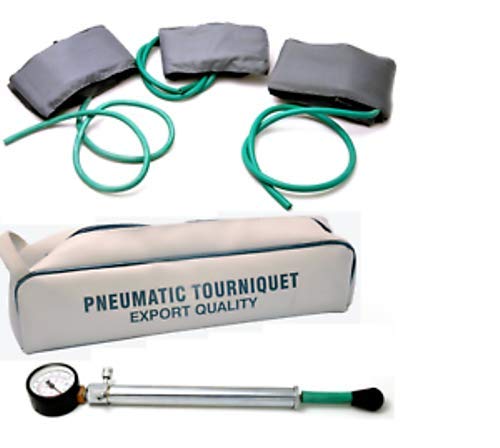
| Pneumatic Manual Tourniquet with Carrying Bag | Stainless steel pump, small, medium and large cuffs with bladders, manometer, release valve, washable cuffs | ₹1,949 |
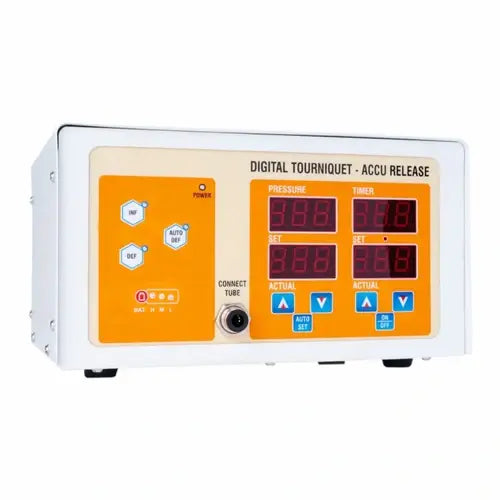
| Digital Tourniquet Machine for Surgical Use (Accu Release M) | Digital display, single port, battery backup up to 4 hours, about 3 kg, 220 to 240V AC. Currently shown as out of stock. | ₹32,200 |

Related product for vein access
Meddey also lists an Infrared Vein Showing Device at ₹1,12,515. It is a portable infrared device for detecting peripheral veins in hospitals, and it can help with difficult access.
Tourniquet bands for blood collection
The collection page describes disposable and reusable bands for phlebotomy. However, no tourniquet band for blood collection has a live product listing on the page on 1 October 2026. Therefore, please contact Meddey to ask about tourniquet bands, current stock and bulk pricing for clinics and labs.
Price note: Prices and offers change often. Please confirm the live price and stock before you order.
Buying Checklist for a Tourniquet
Use First, decide whether it is for blood collection, surgery or emergency care.
Type Next, choose a pneumatic set, a band or a digital machine.
Cuff sizes Also, check that cuffs fit the limbs you treat.
Gauge and display In addition, check that the manometer or display is clear and accurate.
Material and cleaning Since cleaning matters, look for washable or single-use parts and a latex-free option.
Supplier Finally, confirm warranty, service and return policy.
Frequently Asked Questions About Tourniquets
What is the tourniquet used for?
It is used to make veins prominent for blood collection and IV access, to give a bloodless field in limb surgery and to control life-threatening bleeding in emergencies.
What are two types of tourniquets?
The two common types are the pneumatic tourniquet, which uses an air cuff set to a measured pressure, and the strap or band type, which is tightened by hand.
Is a tourniquet painful?
It can be. A blood collection band feels like a firm squeeze, an emergency device is painful when it works, and a surgical tourniquet can cause aching pain over time. Do not loosen an emergency device because of pain.
How many minutes to apply a tourniquet?
The limit is no more than 1 minute for blood collection and usually up to about 2 hours for surgery. In emergencies, leave it on until trained medical staff take over, and record the time.
Where should a tourniquet be placed for blood collection?
About 7.5 to 10 cm above the planned puncture site, snug enough to slow venous return but not to stop the pulse.
What is the tourniquet price at Meddey?
As of 1 October 2026, Meddey lists a Pneumatic Manual Tourniquet with carrying bag at ₹1,949 and a Digital Tourniquet Machine at ₹32,200, which is currently out of stock. Please check the live listing.
Should a tourniquet band be disposable?
Disposable bands lower the risk of cross-infection and suit high-volume settings. Reusable bands need a clear cleaning routine between patients.
Where to Buy a Tourniquet Online in India?
Clinics, hospitals and training centres can buy tourniquets from medical equipment suppliers. Before you buy, compare the type, cuff sizes, pressure display, cleaning needs and price. Because Meddey lists a medical tourniquet in pneumatic and digital forms, its support team can help you choose.
View TourniquetsContact MeddeyVisit MeddeyDisclaimer
This article is for general education. Therefore, it does not replace hospital protocol, the maker's instructions or formal training in their use. Only trained staff should use surgical and emergency devices. Also, prices and product details may change over time.
Explore Medical Collections
All Categories
Abdominal & Maternity Support

Accessories

Accu-Chek Instant Strips: Use, Compatibility, Price & Blood Sugar Testing Guide
Accu-Chek Instant Strips: Uses, Features & Complete Guide

Accupressure Products for Pressure Point Therapy, Pain Relief & Wellness

accupuncture

Acupuncture Needles & Supplies

Advanced Physiotherapy Machines & Lumbar Physiotherapy

Airways

Ambulance

Anatomy Models
Anesthesia Machine

Anesthesia Products
Ankle Support, Braces & Walker Boots for Recovery
Ankle Weights & Exercise Weights for Home & Rehab
You may also need
FOR YOURecommended for you
Save 29%