


Featured ChoiceSave 41%

Save 15%
Save 26%


Save 15%

Save 32%

Save 48%
About this collection
Suction Machines: Types, Uses, Safety and Buying Guide for Healthcare Professionals
This guide explains what suction machines are used for and how they work. It also covers the main types, home use, safe steps, risks and how to choose the right machine.
Key Takeaways
- First, suction machines remove phlegm, mucus, blood and other fluids from the airway or a surgical site.
- In practice, a portable suction machine suits emergency care, clinics and supervised home care, while high-vacuum units suit procedure rooms.
- According to the AARC guideline, airway suction pressure should not go above 150 mmHg, and each pass should last no more than 15 seconds.
- For home use, a doctor or nurse should train the caregiver first, because wrong use can harm the patient.
- Finally, choose a machine by its use, vacuum level, flow, jar size, safety features and service support, and not by price alone.
Contents
- What is a suction machine?
- What is a suction machine used for?
- How does a suction machine work?
- What are the different types of suction machines?
- Portable suction machines
- Suction machine for home use
- What is the best suction machine?
- Suction machines available at Meddey
- How do I use a suction machine?
- Risks of using a suction device
- Buying checklist
- Cleaning and care
- Frequently asked questions
A patient who cannot clear the airway can get into trouble within minutes. Therefore, suction machines are among the most important tools in every hospital, clinic and emergency kit. However, many students and caregivers know little about how these devices work or how to use them safely.
This guide is for doctors, nurses, medical students and buyers of clinic and hospital equipment. In addition, it gives simple answers on suction machine use at home and in the hospital. Some people also search for this device as a "sanction machine", which is a common spelling mistake for suction machine. For products, you can view the suction machines available at Meddey.
Latest standard note: The current international standard for electric suction equipment is ISO 10079-1:2022 (fourth edition, March 2022). It covers safety and performance for equipment used in hospitals, in home care and in field or transport use. Therefore, ask every supplier if the machine follows it.
What Is a Suction Machine?
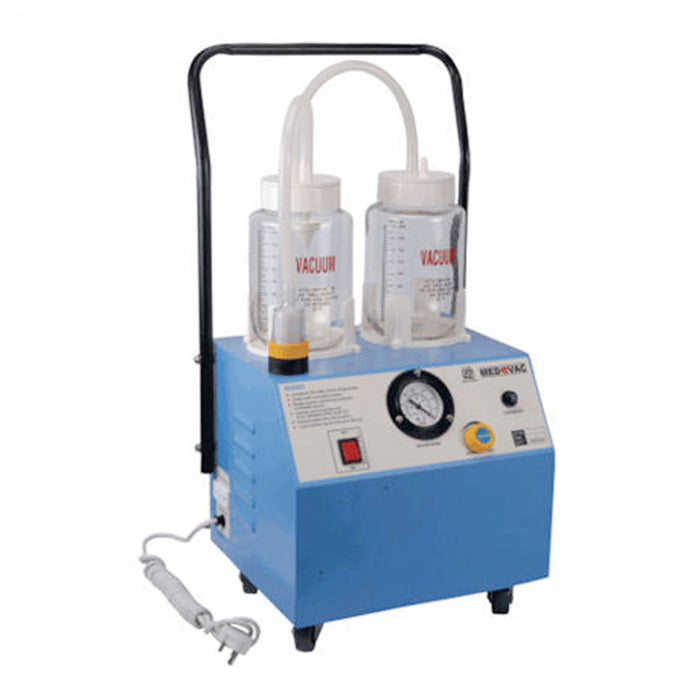
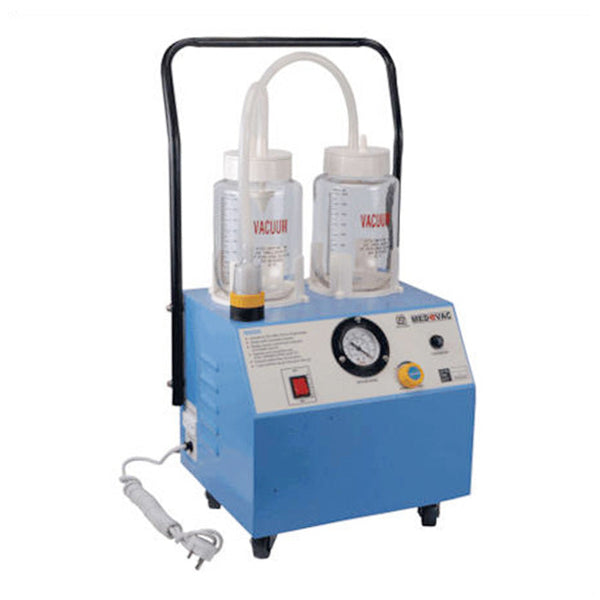
A suction machine, also called a suction apparatus, aspirator or phlegm suction unit, is a medical device that creates negative pressure. This pressure pulls fluids and secretions through a tube into a collection jar. As a result, the airway or the working area stays clear.
Most electric machines have a pump, a vacuum regulator, a gauge, a collection jar, tubing and a suction catheter or tip. Meanwhile, simple hand-operated units use a squeeze handle instead of a motor. In both cases, the aim is the same: to remove what should not be there, quickly and safely.
For students, one line is enough to remember. A suction machine uses controlled negative pressure to remove secretions, blood or other fluids from a patient.
What Is a Suction Machine Used For?
Suction machines help in many places, from the emergency room to the home. Below are the main uses.
Airway clearance Staff remove saliva, phlegm and mucus so the patient can breathe freely.
Emergency care In accidents, choking, drowning or vomiting, quick suction keeps the airway open.
Surgery and procedures Teams clear blood and fluids from the surgical field so the surgeon can see clearly.
ENT and tracheostomy care Also, staff remove secretions from the mouth, nose, throat and tracheostomy tube.
Gynaecology and MTP In addition, high-vacuum machines are used in selected procedures by qualified professionals.
Home and long-term care Finally, some patients cannot clear secretions on their own, so trained caregivers use a suction machine at home.
In short, suction machine use is about one thing: keeping the airway or the working area clear, so that oxygen, vision and safety are not lost.
How Does a Suction Machine Work?
An electric suction machine works in a simple loop. First, the pump removes air from the collection jar. Next, this creates negative pressure, so air and fluid move from the patient towards the jar through the tubing. Then, the fluid stays in the jar, while a filter or overflow guard protects the pump.
Main parts
- Pump or motor: It creates the vacuum. Oil-free pumps need less upkeep than oil-lubricated ones.
- Vacuum regulator and gauge: They let the user set and read the suction pressure in mmHg or kPa.
- Collection jar: It holds the fluid, and a clear jar lets staff see the amount and colour.
- Overflow guard and bacterial filter: They stop fluid and germs from reaching the pump.
- Tubing and catheter or tip: They carry the suction to the patient.
Key terms
Two numbers matter most. Vacuum (negative pressure) tells how strong the pull is, while flow (litres per minute) tells how fast the machine moves air. Therefore, a good machine needs both a suitable vacuum and enough flow for its job.
What Are the Different Types of Suction Machines?
There is no single official list, because makers group suction machines in different ways. However, most professionals sort them by power source and by use. Together, this gives a clear picture of the main types.
By power source
1. Electric (mains-powered) It plugs into AC power and gives steady suction. Therefore, it is common in clinics, wards and homes.
2. Battery or rechargeable It works without a wall socket. As a result, it suits ambulances, transport and power cuts.
3. Manual or hand-operated It uses a hand squeeze or pump. Because it needs no power, it works well as a backup.
4. Wall or central vacuum It draws suction from a hospital pipeline. Also, it is common in wards, ICUs and operation theatres.
By use and vacuum level
5. Airway or phlegm suction unit It gives low to medium vacuum for mouth, throat and tracheostomy care.
6. High-vacuum surgical suction It gives strong vacuum and often uses large jars. Thus, it suits operation rooms and procedure rooms.
7. Portable emergency suction It is light and compact. Therefore, teams can carry it to the patient.
8. Dental and neonatal units These are special designs with low, gentle suction for small or specific areas.
Note that these groups overlap. For example, one machine can be electric, portable and made for airway use. Therefore, when you buy, pick one option from each group.
Portable Suction Machines: What Makes Them Useful?
A portable suction machine, sometimes searched as a suction portable machine, is small and light enough to move between rooms. Because of this, it suits clinics with several treatment areas, ambulances and home care. It also works well as a backup when the wall suction is busy or fails.
However, portable does not mean weak or unsafe. A good portable unit still needs an adjustable regulator, a gauge, a jar with overflow protection and a filter. Moreover, it should be easy to clean, since staff will use it on many patients.
Tip: Look at the flow rate and the jar size together. For example, a compact unit with a 1-litre jar and a flow of about 18 litres per minute is enough for many bedside tasks, while a larger unit with a higher flow suits busier settings.
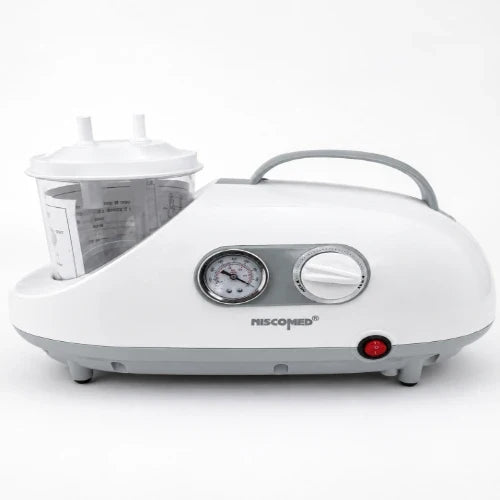
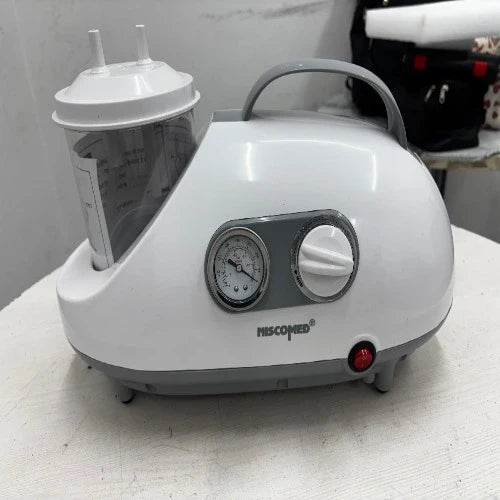
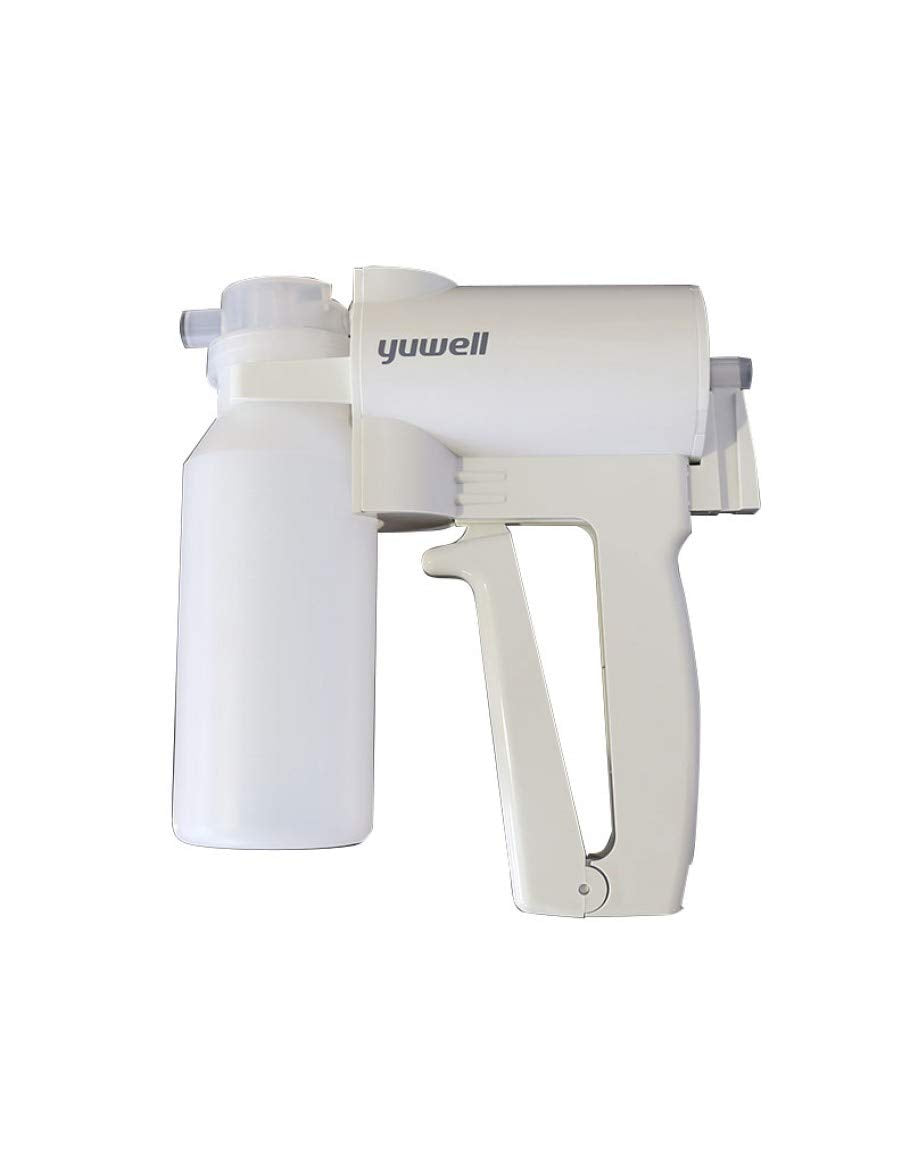
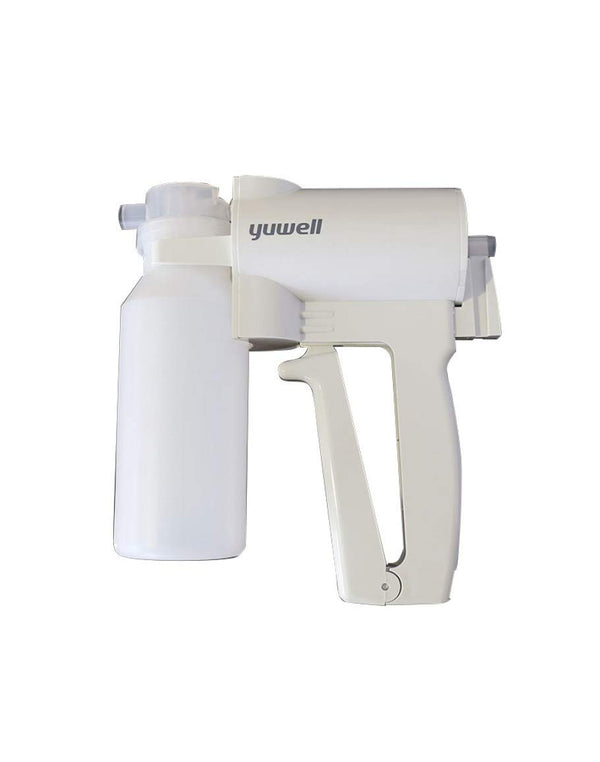
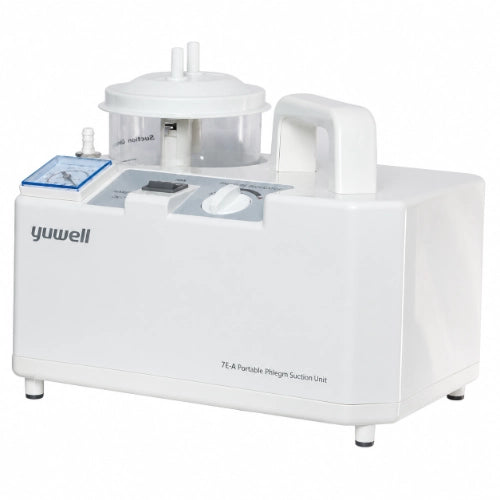
Meddey lists several portable options, including the Niscomed SU-107 portable phlegm suction machine and the Yuwell portable suction machine.
Suction Machine for Home Use: What Should You Know?
A suction machine for home use helps patients who cannot clear their own secretions. This may happen in some long-term neurological, respiratory or tracheostomy cases. However, a doctor should decide if home suction is needed, and a nurse or doctor should train the caregiver first.
What to look for in a home machine
- First, choose a compact and quiet unit, since it will sit near the patient for long hours.
- Second, check that the vacuum is adjustable and the gauge is easy to read.
- Third, pick a jar that is easy to see, empty and clean.
- Also, look for overflow protection and a filter.
- In addition, keep a hand-operated unit as a backup for power cuts.
- Finally, confirm that the maker offers a warranty and service.
What is the best suction machine for home use?
There is no single best model for every home, because each patient has different needs. Therefore, the best choice is the one your doctor approves and the caregiver can use with confidence. Among Meddey's range, the Niscomed SU-107 and the Yuwell portable suction machine are listed for supervised home and bedside care, while the Yuwell hand-operated suction unit is made for places where electricity is not easily available.
Safety point: Do not start home suction without medical advice. Also, call for emergency help if the patient turns blue, struggles to breathe or bleeds during suction.
What Is the Best Suction Machine?
No single suction machine is best for every place. Instead, the best machine is the one that matches the setting, the patients and the budget. For example, an emergency room needs fast, strong and portable suction, while an operation room may need high vacuum and large jars.
| Setting | Suitable type | Key features to check |
|---|---|---|
| Emergency room and ambulance | Portable or battery suction | Light weight, fast set-up, adjustable vacuum |
| Ward and ICU | Wall suction or electric unit | Regulator, gauge, overflow guard |
| Operation and procedure room | High-vacuum electric unit | Strong vacuum, large jars, bacterial filter |
| ENT and small clinic | Portable phlegm suction unit | Compact body, easy cleaning, low noise |
| Home care | Small electric or hand-operated unit | Quiet, simple controls, easy jar care |
Therefore, when someone asks "what is the best suction machine", the right answer is another question: where will you use it, and for which patient?
Suction Machines Available at Meddey
Meddey lists six suction products in its suction machines collection. The table below shows the products and their prices as listed on Meddey on 29 September 2026. However, prices and stock can change, so please check the live product page before you order.
| Product | Type | Key detail | Meddey price |
|---|---|---|---|
| Yuwell Hand Operated Suction Unit | Manual | 200 ml jar, single-hand use, travel pouch | ₹2,556 |
| Niscomed SU-107 Portable Phlegm Suction Machine | Portable electric | 18 L/min, max 0.075 MPa, 1000 ml jar, oil-free pump | ₹3,679 |
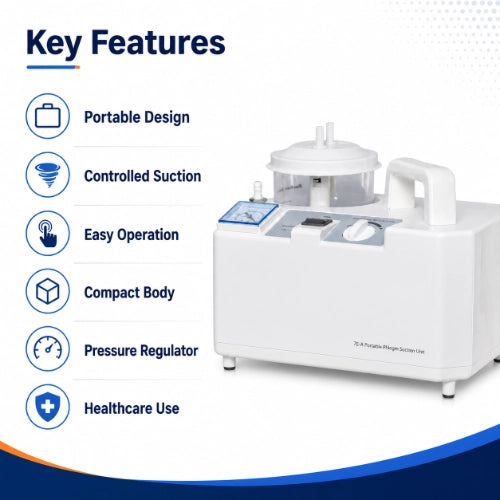
| Yuwell Portable Suction Machine | Portable electric | Compact, for clinic and home-care use | ₹6,836 |
| Portable Phlegm Suction Unit for ENT | Portable electric | For ENT clinics and treatment rooms | ₹9,749 |
| Half HP Medical Suction Machine, dual glass jars | High-vacuum electric | Up to -700 mmHg, 30–35 L/min, two 1.5 L jars, bacterial filter | ₹12,999 |
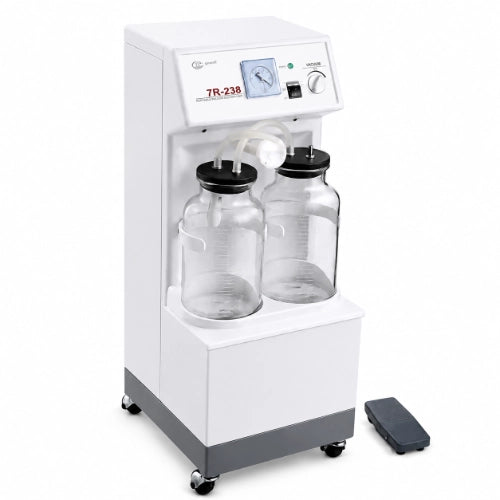
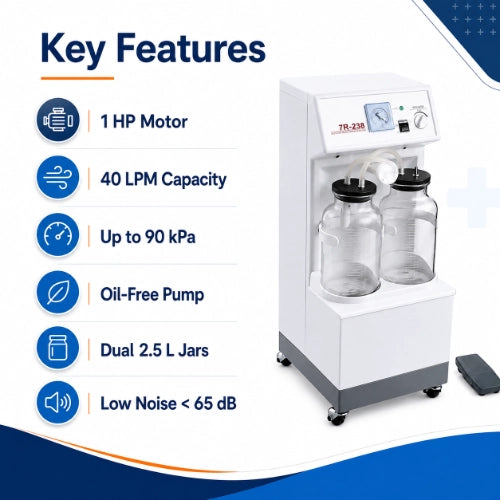
| Yuwell Suction Machine 1HP 40 LPM | Portable electric, high flow | 1HP motor, up to 40 L/min | ₹21,979 |
For a small clinic or a supervised home, a compact portable unit is often enough. On the other hand, a procedure room or a busy facility may prefer a high-vacuum or high-flow machine. Always read the product page for the full specification before you choose.
How Do I Use a Suction Machine?
The steps below give a general idea for trained users. However, always follow the maker's manual and your hospital protocol, because they can differ by device and by patient.
1. Prepare
First, wash your hands and wear gloves. Then, place the machine on a stable surface and check the jar, tubing, filter and catheter. In addition, make sure the machine is clean and the power is ready.
2. Set the pressure
Next, turn on the machine, block the tube end and set the vacuum with the regulator. Use the lowest pressure that clears the secretions. Portable units may need a lower setting, so follow the manual.
| Patient group | Usual airway suction pressure (mmHg) |
|---|---|
| Neonates | 60 to 80 |
| Infants | 80 to 100 |
| Children | 100 to 120 |
| Adults | 100 to 150 |
These ranges follow the AARC clinical practice guideline, and the pressure should not go above 150 mmHg. Meanwhile, some hospital protocols use slightly lower figures for adults, so follow your local policy.
3. Prepare the patient
Then, explain the steps to the patient if possible. Also, give extra oxygen before suction if it is ordered, since suction can lower oxygen levels. A pulse oximeter helps you watch the oxygen level and the pulse.
4. Suction
After that, insert the catheter gently without suction. Then, apply suction only while withdrawing the catheter, with a gentle turning motion. Limit each pass to 15 seconds or less, and allow the patient to rest between passes.
5. Check and finish
Afterwards, watch the breathing, colour and pulse. Next, rinse the tubing with clean water, discard the catheter and empty the jar when it is about three-quarters full. Finally, wash your hands and record the amount, colour and type of secretions.
Note: A high-vacuum surgical machine can produce much more than 150 mmHg. Therefore, for airway suction, always set the regulator to the safe range before you connect the catheter.
What Are the Risks of Using a Suction Device?
Suction saves lives, but it is not risk-free. Because of this, trained users should suction only when there is a clear need and not by a fixed timetable.
Patient risks
- Low oxygen (hypoxia), especially when a pass lasts too long.
- Slow or irregular heartbeat, because suction can trigger a strong nerve response.
- Injury or bleeding of the nose, throat or airway lining, mostly from high pressure.
- Collapse of small lung areas (atelectasis) and, in some cases, bronchospasm or laryngospasm.
- Coughing, gagging, vomiting, pain and discomfort.
- Infection, if the catheter or equipment is not clean.
- A rise in pressure inside the skull, which matters in some head injury patients.
Equipment risks
- Overflow of fluid into the pump when the jar is too full.
- Blocked or kinked tubing, which stops suction.
- Wrong pressure setting, especially on high-vacuum machines.
- Power failure without a backup unit.
- Cross-infection from dirty jars, tubes or filters.
How to lower the risks
To begin with, get proper training and follow the protocol. In addition, use the lowest effective pressure, keep each pass short and watch the patient throughout. Also, keep a backup suction unit ready and clean all reusable parts after use.
Safety point: Stop suction and get help if the patient shows a fall in oxygen level, a change in heart rate, heavy bleeding or severe distress.
Buying Checklist for Suction Machines
Define the use First, decide if you need airway, surgical, emergency or home-care suction.
Check vacuum and flow Next, ask for the maximum vacuum and the flow rate, and make sure the vacuum is adjustable.
Look at the jar Also, check the size, material and overflow protection. Glass and clear plastic jars both work if they are easy to clean.
Ask about safety parts In addition, look for a bacterial filter, a clear gauge and non-collapsible tubing.
Check noise and size Since noise can disturb patients, a quiet and compact unit is better for bedside and home use.
Confirm standards and service Finally, ask for ISO 10079-1 compliance, warranty, spare parts and service support.
As a simple rule, keep one main suction machine and one backup unit, either battery or hand-operated. Then, store both where staff can reach them fast.
Cleaning and Care
- After each use: Discard the catheter, rinse the tubing and empty and wash the jar.
- Disinfection: Use the disinfectant that the maker advises, and let the parts dry fully.
- Filter: Check the bacterial filter often, and replace it if it is wet, dirty or blocked.
- Pump and cable: Inspect them for damage, and do not use a machine with a worn cable.
- Storage: Keep the machine clean, dry and ready, with spare tubing and jars nearby.
- Testing: Test the vacuum before each shift or at set times, so a fault does not appear during an emergency.
Frequently Asked Questions About Suction Machines
What is a suction machine used for?
A suction machine removes phlegm, mucus, blood and other fluids from the airway or a surgical site. As a result, it helps keep the airway open and the working area clear.
What are the different types of suction machines?
By power source, there are electric, battery, manual and wall suction machines. In addition, by use, there are airway units, high-vacuum surgical units, portable emergency units and special dental or neonatal units.
What is the best suction machine for home use?
There is no single best model. However, a quiet, compact unit with an adjustable vacuum, an easy-to-clean jar and a backup hand-operated unit is a good starting point. Your doctor should approve the choice.
How do I use a suction machine?
First, prepare the machine and set a safe pressure. Then, suction only while withdrawing the catheter, keep each pass to 15 seconds or less, and watch the patient. Finally, clean the equipment and wash your hands.
What is the best suction machine?
The best machine depends on the setting, the patients and the budget. For example, an emergency room may prefer a portable unit, while an operation room may need a high-vacuum machine.
What are the risks of using a suction device?
The main risks are low oxygen, heart rate changes, tissue injury, bleeding, infection and coughing or gagging. Therefore, only trained people should use suction, with the lowest effective pressure.
What is a sanction machine?
"Sanction machine" is a common spelling mistake. People usually mean a suction machine, the medical device that removes secretions and fluids.
Can I use a suction portable machine at home?
Yes, in some cases. However, a doctor should advise it first, and a nurse or doctor should train the caregiver before home use.
Where to Buy Suction Machines Online in India?
Clinics, hospitals and families can buy suction machines from medical equipment stores. Before you buy, compare the exact model, vacuum, flow, jar size, warranty and service. Meddey lists portable, high-vacuum and hand-operated options, and its support team can help you choose.
View Suction MachinesRespiratory CareVisit MeddeyDisclaimer
This article is for general education. Therefore, it does not replace maker instructions, hospital protocols or clinical judgement. A trained healthcare professional should decide when to use suction and which settings are safe. Also, prices and product details may change over time.
Explore Medical Collections
All Categories
Abdominal & Maternity Support

Accessories

Accu-Chek Instant Strips: Use, Compatibility, Price & Blood Sugar Testing Guide
Accu-Chek Instant Strips: Uses, Features & Complete Guide

Accupressure Products for Pressure Point Therapy, Pain Relief & Wellness

accupuncture

Acupuncture Needles & Supplies

Advanced Physiotherapy Machines & Lumbar Physiotherapy

Airways

Ambulance

Anatomy Models
Anesthesia Machine

Anesthesia Products
Ankle Support, Braces & Walker Boots for Recovery
Ankle Weights & Exercise Weights for Home & Rehab
You may also need
FOR YOURecommended for you
Save 41%
Save 15%
Save 26%
Save 15%
Save 32%
Save 48%