
1

Ultrasonic LCD with 27 Program 1MHz and 3MHz


Double-tap to zoom · drag to pan · swipe to browse
Ultrasonic LCD with 27 Program 1MHz and 3MHz
In Stock
Check delivery
See if we deliver to you and when.
Delivering to
Delivery applicable
Free Shipping
on orders ₹999+
100% Genuine
Products
Dedicated
Support
Secure
Payments
Need help choosing or using this product?
Our team can help with product questions and orders.
Chat with support
Choose options

Two Frequencies, Two Depths of Treatment The defining feature of this ultrasonic unit is that it operates at two selectable frequencies — 1MHz and 3MHz — rather than a single fixed one, and the...
Check delivery
See if we deliver to you and when.
Delivering to
Delivery applicable
Two Frequencies, Two Depths of Treatment The defining feature of this ultrasonic unit is that it operates at two selectable frequencies — 1MHz and 3MHz — rather than a single fixed one, and the...
Check delivery
See if we deliver to you and when.
Delivering to
Delivery applicable
About this product
Two Frequencies, Two Depths of Treatment
The defining feature of this ultrasonic unit is that it operates at two selectable frequencies — 1MHz and 3MHz — rather than a single fixed one, and the reason that distinction matters comes down to depth. Lower-frequency ultrasound, such as 1MHz, penetrates further into the body before its energy is absorbed, making it the frequency generally associated with deeper structures such as larger joints and thicker muscle groups. Higher-frequency ultrasound, such as 3MHz, is absorbed more quickly and therefore concentrates its energy closer to the surface, making it better suited to more superficial tissue. Having both frequencies built into a single machine means a clinic isn't limited to treating only deep or only shallow tissue — the operator can switch frequency based on what the specific case in front of them actually requires, without needing two separate machines.
Why 27 Programs Instead of Manual Setup Every Time
Rather than requiring a therapist to configure intensity, pulse pattern, and duration from scratch for every session, this unit stores 27 pre-fixed treatment programs. In a busy clinical setting, this has a real practical benefit: once a program has been matched to a type of case, subsequent similar sessions can be set up in seconds rather than being rebuilt manually each time, reducing the chance of an inconsistent setting being applied by mistake. The adjustable treatment timer, running from 0 to 99 minutes, sits alongside these programs so that duration can still be fine-tuned per session even when a stored program is being used as the starting point.
What Ultrasound Therapy Is Commonly Used For
Therapeutic ultrasound is a long-established tool in physiotherapy and occupational therapy practice, generally used for chronic pain and to support tissue healing in muscles, tendons, and ligaments. Conditions where it is commonly considered include carpal tunnel syndrome, shoulder pain such as frozen shoulder, tendonitis, ligament injuries, and general joint tightness. The mechanism behind these applications is the same regardless of the condition: the ultrasound energy creates vibration in the tissue, which in turn is associated with an increase in local blood vessel size and blood flow to the treated area. Better local blood flow means more nutrients reaching the injured tissue and more efficient removal of waste products, which is the basis for ultrasound's role in supporting the body's own healing process rather than replacing it.
A Typical Treatment Session
In practice, a session begins with conductive gel applied to the skin over the area being treated — this gel is necessary because ultrasound energy does not transmit efficiently through air, so direct, gel-coupled contact between the applicator head and skin is what allows the energy to actually enter the tissue. The therapist then moves the transducer head steadily back and forth over the area rather than holding it in one spot, and adjusts the depth of penetration — via the frequency and intensity settings — according to the individual's specific condition. Sessions commonly last somewhere in the five-to-ten-minute range, though the exact duration depends on what is being treated and how the individual is responding.
What's in the Box
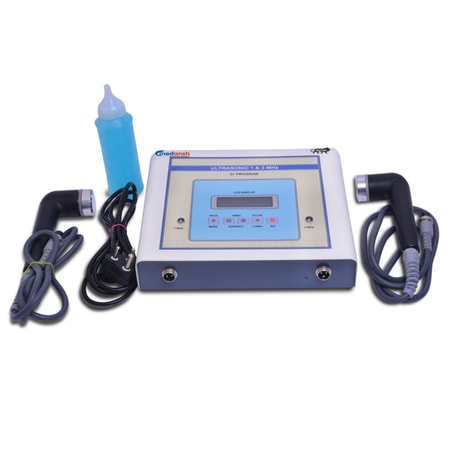
The unit ships as a complete, ready-to-use setup rather than requiring separate purchases to get started: it includes the head applicator itself, a power cord, and a bottle of conductive gel, covering everything needed for the coupling-and-treatment process described above from the first session.
Built for Regular Handling
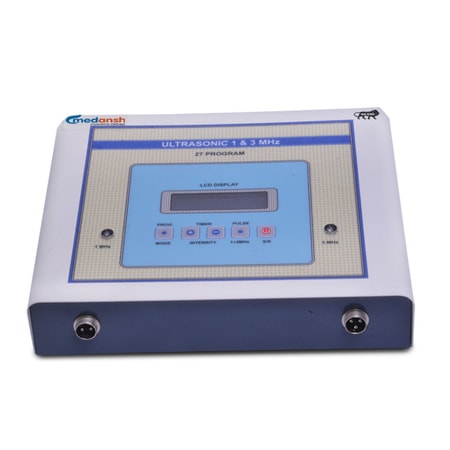
Beyond the treatment electronics, the unit is designed to be compact and lightweight with an A.B.S. shockproof body, reflecting the fact that clinical equipment gets moved, picked up, and set down constantly through a working day. The LCD display shows power intensity clearly, which — combined with the digital treatment timer — gives the operator an exact, repeatable readout rather than an analog dial that has to be interpreted by eye.
Frequently Asked Questions
How do I know whether to use 1MHz or 3MHz?
The general principle is that 1MHz reaches deeper into tissue and is more often used for deeper structures, while 3MHz is absorbed more superficially and is more often used for tissue closer to the skin's surface. The right choice depends on the specific condition and depth of the target tissue, so this decision is best made by a qualified physiotherapist rather than guessed at.
What do the 27 programs actually store?
They function as pre-configured treatment setups, allowing a practitioner to move quickly between different session types without manually rebuilding settings from scratch each time, while still leaving the treatment timer adjustable for the individual session.
Is the gel included, or does it need to be bought separately?
The package includes a gel bottle along with the head applicator and power cord, so a first session doesn't require sourcing coupling gel separately.
Can this be used without professional training?
As with any therapeutic ultrasound equipment, effectiveness depends on selecting the correct frequency, program, and duration for the specific condition being treated, so use by, or under the guidance of, a trained physiotherapist or occupational therapist is recommended rather than self-directed use.
How long does a typical session take?
Session length varies by condition, but treatments commonly fall in a short five-to-ten-minute range per area, with the adjustable 0-99 minute timer allowing the exact duration to be set for each individual case.
You may also need
FOR YOURecommended for you
Save 55%

Save 39%

Save 8%

Save 37%

Save 23%

Save 45%

Save 48%

Save 50%