
1
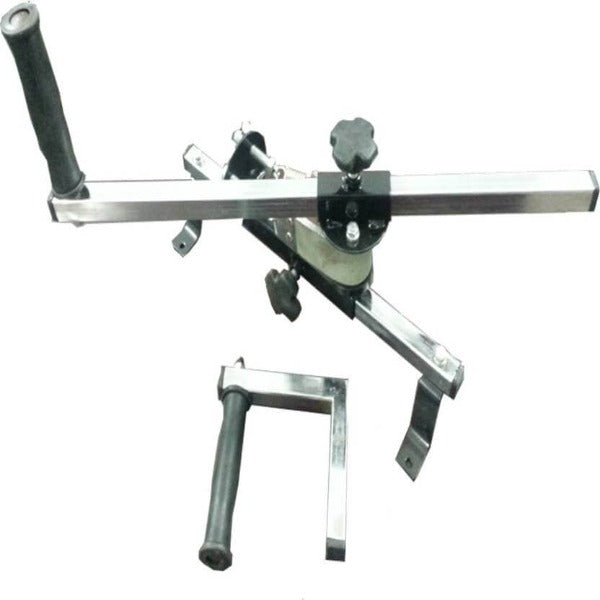
Axial Shoulder Wheel

Double-tap to zoom · drag to pan · swipe to browse
Axial Shoulder Wheel
In Stock
Check delivery
See if we deliver to you and when.
Delivering to
Delivery applicable
Free Shipping
on orders ₹999+
100% Genuine
Products
Dedicated
Support
Secure
Payments
Need help choosing or using this product?
Our team can help with product questions and orders.
Chat with support
Choose options
- Helps relieve pain associated with shoulder stiffness and restricted rotation
- Supports improvement in shoulder range of motion over a course of treatment
- Allows patients to perform graded resistance exercises as tolerance improves
- Two chrome-plated height adjustment rails suited to daily clinical use
Check delivery
See if we deliver to you and when.
Delivering to
Delivery applicable
- Helps relieve pain associated with shoulder stiffness and restricted rotation
- Supports improvement in shoulder range of motion over a course of treatment
- Allows patients to perform graded resistance exercises as tolerance improves
- Two chrome-plated height adjustment rails suited to daily clinical use
Check delivery
See if we deliver to you and when.
Delivering to
Delivery applicable
About this product
An Axial Wall-Mounted Wheel for Shoulder and Forearm Rehabilitation
The Axial Shoulder Wheel is used for shoulder and supination-pronation exercises, working the same way as a conventional shoulder wheel and wrist machine. It is a wall-mounting unit suitable for small clinics, adjustable in both height and radius, and fitted with a calibrated, sensitive resistance mechanism. Resistance is controllable from zero up to maximum simply by tightening the strap, and a 360-degree scale on the drum lets a therapist measure and record the degree of revolution achieved in either direction. The adjustment bars are chrome plated for long-term durability in daily clinical use.
Why the Axial Design Matters
Because the wheel mounts to the wall and rotates around a fixed axial point, the exercise keeps the shoulder moving through a controlled, repeatable arc rather than an unstructured freehand motion. This makes it easier for a therapist to standardise a patient's exercise from one session to the next, and to compare the recorded degree of rotation over time as a simple, objective measure of range-of-motion progress.
When This Exercise Is Used
The axial shoulder wheel is commonly used for frozen shoulder and peri-arthritis of the shoulder, both conditions in which capsular tightness restricts rotational movement. It is also used to help increase shoulder range of motion after surgery, where a graded, resistance-adjustable rotational exercise supports regaining movement without asking the joint to do more than it is ready for. Because resistance can be dialled all the way down to zero, therapists can introduce the exercise early in a recovery timeline and increase load only once tolerance improves.
When Not to Use It
This exercise should not be used with fractures or dislocations, since rotational loading through the joint could interfere with healing. If the movement causes discomfort or pain, the session should stop and the exercise plan should be reviewed by a physiotherapist before continuing.
How to Use the Axial Shoulder Wheel
The patient holds the handle and rotates the wheel forward or backward, standing either facing the wheel or turned to the side depending on the movement plane being targeted. As a range-of-motion therapy tool, it allows the physical therapist to directly assess the patient's shoulder abilities by observing the smoothness and extent of rotation, and by reading the exact degree achieved from the 360-degree scale.
Key Benefits
- Helps relieve pain associated with shoulder stiffness and restricted rotation
- Supports improvement in shoulder range of motion over a course of treatment
- Allows patients to perform graded resistance exercises as tolerance improves
- Two chrome-plated height adjustment rails suited to daily clinical use
- Handle position can be adjusted to increase the wheel's diameter range
Frequently Asked Questions
What is the difference between an axial shoulder wheel and a standard one?
The axial design rotates around a fixed wall-mounted point, which keeps the exercise arc controlled and repeatable, making it easier for a therapist to standardise the movement pattern and track range-of-motion progress session over session using the drum's 360-degree scale.
Can resistance be adjusted for different stages of recovery?
Yes. The calibrated resistance mechanism runs from zero up to a maximum setting via the strap, which means the same unit can be used from an early, protected stage of rehabilitation through to more demanding strengthening exercise as tolerance improves.
Who typically uses this exercise?
It is most often used for frozen shoulder, peri-arthritis of the shoulder, and for increasing shoulder range of motion after surgery, generally as part of a broader physiotherapy programme designed by a qualified therapist.
Is this suitable for a small clinic?
Yes. It is a wall-mounting unit specifically designed for small clinics that need an adjustable, space-efficient shoulder exerciser rather than a larger floor-standing model.
Country of Origin: India
Manufacturer/Importer/Marketed By: Meddey Technologies Pvt Ltd. C-75, First Floor, DDA Sheds, Industrial Area, Phase 1, Okhla, New Delhi - 110020, Phone No- +91 8586-012345
You may also need
FOR YOURecommended for you
Save 55%

Save 39%

Save 8%



Save 37%

Save 22%
Save 22%

Save 32%
Save 50%