


Featured ChoiceSave 33%

Save 31%

Save 35%


Save 19%

Save 36%

Save 38%

Sold out

What customers say
★★★★★ 5.0 · 5 reviews
 Contec CMS50D OLED Fingertip Pulse Oximeter for Home Use
“This is an excellent device. It provides accurate readings in seconds, and the OLED display is bright and e...”
 Contec CMS60C Handheld Pulse Oximeter with Adult SpO2 Probe
“Compact, accurate, and simple to use. Great for quick oxygen level checks. A must-have for home health care!”
“This is incredibly easy to use and provides quick, accurate readings. It's small and portable, making it pe...”
 Contec CMS70A Portable Tabletop Pulse Oximeter
“Compact, accurate, and easy to use. Provides quick and reliable readings. Perfect for home health monitoring!”
“This is very durable. I highly recommend it for monitoring oxygen levels, especially during illness. Great ...”
Oximeter for Home Use: Fingertip, Handheld & Tabletop
Oximeter for Home Use: Fingertip, Handheld & Tabletop Guide
Oximeter for home use is a practical tool for checking oxygen saturation and pulse rate at home, especially when you want a quick snapshot rather than a guess. An oximeter, sometimes called an oxygen level meter or SpO2 meter, does not diagnose illness by itself. It can help you track readings, notice patterns, and share clearer information with a healthcare professional. This guide explains the main home-friendly options—fingertip, handheld, and tabletop—plus how to use one correctly and what can make readings misleading.
Consult your doctor if a reading concerns you.
The best oximeter for home use is usually the one you can place correctly, read easily, and use consistently. For many households, that means a fingertip oximeter; for longer checks or multiple users, a handheld oximeter or larger tabletop oximeter may be more convenient.


How does an oximeter work?
An oximeter works by shining light through a fingertip or another sensor site and estimating how much oxygen is being carried by the blood. Oxygenated and deoxygenated hemoglobin absorb light differently, so the pulse oximeter uses those light signals to estimate SpO2, or oxygen saturation, while also detecting pulse rate. This is why movement, poor circulation, nail polish, cold fingers, and sensor placement can change the reading.

In everyday language, the number on the screen tells you the percentage of hemoglobin that appears to be carrying oxygen at that moment. A supporting term you may see in manuals is pulse oximeter, because the device reads oxygen saturation from a pulsing blood signal. That pulsing signal is also why a steady hand and a warm finger often matter as much as the device itself.
Oximeter for home use starts with choosing the right format
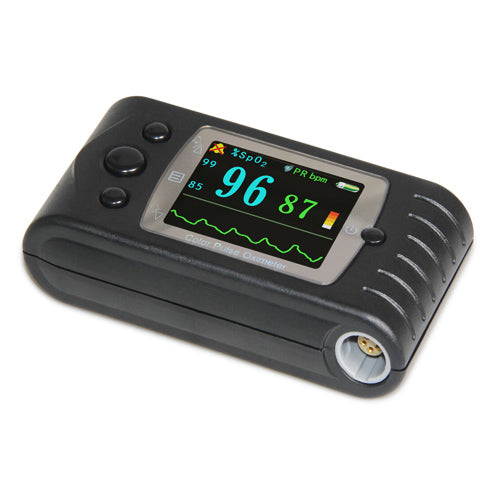
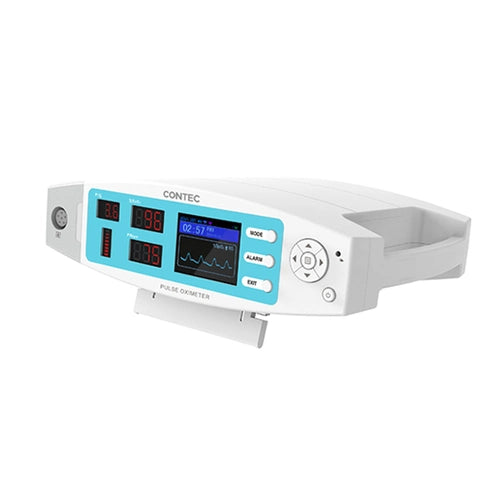
An oximeter for home does not have to be complicated, but the format matters. Small finger models are quick and portable, while a handheld oximeter usually gives you a separate probe and a larger display. A tabletop oximeter is the larger type, suitable for higher-volume monitoring when repeated checks, a bigger screen, or more durable placement is useful.


Fingertip oximeter models are simple and portable
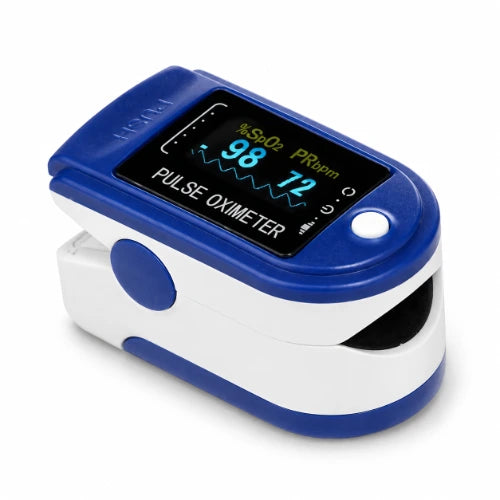
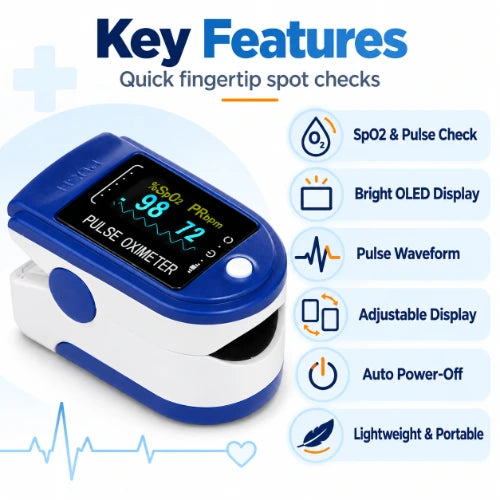
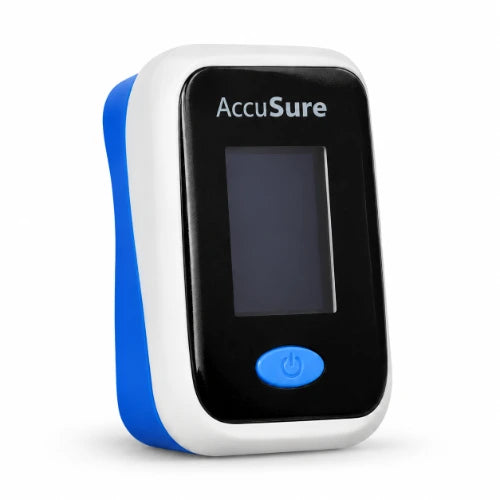
A fingertip oximeter clips directly over the end of the finger and shows SpO2 and pulse rate on a small built-in screen. This is the most familiar home style because it is compact, battery-powered, and easy to store in a drawer, travel pouch, or first-aid kit. It is often the right choice when you only need quick spot checks.

Examples in this category include the Contec CMS50D fingertip and AccuSure fingertip. Public device and product listings identify CMS50D as a Contec fingertip oximeter model. AccuSure lists fingertip oximeter products designed to show oxygen saturation and pulse rate.
A fingertip oximeter is most useful when the user can keep a finger still and has enough circulation in the fingertip for the device to detect a clean signal. It may be less convenient for very frequent checks, shaky hands, or situations where you want a sensor on the finger but the display somewhere easier to see.
Handheld oximeter models are easier to read and manage
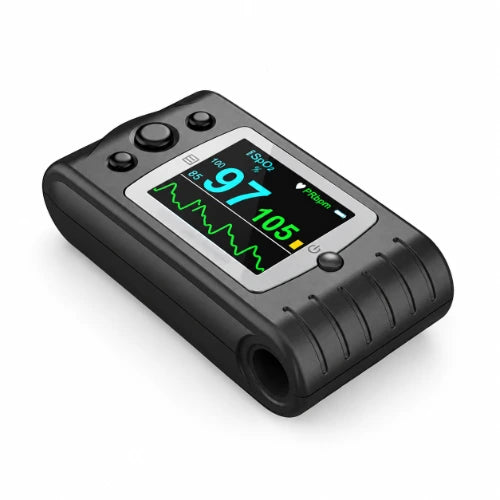
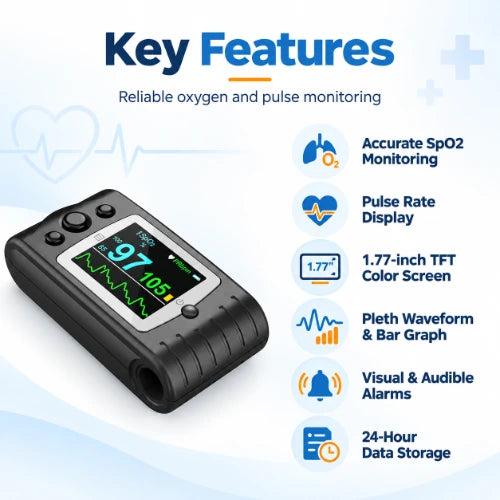
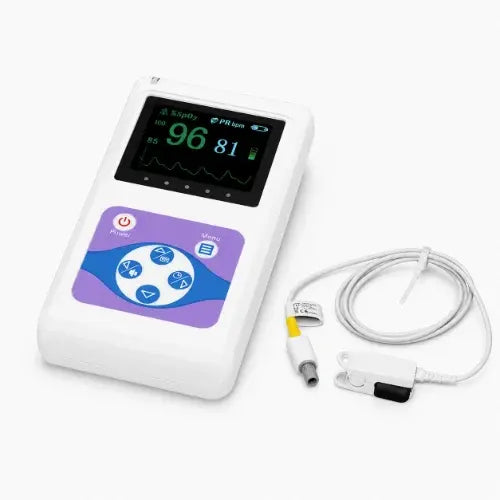
A handheld oximeter typically uses a separate sensor connected to a main unit. The sensor goes on the finger, while the display stays in the hand, on a nearby surface, or with the person assisting. That separation can make readings easier to view, especially if the user has difficulty turning the hand to see a small fingertip screen.

Examples include the Contec CMS60C handheld, a handheld oximeter with data transmission, and a handheld delux rechargeable model. A handheld format may appeal to households that want a larger display, rechargeable convenience, trend storage, or easier repeated use. Product listings for CMS60C describe it as a handheld device for SpO2 and pulse rate measurement.
A handheld oximeter may also be easier for caregivers because the sensor can remain placed while the display is read separately. The tradeoff is that it usually has more parts than a fingertip unit, so you need to store the cable, sensor, and main device together.
Tabletop oximeter models support higher-volume monitoring
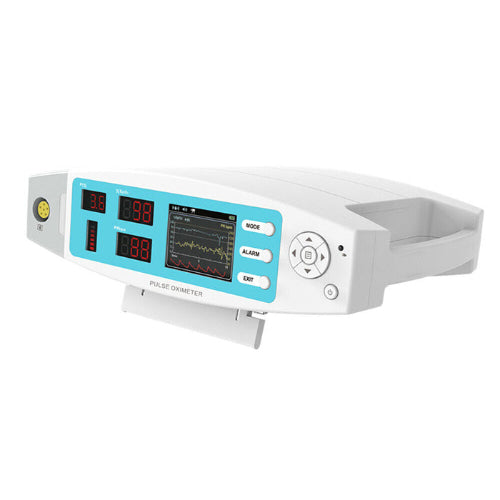
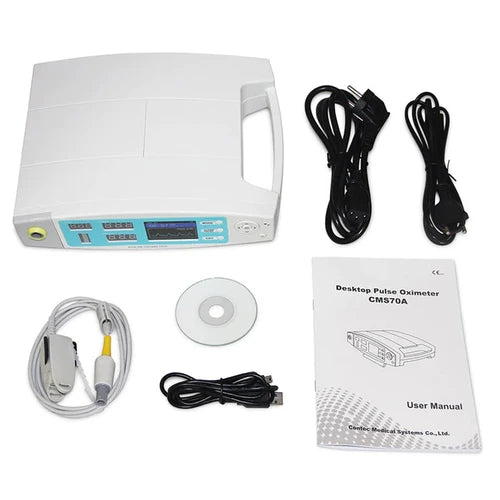
A tabletop oximeter is a larger type designed for more frequent or higher-volume monitoring. Compared with fingertip and handheld styles, it generally prioritizes a bigger display area, more stable placement, and repeated use over pocket-size portability. The Contec CMS70A tabletop is an example of this larger format. Product listings describe it as a tabletop device for SpO2 and pulse rate measurement.
This type makes sense when you take readings often, when multiple people may need checks, or when the screen needs to be easier to see from a seated position. It is not the smallest option. It works best in a dedicated spot where it can remain ready rather than being packed away after every reading.
Fingertip vs handheld oximeter?
Fingertip vs handheld oximeter? Choose a fingertip model if you want the simplest, smallest device for quick spot checks. Choose a handheld model if you want a larger display, a separate probe, or easier repeated readings. Both formats estimate SpO2 and pulse rate. The better choice is less about the basic measurement and more about comfort, visibility, handling, storage, and how often you plan to use it.

| Feature | Fingertip oximeter | Handheld oximeter |
|---|---|---|
| Best fit | Quick home checks and portability | Repeated checks and easier viewing |
| Display | Built into the finger clip | On a separate main unit |
| Sensor setup | One-piece clip | Probe plus handheld display |
| Storage | Very compact | Slightly bulkier, more parts |
| Ease for self-use | Simple if you can see the screen | Easier if a separate display helps |
| Typical examples | Contec CMS50D fingertip, AccuSure fingertip | Contec CMS60C handheld, handheld oximeter with data transmission, handheld delux rechargeable |
For many first-time buyers, a fingertip oximeter is enough. It gives fast readings, takes little space, and is easy to learn. If the reader has trouble seeing a small screen, wants a rechargeable option, or needs a device that feels easier to manage during repeated checks, a handheld oximeter may be worth considering.
The decision also depends on who will use it. A person checking their own oxygen occasionally may prefer a one-piece finger oximeter. Someone assisting another person may prefer a handheld display because it can be read without asking the user to twist their hand.
How to use an oximeter at home
Learning how to use an oximeter is mostly about creating the right conditions before trusting the number. Sit still, warm your hands, remove anything that blocks the light path, place the sensor correctly, and wait for the reading to settle. A rushed reading taken on a cold finger while moving around is more likely to confuse than help.

Use this basic routine for a fingertip model:
- Rest first. Sit comfortably for a few minutes before checking, especially after walking, climbing stairs, coughing, or using an inhaler.
- Warm the hand. If your fingers are cold, rub your hands together or warm them gently before measuring.
- Use a clean finger. Remove heavy nail polish, artificial nails, dirt, or anything else that may block the sensor light.
- Place the clip correctly. Insert the finger fully so the pad of the finger and nail sit where the sensor expects them.
- Keep still. Rest your hand on a table, armrest, or lap, and avoid talking or tapping.
- Wait for stability. Watch for the SpO2 and pulse rate to settle rather than reacting to the first number that flashes.
- Write down the result. Record the reading, pulse rate, time, activity level, and any symptoms.
For a handheld oximeter, the same principles apply, but the finger sensor and display are separate. Place the probe securely, keep the finger still, and read the main unit after the signal stabilizes. If the pulse oximeter includes data transmission or memory, use those features to support a clearer pattern rather than relying on a single isolated value.
Which finger is best for an oximeter?
Which finger is best for an oximeter? For many fingertip devices, the middle or ring finger often works well. Some FDA draft guidance notes that these fingers usually work best for fingertip use. The practical answer is to use a warm, clean finger that fits the clip properly and produces a stable signal.
If one finger gives an unstable reading, try another finger after warming the hand and sitting still. Avoid choosing a finger with nail polish, artificial nails, injury, heavy callus, or poor circulation if another finger is available. Consistency matters too: if you are tracking a trend over days, using the same finger in the same resting position can make your notes easier to compare.
When should you check oxygen at home?
The question “when should you check oxygen at home?” depends on why you have the device. Some people check only when they feel unwell; others follow a schedule recommended by a healthcare professional. In general, readings are more useful when taken at consistent times, such as after resting, before and after a specific activity, or when symptoms change.
Good times to check may include:
- When you feel more short of breath than usual.
- Before and after light activity, if you were asked to track exertion.
- At the same time each day during a short monitoring period.
- After warming cold hands and resting quietly.
- When you need a clear number to share during a health call.
Avoid checking over and over every few minutes unless you were specifically told to do so. Repeated checking can create anxiety, and normal small changes may look alarming when you stare at the screen. The goal is to capture useful information, not chase a perfect number.
What is a normal SpO2 reading?
What is a normal SpO2 reading? For many people, a normal oxygen level on an oximeter is commonly in the 95% to 100% range. Still, “normal” can vary depending on health history, altitude, and the reason you are measuring. Cleveland Clinic notes that most people have a normal oximeter oxygen saturation reading between 95% and 100%.
That range is a guide, not a personal diagnosis. Some people with long-term lung or heart conditions may have target ranges set by a healthcare professional. Those personal instructions should matter more than a generic internet range. If you have symptoms that feel severe or unusual, do not let a reassuring number delay getting help.
It also helps to understand what the device is showing. SpO2 is an estimate of oxygen saturation, not a full picture of breathing, lung function, circulation, infection, anemia, carbon monoxide exposure, or overall health. An oximeter reading is one data point; how you feel, how you are breathing, and whether symptoms are changing all matter.
Oximeter accuracy depends on technique, signal, and context
A common supporting question is: how accurate is a pulse oximeter? The answer is that a good device used correctly can be useful for estimating oxygen saturation, but it is not perfect. User technique, circulation, movement, skin pigmentation, skin temperature, nail polish, tobacco use, and other factors can all change the reading. The FDA specifically warns that multiple factors can affect accuracy and that readings should be considered estimates rather than the only basis for health decisions.
This matters because home users often treat the number as absolute. If the screen shows 96%, they may assume everything is fine; if it shows 92%, they may panic. A better approach is to look for a stable reading, compare it with your usual baseline, note symptoms, and follow your action plan.
Why one reading can differ from the next
Small changes happen. You may see a slightly different number after changing fingers, warming your hands, standing up, walking, coughing, or adjusting the clip. That does not always mean your oxygen level truly changed in a meaningful way.
Before reacting to an unexpected number, repeat the reading under better conditions. Sit still, warm your hand, remove barriers, reposition the oximeter, and wait for the result to settle. If the reading remains concerning or you feel unwell, treat that as useful information to share promptly with a healthcare professional.
Skin tone and oximeter readings
The FDA has highlighted concerns that oximeter accuracy can vary with skin pigmentation, including the possibility of less accurate readings in people with darker skin pigmentation. This does not mean the device is useless; it means users should avoid relying on a single number without considering symptoms and trends.
If you have darker skin, the same best practices still apply: use a good signal, keep the finger warm and still, and track patterns. However, be especially careful about dismissing symptoms just because the number looks acceptable. Breathing difficulty, chest discomfort, confusion, bluish lips, fainting, or rapid worsening should be taken seriously regardless of the screen.
Common oximeter reading mistakes are easy to avoid
Many confusing readings come from simple setup issues rather than a true change in oxygen. Before blaming the device, check the basics: finger temperature, nail condition, movement, fit, battery level, and whether the display has settled. A few extra seconds of preparation can save a lot of worry.

can nail polish affect an oximeter reading?
Yes, nail polish can affect an oximeter reading because it may interfere with the light used by the sensor. False nails, dark polish, thick coatings, dirt, and some nail decorations can also make the signal less reliable. FDA materials and respiratory testing guidance both identify nail polish or artificial nails as factors that can affect readings.
If you need regular home readings, keep at least one finger free of polish or use a finger without artificial nail coverage. If that is not possible, follow the device instructions and ask a healthcare professional how they want you to measure. Do not assume a strange number is meaningful until you have ruled out obvious interference.
can cold hands change an oximeter reading?
Yes, cold hands can change an oximeter reading because reduced blood flow can make it harder for the sensor to detect a strong pulse signal. Cold fingers, shivering, poor circulation, and movement can all make readings unstable or inaccurate.
Warm the hand gently before measuring. Rest it on your lap or a table and avoid clenching your fist. Wait until the pulse oximeter shows a steady pulse rate along with the SpO2 number. If your hands are often cold, take readings in the same warm room and use the same routine each time.
Movement, weak signal, and poor fit matter too
Motion is one of the most common reasons a home oximeter gives confusing results. Tapping fingers, talking with animated hand movement, shivering, or checking while walking can produce unstable numbers. A clip that is too loose, too tight, or not fully seated can also weaken the signal.
Battery level can matter as well. If a pulse oximeter is dim, slow, inconsistent, or repeatedly shuts off, replace or recharge the batteries before trusting it. For handheld and tabletop models, also check that the probe cable is fully connected and not damaged.
Cleanliness and storage help keep readings consistent
Keep a home oximeter clean, dry, and protected from rough handling. Oils, dust, lotion, or debris inside the clip can interfere with the sensor area. Wipe the device according to the manufacturer’s instructions, and avoid harsh cleaning methods unless the manual specifically allows them.
Store the device where it is easy to find but not exposed to moisture, heat, or heavy objects. If multiple people use the same device, clean it between uses. A simple storage pouch or dedicated drawer can prevent damage and keep the sensor ready.
Oximeter price reflects features, not just the number on the screen
Oximeter price varies because devices differ in format, display size, build quality, battery style, memory, alarms, probes, data features, and intended use. A basic fingertip oximeter is usually the simplest category, while a handheld oximeter with data transmission, rechargeable power, or separate probes may carry a higher price. A tabletop oximeter typically carries a higher price because it is built for higher-volume monitoring and easier repeated viewing.

When comparing options, do not shop only by the lowest price. A device that is difficult to read, uncomfortable to place, or inconsistent in your hands may not be a good value. The right oximeter for home use should match the person using it and the reason it is being used.

Use this buying checklist before deciding:
- Display readability: Can you read the SpO2 and pulse rate without twisting your hand?
- Fit: Does the clip or probe fit the intended user’s finger comfortably?
- Signal stability: Does the reading settle when the hand is warm and still?
- Power source: Do you prefer replaceable batteries or a rechargeable model?
- Memory or data: Do you need stored readings or data transmission?
- Portability: Will the device travel, stay bedside, or remain on a table?
- Instructions: Is the manual clear enough for the household to follow?
- Cleaning: Can the device be cleaned easily between users?
Choosing an oximeter format by use
If you only need occasional spot checks, a fingertip option such as Contec CMS50D fingertip or AccuSure fingertip may be practical. Should you want a larger display and more handling flexibility, Contec CMS60C handheld or another handheld model may make sense. If repeated checks are part of the routine, Contec CMS70A tabletop may be worth considering as the larger, higher-volume style.


A simple oximeter routine makes readings more useful
The best oximeter routine is repeatable. When readings are taken under similar conditions, they are easier to interpret. That does not mean every number will be identical; it means changes are less likely to be caused by random technique differences.
Try this routine if you are tracking at home:
- Choose a usual time. For example, after breakfast or before bedtime, unless you were told otherwise.
- Sit and rest. Give your breathing and pulse time to settle.
- Prepare the finger. Use a warm, clean finger without polish or artificial nail coverage.
- Place the device. Make sure the sensor sits correctly and the hand is supported.
- Wait. Let the SpO2 and pulse rate stabilize.
- Record context. Write down the number, pulse, time, symptoms, and recent activity.
- Look for patterns. Compare readings taken in similar conditions, not random numbers from different situations.
A short log can be more helpful than memory. Instead of saying, “It was low yesterday,” you can say, “After resting for five minutes, it was 94% at 8 p.m., with more coughing than usual.” That kind of detail gives better context.
What to write down with each reading
A useful home log does not need to be complicated. Include the date, time, SpO2 reading, pulse rate, finger used, and how you felt. If you had just walked, used medication, coughed heavily, felt feverish, or changed position, write that down too.
Here is a simple format:
| Date/time | SpO2 | Pulse | Finger | Rested first? | Symptoms or notes |
|---|---|---|---|---|---|
| Example | 96% | 78 | Right middle | Yes | Mild cough, no shortness of breath |
| Example | 94% | 92 | Right middle | After stairs | Felt winded, improved after rest |
The point is not to create a perfect medical chart. The point is to make your observations clear, consistent, and easier to discuss.
When an oximeter reading should not be ignored
An oximeter can be reassuring, but it should not override how someone looks or feels. If a person is struggling to breathe, has chest discomfort, seems confused, has bluish lips or face, faints, or worsens quickly, seek urgent help even if the number looks acceptable. The FDA advises that readings should not be used as the only basis for medical decisions and should be considered alongside symptoms.
You should also be cautious with repeated low readings that do not improve after correcting technique. Warm the hand, reposition the device, remove nail interference, and repeat after resting. If the reading remains below the range your healthcare professional told you to watch, follow your action plan or contact them promptly.
For people with known lung or heart conditions, the most important “normal” may be the personal range set for you. Do not change oxygen therapy, medications, or activity limits based only on a home device unless your healthcare professional has told you exactly how to respond.
Matching the oximeter to the person using it
A device can have good features and still be the wrong fit for a household. Think about eyesight, hand strength, finger size, comfort with technology, and whether the user will be alone when checking. The more the device matches real life, the more likely it is to be used correctly.

For an older adult with limited vision, display size and orientation may matter more than pocket portability. When you travel, a fingertip oximeter may be easier to keep available. For someone who wants stored readings, a handheld oximeter with data transmission may offer a more organized way to review trends.
For occasional reassurance
A fingertip oximeter is usually the simplest choice for occasional checks. It is quick to use, easy to store, and familiar to most people. Choose one with a display that is bright enough and numbers that are large enough for the intended user.

For assisted readings
If one person regularly helps another person check oxygen saturation, a handheld oximeter can be more convenient. The sensor can stay on the finger while the helper reads the main unit. This can reduce awkward hand positioning and may make the process calmer.
For repeated checks in one place
A tabletop oximeter is the larger option for higher-volume monitoring in a fixed space. It is best when the device does not need to fit in a pocket and when a larger display is helpful. Because it occupies more room, choose it when repeated use matters more than portability.
Final takeaway: use the oximeter as a guide, not a verdict
An oximeter is most valuable when it is used calmly, consistently, and in context. Choose the format that fits your routine and learn how to use an oximeter correctly. Remember that a single reading is less useful than a stable number paired with how you feel. A fingertip oximeter, handheld oximeter, or tabletop oximeter can all support home awareness when used with good technique.
For most households, the starting point is simple: warm the hand, use a clean finger, sit still, wait for the reading to settle, and record the result. If the number seems wrong, check the conditions before reacting. If symptoms are serious or readings remain concerning, use the oximeter as one piece of information and seek appropriate medical guidance.
Explore Medical Collections
All Categories
Abdominal & Maternity Support

Accessories

Accu-Chek Instant Strips: Use, Compatibility, Price & Blood Sugar Testing Guide
Accu-Chek Instant Strips: Uses, Features & Complete Guide

accupuncture

Acupuncture Needles & Supplies

Advanced Physiotherapy Machines & Lumbar Physiotherapy

Airways

Ambulance

Anatomy Models
Anesthesia Machine

Anesthesia Products

Ankle Support for Home Use: Braces, Sleeves & Walker Boots

Ankle Weights & Exercise Weights for Home & Rehab

Anti-Bedsore Air Mattresses
You may also need
FOR YOURecommended for you
Save 33%
Save 31%
Save 35%
Save 19%
Save 36%
Save 38%