
1

Therapeutic Muscle Stimulator


Double-tap to zoom · drag to pan · swipe to browse
Therapeutic Muscle Stimulator
In Stock
Check delivery
See if we deliver to you and when.
Delivering to
Delivery applicable
Free Shipping
on orders ₹999+
100% Genuine
Products
Dedicated
Support
Secure
Payments
Need help choosing or using this product?
Our team can help with product questions and orders.
Chat with support
Choose options
What a Muscle Stimulator Actually Does A muscle stimulator works by sending a controlled electrical current through the skin to the muscle beneath it, causing the muscle fibers to contract without you having to...
Check delivery
See if we deliver to you and when.
Delivering to
Delivery applicable
What a Muscle Stimulator Actually Does A muscle stimulator works by sending a controlled electrical current through the skin to the muscle beneath it, causing the muscle fibers to contract without you having to...
Check delivery
See if we deliver to you and when.
Delivering to
Delivery applicable
About this product
What a Muscle Stimulator Actually Does
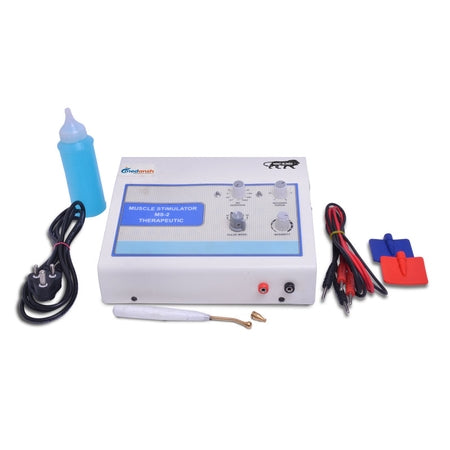
A muscle stimulator works by sending a controlled electrical current through the skin to the muscle beneath it, causing the muscle fibers to contract without you having to move the joint voluntarily. Physiotherapists and sports trainers use this effect in two broad ways: to make a muscle contract harder or more often than it would during normal exercise, and to trigger contractions in a muscle that a person cannot yet activate well on their own — for example, early after an injury or surgery. The Therapeutic Muscle Stimulator is built around this principle, using several distinct current patterns rather than a single fixed setting, so the output can be matched to the specific training or recovery goal at hand.
The Different Current Modes and What They're For
Rather than a single generic "shock" setting, this unit offers several treatment modes — Iontophoresis, Galvanic, Interrupted Galvanic Faradic, and Surged Faradic — each producing a different pattern of electrical output. Broadly speaking, galvanic-type currents are a steady direct current used in techniques such as iontophoresis, where the current assists the movement of substances through the skin. Faradic-type currents, by contrast, are pulsed and are the type generally associated with producing an actual muscle contraction, which is why they are surged — delivered in an on-again, off-again rhythm — to mimic the natural contract-and-relax pattern of a voluntary muscle action rather than holding a single continuous contraction. Having multiple modes on one device means a clinic or trainer is not limited to one application; the same base unit can be configured differently depending on whether the goal is muscle stimulation, pain-related work, or another current-based application.
Surged Faradic: The On/Off Rhythm
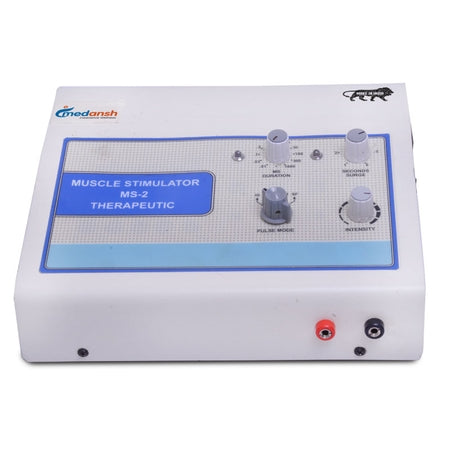
The surged faradic mode on this unit allows the "on time" and "off time" of the pulsed current to each be set anywhere from 1 to 10 seconds. This on/off ratio is what determines how a training or therapy session actually feels and behaves: a longer on-time relative to off-time asks more of the muscle in each burst, while a longer off-time gives the muscle more recovery between contractions. Being able to adjust this ratio, rather than being locked into a single fixed rhythm, lets the person operating the device tailor the contraction pattern — for instance, using a rhythm suited to endurance-style repeated contractions versus one suited to fewer, more demanding contractions.
Training and Performance Applications
For athletes and active individuals, adding electrical stimulation on top of regular training is generally used to work a muscle group harder or more frequently than voluntary exercise alone allows, which is the basis for claims around improved speed, power, and endurance. Because the device can trigger contractions without the cardiovascular and joint stress of an equivalent voluntary workout, it is also commonly used as part of warm-up routines, where activating a muscle group before activity is associated with a reduced risk of strain-type injuries. Over a training block, the added contraction volume is the basis for supporting increases in muscle size and density, and for working on the muscle's reaction time — how quickly it responds when called upon.
Recovery and Pain-Focused Applications
Beyond performance training, electrical muscle stimulation is widely used for recovery. Repeated muscle contractions act similarly to a pumping action on the local circulation, which is the mechanism behind claims of increased local blood flow to muscles that are sore or fatigued — more blood flow to a worked area generally supports faster clearance of metabolic byproducts and delivery of nutrients needed for repair, which is why stimulation is often used after intense training rather than only before it. This same current-based approach is also used more generally in pain management settings, where appropriate current parameters are selected to help modulate the sensation of pain in a treated area, alongside other physiotherapy techniques rather than as a stand-alone solution.
Getting the Timing Right
The unit's therapeutic timing range runs from 30 to 300 milliseconds in 10-millisecond steps, which governs the duration of each individual pulse within a treatment. Fine steps like this matter because muscle and nerve tissue respond differently depending on how long each electrical pulse lasts — too short and the muscle may not contract effectively, too long and the sensation can become uncomfortable before it needs to be. Having granular control in small increments allows a practitioner to find the setting that produces an effective contraction at a tolerable intensity for the specific person and muscle group being treated.
Who Uses Devices Like This
Equipment of this type is typically found in physiotherapy clinics, sports rehabilitation centers, and training facilities where staff can select the appropriate mode and parameters for the person in front of them. Because the effectiveness of electrical stimulation depends heavily on correct electrode placement, current selection, and intensity, this is equipment best used by or under the guidance of a qualified physiotherapist or trained professional, rather than through trial and error.
Frequently Asked Questions
Does electrical muscle stimulation replace exercise?
No — it is generally used alongside voluntary exercise and training, not as a replacement for it. Its main value is in supplementing what a muscle can be asked to do beyond normal voluntary effort, or in activating a muscle that cannot yet be well controlled voluntarily, such as soon after an injury.
What is the difference between the treatment modes?
Galvanic-type currents are steady and direct, used in applications like iontophoresis, while faradic-type currents are pulsed and are the pattern generally used to produce a visible muscle contraction. Having both available on one unit means the same device can be configured for different clinical or training purposes.
Is this device only for athletes?
No. While the performance-related benefits — speed, power, endurance — are often discussed in a sporting context, the same underlying contraction and circulation effects are used just as often for general recovery and pain management in physiotherapy and rehabilitation settings.
Do I need training to use it correctly?
Getting good results depends on selecting the right mode, current parameters, and electrode placement for the specific muscle and goal, so this is equipment best operated by, or under the direction of, a qualified physiotherapist or sports trainer rather than used without guidance.
You may also need
FOR YOURecommended for you
Save 55%

Save 39%

Save 8%



Save 37%

Sold out

Save 18%

Save 20%
Save 33%