




About this collection
Theratubes: Uses, Resistance Levels, Benefits & Professional Exercise Guide
Learn what Theratubes are used for, how resistance tubing works, which level to choose, how to use TheraBand tubing correctly and where resistance tubes fit into physiotherapy and rehabilitation.
Theratubes are flexible resistance tubes used for strengthening, mobility, rehabilitation and exercise training. They create tension as the user stretches the tube, which allows therapists and patients to add resistance without using heavy weights.
In clinical settings, resistance tubes can support upper-body and lower-body exercises. For example, a physiotherapist may use tubing for shoulder rotation, hip strengthening or controlled functional movement. Meanwhile, fitness professionals may use the same equipment for warm-up, conditioning and progressive strength work.
One major advantage of Theratubes is portability. Because they are light and compact, clinics can store several resistance levels without taking up much space. In addition, patients can often continue suitable exercises at home after receiving clear professional guidance.
However, resistance level matters. A tube that is too light may not create enough challenge, while excessive resistance can reduce movement quality. Therefore, the correct tube should match the user's strength, movement goal and stage of rehabilitation.
This guide explains the purpose of Theratubes, how TheraBand tubing works, which resistance level to choose, whether resistance tubes work, and how to use them correctly.
You can also browse TheraBand resistance products available on Meddey.
What Are Theratubes?
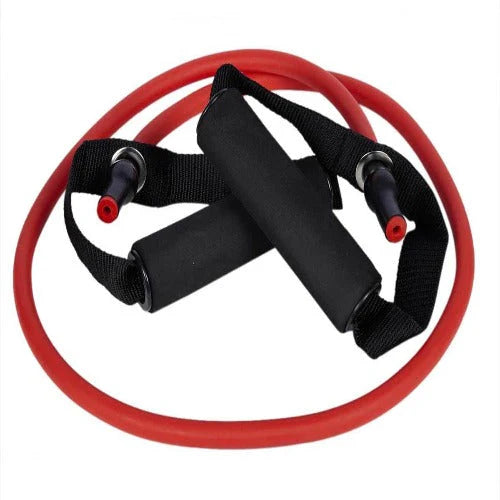
Theratubes are elastic tubes that create resistance when stretched. Unlike flat resistance bands, tubes usually have a round profile and may include handles, anchors or other attachments.
Depending on the product, they may be made from natural rubber latex or latex-free material. Resistance rises as the tube stretches further, so the exercise becomes harder through the movement.
Common uses include:
- Strength training
- Physiotherapy exercises
- Rehabilitation
- Mobility work
- Shoulder exercises
- Hip and leg strengthening
- Warm-up routines
- Sports conditioning
As a result, resistance tubing can support both early-stage exercise and more demanding strength programmes when the correct level is selected.

What Is the Purpose of a Theratube?
The main purpose of a Theratube is to provide progressive resistance during movement.
As the user pulls the tube, tension increases. Therefore, muscles must work against that resistance throughout the exercise.
Therapists can use this property to make exercises easier or harder. For example, they may change the resistance level, shorten the working length or adjust the starting position.
Consequently, Theratubes give healthcare professionals a simple way to adjust exercise difficulty over time.
What Is TheraBand Tubing Used For?
TheraBand tubing is commonly used for progressive resistance exercise. Its colour-coded system helps users and professionals identify different resistance levels.
Clinicians may use tubing for:
- Shoulder rotation exercises
- Scapular strengthening
- Elbow flexion and extension
- Hip abduction
- Knee strengthening
- Ankle exercises
- Postural training
- Functional movement practice
In addition, athletes may use resistance tubing during warm-up or conditioning. Older adults may also use elastic resistance in structured programmes to improve strength and balance.
Recent evidence supports this wider role. A 2025 systematic review and meta-analysis found improvements in lower-limb strength and balance measures after elastic-band resistance training in older adults.
Therefore, tubing can be useful well beyond simple stretching.
Do Resistance Tubes Actually Work?
Yes, resistance tubes can provide a real training stimulus when the resistance and exercise are appropriate.
Elastic resistance works because the muscle must produce force against the tension created by the tube. As the tube stretches further, resistance usually rises.
This allows users to train:
- Muscular strength
- Muscular endurance
- Movement control
- Range of motion
- Balance-related strength
- Functional movement
However, results depend on programme design. Simply owning a resistance tube does not improve strength.
Instead, progress requires enough resistance, correct technique, suitable exercise volume and regular training.
Theratubes vs Resistance Bands
| Feature | Resistance Tube | Flat Resistance Band |
|---|---|---|
| Shape | Round tube | Flat elastic strip |
| Handles | Often available | Usually no fixed handles |
| Grip | Handles may improve grip comfort | User grips or wraps the band |
| Exercise use | Strength and functional training | Strength, mobility and stretching |
| Portability | High | High |
| Progression | Different resistance levels | Different resistance levels |
Neither design is automatically better. Instead, the choice depends on the exercise and user preference.
Which TheraBand Is Best?
There is no single TheraBand level that is best for every user.
The correct resistance depends on current strength, the exercise, movement quality and the goal of training.
For example, a person may need lighter resistance for shoulder rotation but stronger resistance for leg exercises.
Therefore, professionals should choose a level that allows controlled movement without loss of form.
Meddey's current TheraBand collection includes several colour-coded resistance levels for clinic, rehabilitation and exercise use.
Understanding TheraBand Resistance Levels
TheraBand uses colour coding to make resistance progression easier to identify. However, exact resistance values depend on product type and how far the material stretches.
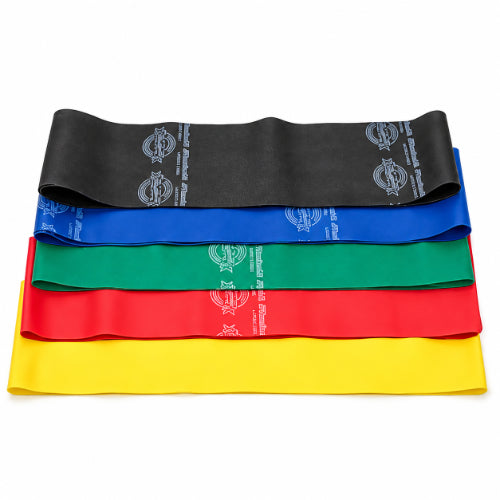
Meddey's current latex-free resistance range includes colours such as:
| Colour | General Resistance Level | Typical Use |
|---|---|---|
| Red | Light | Early strengthening and lower-load exercise |
| Green | Medium | General rehabilitation and strength work |
| Blue | Heavy | Stronger users and later-stage exercise |
| Black | Extra Heavy | Advanced strength work where suitable |
For instance, Meddey's current Blue TheraBand listing reports about 5.73 lb of resistance at 100% elongation. Meanwhile, the Black version lists about 7.3 lb at 100% elongation.
Therefore, clinicians should not select colour only by habit. The actual load should match the exercise goal.
How Do I Use TheraBand Correctly?
Correct use starts with choosing the right resistance and a stable setup.
First, inspect the band or tube for cuts, cracks, tears or weak areas. Next, secure the tube or hold it firmly. Then, move slowly through the planned exercise.
Good technique usually includes:
- Controlled movement
- Stable posture
- Steady breathing
- No sudden jerking
- Appropriate resistance
- Clear exercise range
In addition, the tube should not snap toward the face or eyes. Users should also remove sharp jewellery and avoid contact with rough edges.
Finally, store the tubing away from excess heat and direct sunlight.
How Much Should a Theratube Be Stretched?
The correct stretch depends on the product and the intended resistance.
Elastic resistance rises as the tube length increases. Therefore, changing the amount of stretch changes the load.
However, users should not stretch the material beyond the manufacturer's recommended limit.
For example, Meddey's Premium Exercise Tubes currently state that the tubes can be pulled to more than three times their starting length. Even so, clinicians should use controlled movement rather than treating maximum stretch as the goal.
Theratubes for Shoulder Rehabilitation
The shoulder is one of the most common areas where clinicians use elastic resistance.
Possible exercises include:
- External rotation
- Internal rotation
- Shoulder extension
- Rows
- Scapular retraction
- Controlled elevation patterns
Recent clinical literature supports elastic resistance as a practical tool for shoulder rehabilitation. A 2025 review discussed its use for exercise prescription and load control in shoulder care.
However, the correct exercise depends on diagnosis and stage of recovery.
Therefore, shoulder pain should not automatically be treated with the strongest resistance available.
Theratubes for Lower-Body Strength
Resistance tubing can also train the hips, knees and ankles.
For example, therapists may prescribe:
- Hip abduction
- Hip extension
- Knee extension
- Hamstring exercises
- Ankle plantarflexion
- Ankle dorsiflexion
In addition, tubing can support balance-focused exercise when combined with suitable standing tasks.
As a result, one compact piece of equipment can support several stages of lower-body rehabilitation.
Theratubes for Older Adults
Elastic resistance can be useful for older adults because the load can be adjusted gradually.
A 2025 meta-analysis of 25 studies involving 1,318 participants found that elastic-band resistance training improved several measures of lower-limb strength and balance.
However, programme design matters. Therefore, resistance should match the person's strength, balance ability and health status.
In clinical practice, professionals may combine tubes with chair-based exercises, walking work and balance training.
Theratubes for Clinics and Hospitals
Theratubes can be useful in physiotherapy clinics, rehabilitation centres and hospital therapy departments.
Key advantages include:
- Low storage space
- Multiple resistance levels
- Easy exercise progression
- Upper- and lower-body use
- Portable setup
- Home-program continuity
Moreover, clinics can keep several resistance levels so the therapist can adapt the load for different patients.
Therefore, resistance tubing offers a flexible option for facilities that need simple exercise tools.
How to Progress Theratube Exercises
Progress does not always require moving immediately to the next colour.
A therapist can increase difficulty in several ways:
- Use a stronger tube
- Shorten the working length
- Increase movement range
- Add repetitions
- Add sets
- Slow the movement
- Use a harder body position
However, progression should preserve good technique.
Therefore, a stronger resistance level is only useful when the user can still complete the movement correctly.
How to Choose Theratubes
1. Define the Exercise Goal
First, decide whether the tubing is for rehabilitation, general strength, mobility or sports training.
2. Choose the Resistance Level
Next, select a level that creates challenge without breaking form.
3. Check Material
Then, determine whether latex or latex-free material is required.
4. Review Length
Afterwards, check whether the tube length suits the planned exercises.
5. Check Handles
In addition, handles may improve grip for some users.
6. Inspect Anchoring Options
Door anchors or fixed points can expand the exercise range.
7. Review Durability
Finally, check material quality and replacement availability.
Premium Exercise Tubes Available on Meddey
Meddey currently lists a Premium Exercise Tubes Set of 3 at approximately ₹2,999.
The current product listing describes:
- Set of 3 tubes
- Progressive colour-coded resistance
- Natural rubber latex material
- Longer handles
- Upper- and lower-body use
- Strength, mobility and rehabilitation applications
Current Meddey Product Example
Product: Premium Exercise Tubes Set of 3
Current price: approximately ₹2,999
Use: strength, mobility, rehabilitation and conditioning
Prices can change with stock and promotions. Therefore, buyers should check the live page before ordering.
View Exercise TubesTheraBand Resistance Products on Meddey
Meddey also offers a dedicated TheraBand resistance collection.
Current examples include:
- Latex-free resistance bands
- Red, Green, Blue and Black levels
- TheraBand loop bands
- FlexBar products
- Ankle weights
For example, the current latex-free TheraBand range starts around ₹540 for selected variants. Meanwhile, Green, Blue and Black 1.5 m models are listed separately at different prices.
Therefore, clinics can choose products according to resistance level and exercise format.
Common Mistakes When Using Theratubes
Resistance tubes are simple, but incorrect use can reduce exercise quality.
Common mistakes include:
- Choosing too much resistance
- Using poor posture
- Moving too quickly
- Allowing the tube to snap back
- Using damaged tubing
- Anchoring it to an unstable object
- Ignoring pain
- Using one resistance level for every exercise
Therefore, exercise quality should come before heavier resistance.
How to Care for Resistance Tubes
Regular inspection can help reduce the risk of tube failure.
Before each session, check for:
- Cuts
- Cracks
- Thin areas
- Sticky material
- Damage near handles
- Loose attachments
In addition, keep tubing away from sharp surfaces.
After use, store it away from direct sunlight and high heat. Therefore, a cool, dry storage area is usually better.
Frequently Asked Questions About Theratubes
What is the purpose of a Theratube?
A Theratube provides elastic resistance for strength, mobility and rehabilitation exercises. Resistance rises as the tube stretches.
What is TheraBand tubing used for?
TheraBand tubing is used for progressive strength exercises, shoulder rehab, lower-body work, mobility training and home exercise programmes.
Which TheraBand is best?
No single colour is best for everyone. The correct level depends on the exercise, user strength and stage of rehabilitation.
Do resistance tubes actually work?
Yes. They provide measurable elastic resistance and can support strength and rehabilitation when exercise dose and technique are appropriate.
How do I use TheraBand correctly?
Inspect the material, secure the band or tube, choose suitable resistance and perform the exercise slowly with controlled form.
Are resistance tubes good for physiotherapy?
Yes. Physiotherapists commonly use elastic resistance for strengthening, mobility and functional exercise.
Can beginners use Theratubes?
Yes. Beginners can start with lighter resistance and progress when they can maintain good control.
Can resistance tubes replace weights?
They can provide an effective resistance-training option for many exercises. However, weights and machines may still be useful for other training goals.
Can Theratubes be used after surgery?
They may be used in some recovery programmes, but exercise selection and timing should follow guidance from the treating healthcare professional.
How often should resistance tubes be replaced?
There is no single replacement interval. Replace the tube whenever it shows cracks, tears, thinning or damage that may affect safety.
Professional Buying Checklist
- Define the clinical or exercise goal
- Select suitable resistance levels
- Choose latex or latex-free material
- Check tube length
- Review handle quality
- Check anchor compatibility
- Inspect material durability
- Choose several resistance levels for clinic use
- Review cleaning and storage needs
- Check current price
Overall, good Theratubes should provide controlled resistance, reliable material quality and enough progression for the intended user group.
Where to Buy Theratubes and Resistance Tubes Online in India?
Physiotherapists, hospitals, clinics and home users can buy resistance tubing from rehabilitation-equipment suppliers and healthcare stores.
Before purchasing, compare:
- Resistance level
- Material
- Length
- Handles
- Number of tubes
- Progression options
- Product quality
- Current price
Meddey currently offers both exercise tubes and original TheraBand products for rehabilitation, mobility and strength training.
View Exercise Tubes Browse TheraBand Products Exercise & Rehabilitation EquipmentConclusion
Theratubes are simple but useful resistance tools for physiotherapy, rehabilitation, mobility and strength training.
Their main advantage is progressive elastic resistance. Therefore, therapists can adjust exercise difficulty without large gym machines.
In addition, resistance tubes work across many body areas. For example, they can support shoulder, hip, knee, ankle and functional exercises.
However, correct resistance selection matters. A stronger tube is not automatically better if it reduces movement quality.
Current evidence supports elastic resistance training for several rehabilitation and strength outcomes. Meanwhile, recent research also supports its practical use in shoulder rehabilitation and lower-limb strength programmes.
Ultimately, the best Theratube is the one that matches the exercise, user ability and treatment goal.
You can compare current TheraBand and resistance products on Meddey.
Medical & Exercise Disclaimer
Explore Medical Collections
All Categories
Abdominal & Maternity Support

Accessories

Accu-Chek Instant Strips: Use, Compatibility, Price & Blood Sugar Testing Guide
Accu-Chek Instant Strips: Uses, Features & Complete Guide

Accupressure

accupuncture

Acupuncture Needles & Supplies

Advanced Physiotherapy Machines

Airways

Ambulance

Anatomy Models
Anesthesia Machine

Anesthesia Products
Ankle & Foot Supports

Anti-Bedsore Air Mattresses
You may also need
FOR YOURecommended for you