


Featured Choice
Save 6%
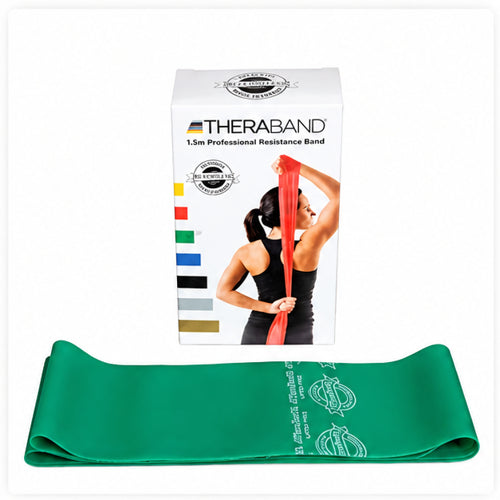

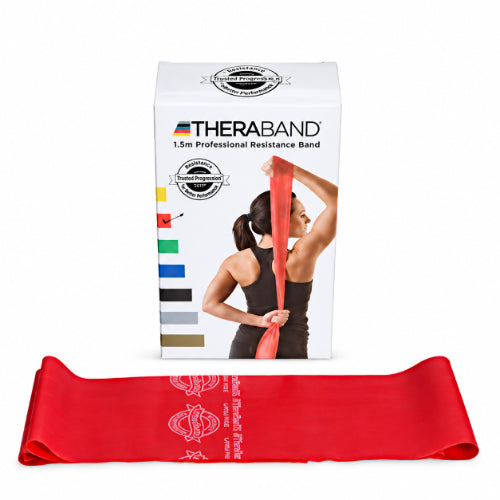


Save 16%

Save 6%
Save 33%
Save 15%


Save 11%


Save 21%


Save 17%


Save 5%

What customers say
★★★★★ 5.0 · 3 reviews
Theraband Resistance Bands for Home, Physio & Rehab
Theraband Resistance Bands: Types, Colours & Buying Guide
Theraband Resistance Bands are simple elastic tools used at home for gentle movement, guided exercise, stretching support, and physiotherapy-style activity when advised by a doctor or physiotherapist. For home users in India, they are easy to store, easy to carry, and useful for families, older adults, and people who want a compact option for daily movement at home. This guide explains the main types, colour levels, material choices, and buying checks so you can choose theraband with more confidence.
What are theraband resistance bands used for at home?
Theraband resistance bands are used for controlled pulling, stretching, and movement-based exercises at home, usually as part of a plan suggested by a doctor or physiotherapist. They can support gentle arm, shoulder, hand, leg, and mobility movements, depending on the theraband type and the person’s health condition. They are not a cure for any problem, and they should not replace personal medical advice.

Many Indian homes do not have much free space. That is one reason fitness bands, stretch bands, and portable workout bands are popular for home use. A flat theraband or loop band can fit inside a drawer, travel bag, or cupboard. Older adults may also find them simple to hold, if the right level and length are chosen.


The key is to use the right product for the right purpose. A flat physiotherapy theraband feels different from a loop band. Theratube with handles feels different from a plain strip. A FlexBar is different again, because it is a solid flexible bar rather than a flat strip.
Understanding the main theraband product types
Theraband products come in different shapes. Each one is made for a different style of grip, movement, or support. Before buying, it helps to understand what each type feels like in the hand and how it may be used at home.
Flat resistance bands
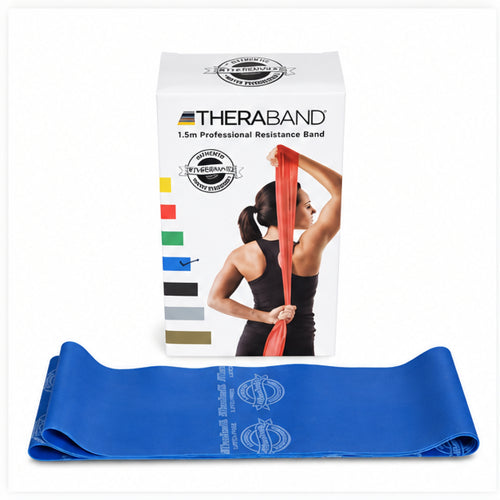
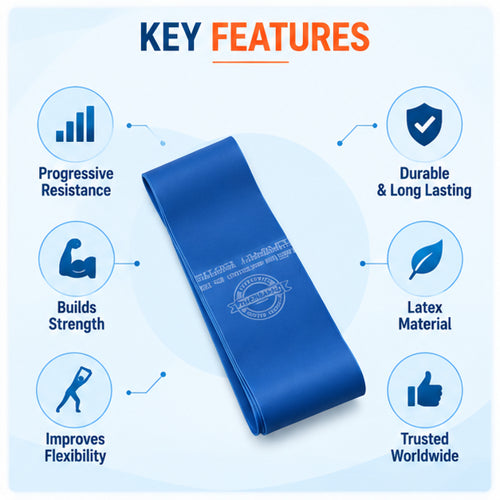
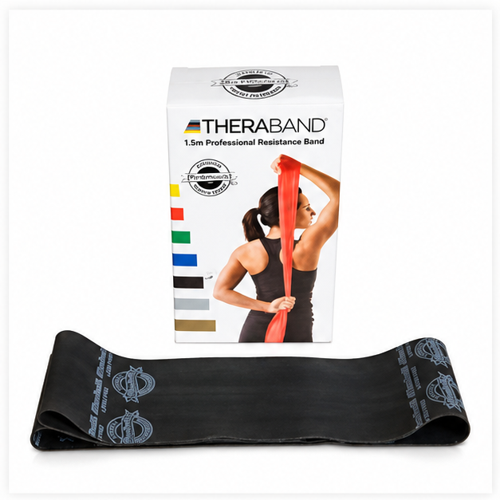
Flat theraband resistance bands are long, flat strips. They are the classic option many people think of when they hear the word theraband or exercise bands. They can be held in the hands, tied carefully if advised, or used with simple guided movements.


Theraband is popular for physiotherapy-style home exercises because it is light, foldable, and easy to cut or choose in useful lengths. Flat bands are often sold as single pieces, longer rolls, or sets with different colour levels. For home users, the most practical length is usually one that can be held comfortably in both hands with enough extra theraband to grip safely.
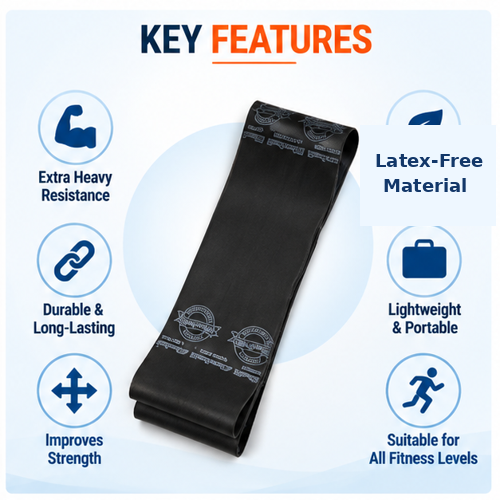
Flat bands may be latex or latex free. If anyone in your family has skin sensitivity or a known latex allergy, check the product description before buying. Theraband non latex resistance bands are made for people who want to avoid natural rubber latex while still using colour-coded resistance.
Band sets of 3 and 5
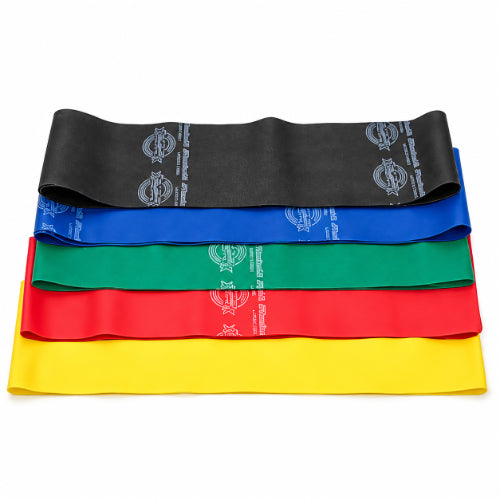
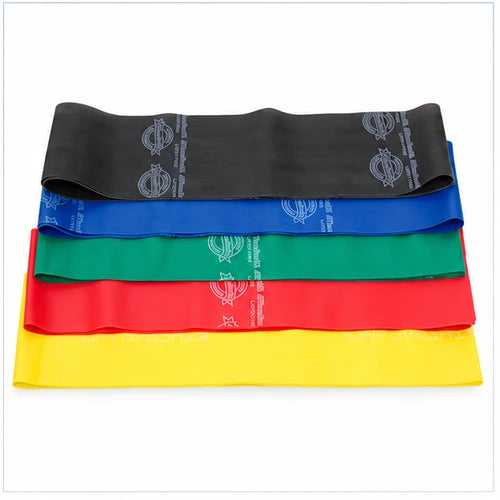
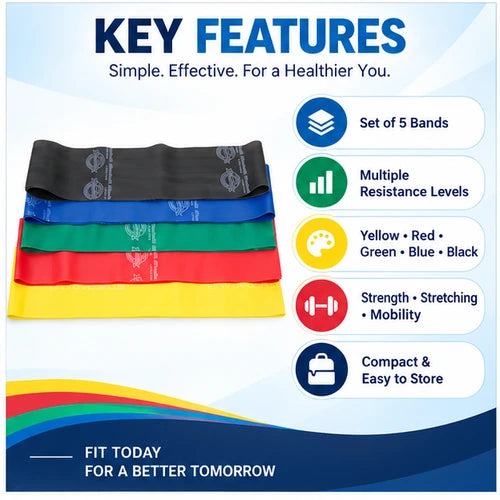
A theraband set is useful when more than one person at home may use it, or when a doctor or physiotherapist may advise moving from one resistance level to another over time. Most sets of 3 include a smaller range of light to medium options. A set of 5 usually gives a wider spread of levels.


For families, a set can be easier than buying one theraband and later realising it feels too light or too firm. For older adults, starting with a lower level may feel more comfortable, but the correct level should come from professional advice. Do not choose a theraband only because it looks strong or because another person in the family uses it.
Band sets also make storage easier when packed together. Keep each colour separate and clean. If the pack includes a pouch, use it to protect the theraband from dust, sunlight, and sharp objects.
Loop bands
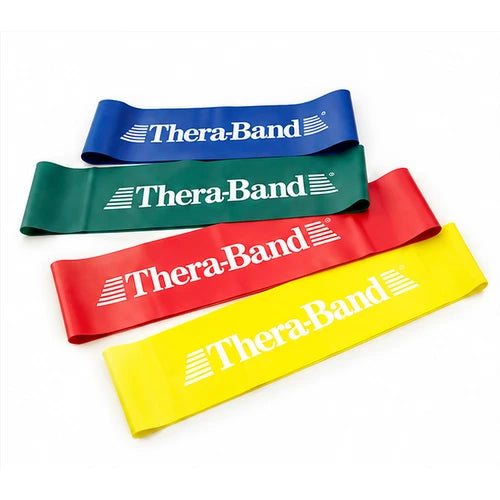
Theraband loops are closed circles. They are also called loop resistance bands. Unlike flat strips, they do not have loose ends. This makes them useful when a continuous loop shape is preferred.


Loop bands are often used around hands, arms, legs, or feet, depending on the guided movement. They come in different resistance levels, and the colour helps show whether the loop is light, medium, or heavier. A loop band should sit flat and should not twist sharply against the skin.
For home users, theraband loops are compact and easy to carry. They are also simple to store because they do not need tying. Still, they must be checked before every use because any crack, thinning, or sticky patch can make the theraband unsafe.
Resistance tubes and Theratube levels
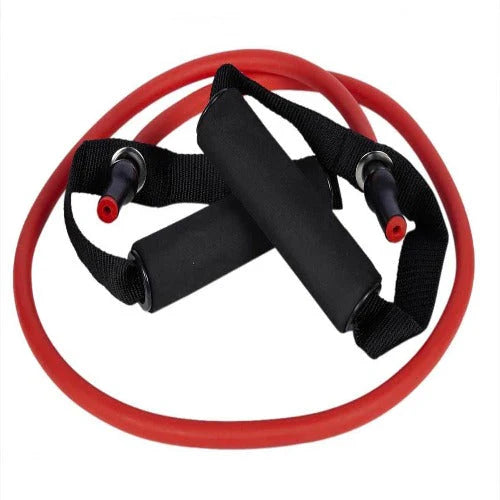
A resistance tube is round and tube-shaped, unlike a flat band. Some tubes come with handles, while some are plain tubing. A theratube can feel easier to grip when handles are included, especially for people who do not like wrapping a flat band around their hands.

Theratube options are commonly understood in light, medium, and heavy levels. These levels help users choose the general firmness of the theratube without needing exact resistance numbers. Light may be suitable when a gentle pull is advised, medium may be used when a firmer pull is suitable, and heavy should be chosen only when specifically advised.
Theratube needs careful anchoring. If you use a theratube with a door, hook, or fixed point, secure it properly. A slipping theratube can spring back. Always follow the safety instructions that come with the product and the advice given by your doctor or physiotherapist.
FlexBar
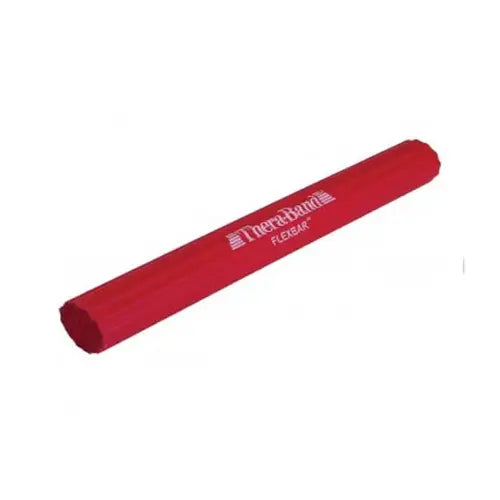
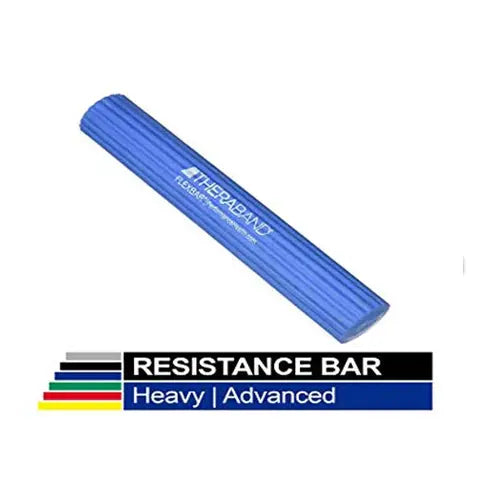
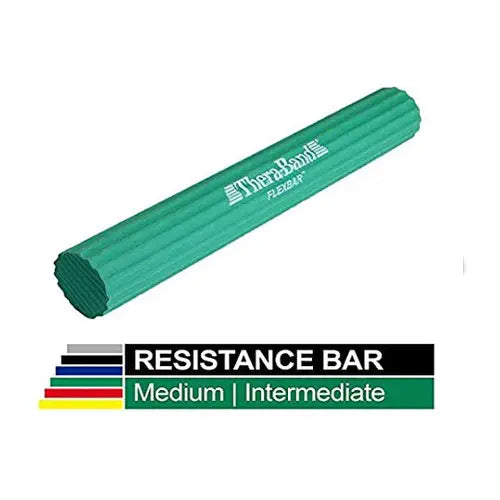
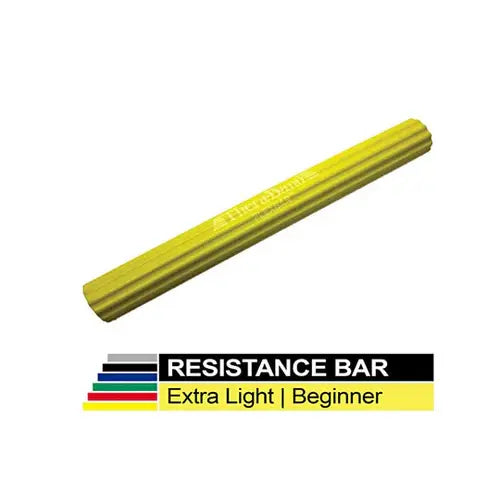
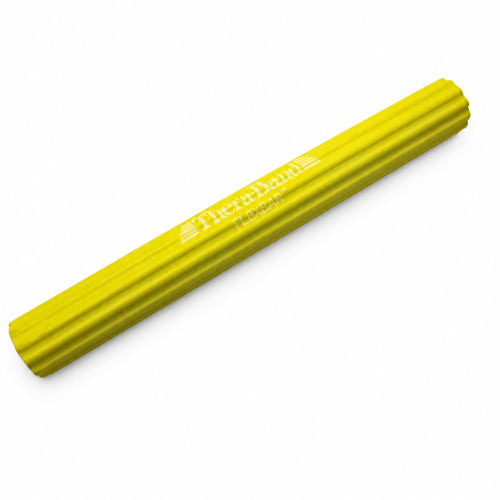
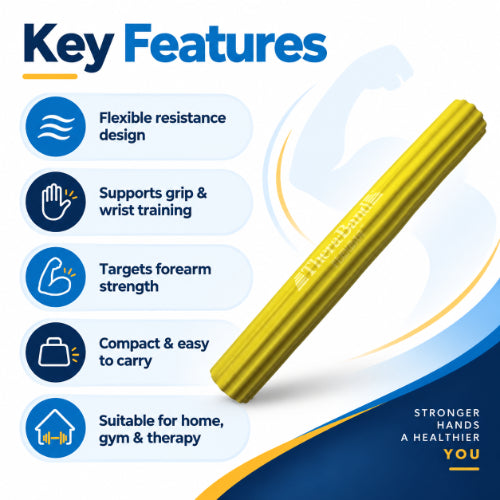
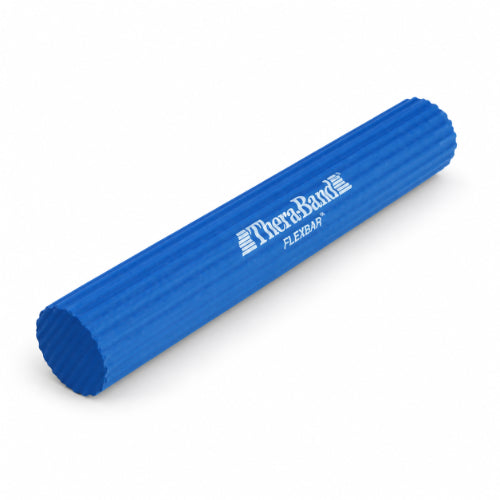
A FlexBar is not a band. The FlexBar is a flexible bar that can be bent or twisted by hand. It is often used for hand, wrist, forearm, or grip-related guided movements when advised by a professional.


At home, a FlexBar may be easier to understand than a long theraband because it has a fixed shape. The FlexBar does not need anchoring, and it does not have loose ends. But a FlexBar still has different resistance levels, so the correct level matters.
Choose a FlexBar only after checking the advised resistance level. Do not assume that a firmer FlexBar is better. For older adults or people recovering after injury or surgery, the wrong level may feel uncomfortable.
Ankle weights and balance board
Ankle weights and a balance board are different from theraband, but some home users consider them for guided movement plans. Ankle weights are worn around the ankle and should be used only if advised, especially by older adults or people with joint concerns. A balance board can be used for balance-style activity, but it needs a safe floor area and support nearby.


These products need extra care at home. Use them only when you understand how they fit into your personal plan. If you feel unsure, ask your doctor or physiotherapist before starting.
What do the different colors of theraband mean?
The different colours of theraband resistance bands show different resistance levels, moving from lighter to heavier resistance. Colour coding helps you identify the level quickly, but the right colour depends on your body, comfort, and professional advice. Official theraband information explains that theraband is colour-coded to identify resistance levels, with lighter colours used for lower resistance and darker or higher-level colours used for more resistance.

Colour levels are helpful because two theraband products may look similar in size but feel very different when stretched. A lighter colour usually gives a gentler pull. A heavier colour gives a firmer pull. This does not mean everyone should move to heavier colours.

For home users in India, colour levels also reduce confusion when several family members use theraband. For example, an older parent may have one advised colour, while another person may use a different colour. Keep theraband labelled or stored separately so you do not mix it up.
Here is a simple way to think about theraband levels:
| Colour level idea | What it usually means | Home buying note |
|---|---|---|
| Very light to light | Gentler pull | Often chosen when a low level is advised |
| Light to medium | Moderate pull | Common in small resistance band set packs |
| Medium to firm | Stronger pull | Use only if it feels controlled and is advised |
| Heavy levels | Much firmer pull | Not for everyone; avoid guessing |
Do not rely on colour alone if the product is old. A worn theraband may feel different from a new one. If the theraband has cracks, powdery patches, thinning, or sticky areas, replace it rather than trying to continue.
What is the difference between theraband and resistance band?
A resistance band is the general product category, while theraband is a product name used for specific resistance bands, tubes, loops, and related tools. So, all theraband resistance bands are resistance bands, but the word “resistance band” can also describe the wider type of elastic exercise band. For buying, the main thing is to check the product type, material, colour level, length, and whether it suits the advice you have received.


This difference matters because many people search for theraband when they simply mean any exercise band. Others search for resistance bands but want colour-coded theraband products. If you are buying for home physiotherapy-style use, read the product name carefully.
Theraband products may include flat bands, latex free resistance band options, loop bands, theratube, and FlexBar. A general search for home fitness bands may show many shapes, but not every shape will suit your need. Choose based on the movement you have been asked to do, not only based on the product photo.
Latex and latex-free materials
Material is one of the most important buying checks. Latex is a natural rubber material that stretches well. Many traditional theraband and theratube products contain latex.

Latex free resistance band options use no natural rubber latex. These can be useful for people who have a latex allergy, skin irritation, or a family member at home who is sensitive to latex. Official theraband information states that non-latex resistance bands are not made with natural rubber latex and are designed to offer similar stretch to latex bands.
If you are buying for an older adult, a child under supervision, or a person with sensitive skin, check the material before opening the pack. If there is any itching, rash, breathing discomfort, or unusual reaction, stop using the product and seek medical advice. Do not use a latex product if you already know you have a latex allergy.
Material also affects storage. Theraband can wear out faster if kept in heat, moisture, or direct sunlight. In many Indian homes, cupboards near windows, balconies, or kitchens can become warm. Store theraband in a cool, dry place, away from oil, sharp items, and dust.
Choosing the right shape for home use
The right shape depends on how the theraband will be held, where it will be used, and what your doctor or physiotherapist has advised. A person doing simple hand-held movements may prefer a flat band. Someone who needs a closed circle shape may prefer loop bands. A person who wants a handle may find a theratube easier to manage.

Flat bands for simple holding and tying
Flat bands are flexible and easy to fold. They can be held with both hands and adjusted by changing where you grip, but this should be done carefully. Do not wrap the theraband so tightly around the hand that it affects comfort or circulation.

Typical flat bands are sold as strips, rolls, or pre-cut lengths. For home use, check whether the length is enough for the movement you have been advised. If the theraband is too short, it may feel too tight too soon. If it is too long, it may be hard to control in a small room.
Flat bands are also easy to carry while travelling. If you visit family, go to work, or travel within India, you can keep one in a pouch. Keep it away from keys, scissors, pens, and sharp-edged items in your bag.
Loop bands for closed-circle movements
Theraband loops are useful when a continuous circle is needed. Since there are no ends to hold, they may feel neat and compact. They are often sold in sets with different colour levels.

Check the loop size before buying. Some loops are short and are better for small-range movements. Some are longer and give more space. The right size depends on the user’s body size, comfort, and advised activity.
Do not overstretch a loop band beyond its comfortable range. If the loop rolls, pinches, or slips, stop and adjust. A slipping loop can be unsafe, especially on smooth clothing or polished floors.
Tubes for handle-based use
Theratube is round and may come with handles. Handles can make gripping easier for some users because the hand does not have to hold a flat strip. Theratube light, medium, and heavy levels give a simple way to choose the broad resistance level.

When buying theratube, check the handle quality if handles are included. The handle should feel secure and comfortable. Also check the connection point between the theratube and handle, because this area gets repeated stress during use.
If anchoring a theratube, use only a safe anchor method. Do not attach it to weak furniture, loose grills, or unstable objects. A theratube that comes loose can snap back quickly.
FlexBar for bar-style hand use
You hold the FlexBar directly in your hands. You do not stretch a FlexBar like a band. The FlexBar bends and twists, so the feel is different from flat bands and tubes.

A FlexBar may be considered when a professional has advised bar-style hand or wrist movements. For home users, the main buying check is the resistance level. A FlexBar that feels too firm may be difficult to control.
FlexBar storage is simple. Keep the FlexBar clean and away from extreme heat. Do not bend the FlexBar sharply beyond normal use, and do not use it as a toy.
What to know before buying theraband?
Before buying theraband, check the material, allergy risk, resistance level, length, shape, grip style, and storage needs. For home users, especially older adults and people following physiotherapy-style advice, comfort and safety matter more than choosing the firmest theraband. If you are buying for a medical reason, ask your doctor or physiotherapist which type and level to use.

Use this simple checklist before you buy:
- Material: Check whether the theraband is latex or latex free. Choose theraband non latex resistance bands if latex must be avoided.
- Allergy risk: If anyone at home has a latex allergy or skin sensitivity, do not ignore it.
- Resistance level: Use the colour level advised. Do not guess based on age, body size, or confidence.
- Length: Make sure the band, theratube, or loop is long enough for the advised movement.
- Shape: Choose flat bands, loop bands, theratube, or FlexBar based on how it will be used.
- Handles or loops: Handles may help some users. Loops may be better when a closed band is needed.
- Storage: Check if the product comes with a pouch or box. If not, keep a clean cloth pouch at home.
- Surface and space: Use theraband in an area with enough room and no sharp corners nearby.
- User comfort: The theraband should feel controlled. It should not cause fear, slipping, or sharp pain.
For Indian homes, also think about the weather. Heat and humidity can affect elastic products over time. Keep theraband away from direct sun, damp bathrooms, cooking oil, and balcony dust.

Safety rules every home user should follow
Theraband is simple, but it still needs care. A theraband can snap, slip, or hit the user if it is old or used wrongly. This is especially important when older adults use theraband at home.
Follow these safety points every time:
- Check the theraband before each use. Look for cracks, cuts, sticky areas, thinning, or colour changes.
- Anchor properly. If the movement needs an anchor, make sure it is stable and safe.
- Keep away from sharp edges. Avoid door corners, metal edges, rough tiles, jewellery, nails, and furniture corners.
- Stop if there is sharp pain. Mild effort and sharp pain are not the same. Stop and ask for advice.
- Do not overstretch. Stretch only within a controlled and advised range.
- Use adult supervision. Do not let children play with theraband or chew it.
- Consult first. Speak to a doctor or physiotherapist before starting, especially after injury, surgery, or if you have heart, blood pressure, or joint problems.

Also check the floor. Smooth tiles are common in Indian homes and can become slippery. Stand or sit in a safe position, and keep the area clear of water, rugs that move, and small objects.
Buying for older adults at home
When buying for an older adult, keep the choice simple. A lower resistance level, comfortable grip, and clear instructions are more useful than a large pack that creates confusion. If the product is part of a physiotherapy-style plan, follow the exact advice given.

Older adults may prefer a theraband that is easy to see and easy to hold. Bright colours can help identify the correct theraband. A theratube with handles may help some users, while others may prefer a flat band because it can be held at different points.
Storage should be easy too. Keep the theraband in one fixed place, such as a drawer near the usual exercise area. Do not leave it on the floor, where someone may slip or trip.
Family members can help by checking the theraband for cracks before use. They can also help read the label and confirm the colour level. But they should not create their own exercise plan unless qualified to do so.
Buying for families in India
A family may need more than one theraband because different people may have different needs. If only a few levels are needed, a band set of 3 can be enough. A band set of 5 gives more colour choices, but it should still be used with care.


If several family members use the same pack, label the theraband. You can keep them in separate pouches or write names on the storage cover. This avoids mixing up colour levels.
For small apartments, choose products that store neatly. Flat bands and loop bands need very little space. Theratube with handles needs slightly more careful storage because handles and connection points should not be crushed.
Avoid keeping theraband where pets can bite it or children can pull it. Theraband is not a toy. If a theraband has tooth marks, cuts, or deep scratches, do not use it.
Simple comparison of product types
This quick comparison can help you choose the broad category before checking the exact colour or level.


| Product type | Shape | Common home use style | What to check |
|---|---|---|---|
| Flat resistance bands | Long flat strip | Hand-held or guided stretching movements | Material, colour level, length, grip comfort |
| Band sets of 3 | Multiple flat bands or loops | Small range of levels for one or more users | Included colours, storage pouch, allergy details |
| Band sets of 5 | Wider level range | Families or users who need more colour choices | Clear labels, material, safe storage |
| Loop bands | Closed circle | Movements where a loop shape is needed | Loop size, rolling, slipping, colour level |
| Resistance tube | Round tube, sometimes with handles | Handle-based pulling movements | Handle quality, anchor safety, tube level |
| Theratube light, medium, heavy | Tube levels | Broad choice of tube firmness | Choose only the advised level |
| FlexBar | Flexible bar | Bar-style hand or wrist movements | Correct firmness, grip comfort |
| Ankle weights | Worn around ankle | Only when advised | Fit, comfort, safe movement area |
| Balance board | Board for balance activity | Only when advised and supervised if needed | Floor grip, support nearby, user confidence |
This table is only a buying guide. It is not a personal exercise plan. If you are unsure, ask your doctor or physiotherapist what type and level is suitable.
Common mistakes to avoid
Many people buy theraband too quickly. They see a colour they like, a set that looks complete, or a theratube that looks strong. But the right choice is not about looks.

Avoid these common mistakes:
- Buying only by colour preference. Colour shows resistance level. It is not a style choice.
- Choosing the heaviest level first. A firmer theraband is not automatically the right choice.
- Ignoring latex allergy. Always check latex or latex-free material details.
- Using a damaged theraband. Small cracks can become bigger during use.
- Anchoring to weak furniture. A poor anchor can slip and cause injury.
- Leaving theraband in sunlight. Heat and sun can reduce theraband life.
- Sharing without checking the level. One person’s advised theraband may not suit another person.
- Using theraband during sharp pain. Stop and get advice.
These mistakes are easy to avoid with a little care. Read the product label. Store the theraband well. Replace them when they show signs of wear.
How to store and care for theraband
Good storage helps your theraband stay cleaner and safer. After use, wipe the theraband gently if it has sweat or dust on it. Let it dry before storing it.
Keep theraband in a cool, dry place. A cloth pouch, drawer, or storage box works well. Do not keep them under heavy items, near sharp tools, or in direct sunlight.
Do not fold theraband sharply for long periods. A soft roll or loose fold is better. For theratube, avoid crushing the handles or bending the tube tightly at one point.
If the theraband becomes sticky, brittle, cracked, or uneven, stop using it. Do not try to repair a damaged theraband with tape or glue. Replacement is safer.
FAQ
What are theraband resistance bands used for?
Theraband resistance bands are used for guided home movements, stretching support, and physiotherapy-style exercises when advised by a doctor or physiotherapist. They are compact and easy to use in small home spaces.

What do the different colors of theraband mean?
The colours show resistance levels from light to heavy. Choose the colour advised for you, and do not move to a heavier level unless your doctor or physiotherapist says it is suitable.
What is the difference between theraband and resistance band?
A resistance band is the general name for an elastic exercise band. Theraband is a product name used for specific bands, tubes, loops, and tools in this category.
What to know before buying theraband?
Check material, latex allergy risk, resistance level, length, handles, loops, and storage needs. Also check whether you need a flat band, loop band, theratube, or FlexBar.

What are the downsides of using theraband?
Theraband can snap or slip if it is worn out, cracked, badly anchored, or used near sharp edges. There is also a risk of latex allergy, resistance is not easy to measure exactly, and theraband is not suitable for heavy strength work.
Are latex free resistance bands useful for sensitive skin?
Latex free resistance band options may be useful for people who need to avoid natural rubber latex. If you have skin irritation or a known allergy, ask a doctor before using any new material.
Are loop bands and flat bands the same?
No. Loop bands are closed circles, while flat bands are open strips. The right choice depends on the movement advised and what feels safe to hold or place.


Can older adults use home fitness bands?
Older adults may use home fitness bands only when the type and level are suitable for them. It is safer to consult a doctor or physiotherapist first, especially after injury, surgery, or with heart, blood pressure, or joint problems.
Final takeaway
Theraband resistance bands, loop bands, resistance tubes, Theratube levels, FlexBar, ankle weights, and a balance board can all have a place in home movement plans when chosen carefully. For families and older adults in India, the most important buying points are simple: choose the right material, check latex allergy risk, follow colour levels, confirm length and grip, and store everything safely.


Do not guess your level and do not use damaged theraband. Check theraband for cracks before each use, anchor it properly, keep it away from sharp edges, and stop if there is sharp pain. If you are starting after injury, surgery, or with heart, blood pressure, or joint concerns, speak to your doctor or physiotherapist before you begin.
Explore more theraband and exercise collections
TheratubesFlexbarTheraloopAnkle weightsExercise machines
Explore Medical Collections
All Categories
Abdominal & Maternity Support

Accessories

Accu-Chek Instant Strips: Use, Compatibility, Price & Blood Sugar Testing Guide
Accu-Chek Instant Strips: Uses, Features & Complete Guide

accupuncture

Acupuncture Needles & Supplies

Advanced Physiotherapy Machines & Lumbar Physiotherapy

Airways

Ambulance

Anatomy Models
Anesthesia Machine

Anesthesia Products
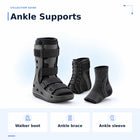
Ankle Support for Home Use: Braces, Sleeves & Walker Boots
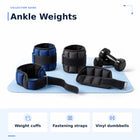
Ankle Weights & Exercise Weights for Home & Rehab

Anti-Bedsore Air Mattresses
You may also need
FOR YOURecommended for you
Save 6%
Save 16%
Save 6%
Save 33%
Save 15%
Save 11%
Save 21%
Save 17%
Save 5%