
1
Ultrasonic Semi Digital


Double-tap to zoom · drag to pan · swipe to browse
Ultrasonic Semi Digital
In Stock
Check delivery
See if we deliver to you and when.
Delivering to
Delivery applicable
Free Shipping
on orders ₹999+
100% Genuine
Products
Dedicated
Support
Secure
Payments
Need help choosing or using this product?
Our team can help with product questions and orders.
Chat with support
Choose options
Semi-Digital Ultrasonic Therapy Unit for Physiotherapy Clinics The Ultrasonic Semi Digital unit from Medansh.com is a therapeutic ultrasound machine built for physiotherapy and rehabilitation settings that need dependable, everyday performance without unnecessary complexity. It...
Check delivery
See if we deliver to you and when.
Delivering to
Delivery applicable
Semi-Digital Ultrasonic Therapy Unit for Physiotherapy Clinics The Ultrasonic Semi Digital unit from Medansh.com is a therapeutic ultrasound machine built for physiotherapy and rehabilitation settings that need dependable, everyday performance without unnecessary complexity. It...
Check delivery
See if we deliver to you and when.
Delivering to
Delivery applicable
About this product
Semi-Digital Ultrasonic Therapy Unit for Physiotherapy Clinics
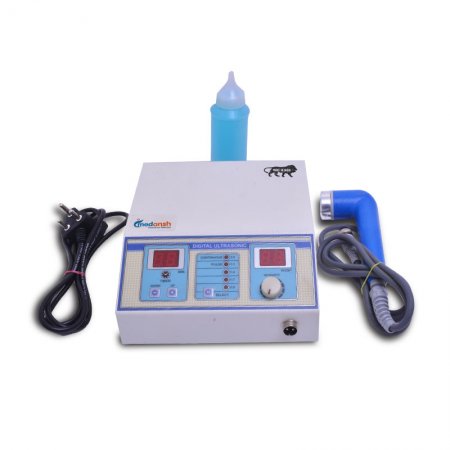
The Ultrasonic Semi Digital unit from Medansh.com is a therapeutic ultrasound machine built for physiotherapy and rehabilitation settings that need dependable, everyday performance without unnecessary complexity. It generates ultrasonic energy at a fixed frequency of 1 MHz, delivered in either continuous or pulsed mode, and channels that energy through a lightweight applicator head so a therapist can work directly over the treatment area. The unit's digital display keeps power intensity visible throughout the session, which makes it easier to stay consistent from one patient to the next and from one day to the next.
How Therapeutic Ultrasound Works
Therapeutic ultrasound is one of the most widely used electrophysical modalities in physiotherapy practice. High-frequency sound waves, well above the range of human hearing, are transmitted into soft tissue through a coupling medium such as gel. As the sound waves travel through muscle, tendon, and connective tissue, they produce three broad categories of effect that clinicians rely on: thermal, mechanical, and chemical.
The thermal effect comes from tissue absorbing acoustic energy, which gently raises local temperature in deeper structures that are harder to warm using surface heat alone. This is typically associated with continuous-mode operation, where the energy output is steady rather than interrupted. The mechanical effect, often referred to as micro-massage or cavitation, is produced by the rapid compression and rarefaction of tissue as the sound wave passes through it — this is thought to assist with tissue mobility and fluid movement at a cellular level. Pulsed mode reduces the average thermal load while retaining much of this mechanical action, which is why therapists often select pulsed settings for more acute or sensitive presentations and continuous mode for chronic, well-tolerated cases. The chemical effects relate to changes in cell membrane permeability and metabolic activity that are believed to support the tissue's own healing processes. Together, these effects are the reason ultrasound therapy is commonly used to support recovery and help manage discomfort in soft tissue conditions as part of a broader physiotherapy plan.
Built for Daily Clinical Use
This unit is designed around practicality. Its ABS shockproof body is meant to hold up to the kind of daily handling a busy clinic involves — being moved between treatment rooms, packed away at the end of a shift, or used across multiple therapists in a single day. The compact, light-weight construction means it does not demand a dedicated corner of the clinic; it can sit on a trolley or countertop and be brought to the patient rather than the other way around.
The applicator itself is also light in the hand. Ultrasound treatment typically involves the therapist moving the head in slow, overlapping circular or longitudinal strokes across the treatment area for the duration of the session, so a lighter applicator reduces fatigue during longer clinic days or when multiple patients are treated back-to-back.
Digital Display and Treatment Timer
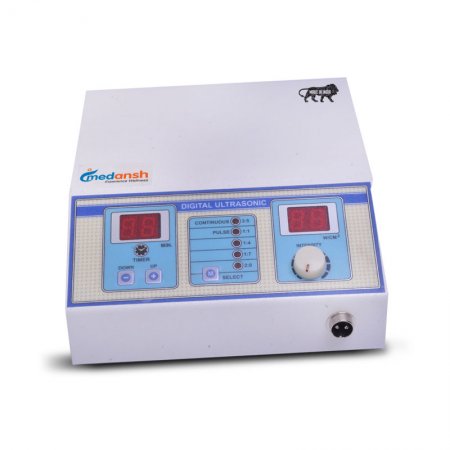
Because this is a semi-digital model, it blends microprocessor-based control with a straightforward digital display for power intensity. The therapist can see the exact output level being delivered at any point in the session rather than relying on an analogue dial alone, which supports better session-to-session consistency for a given patient's treatment protocol. The built-in digital treatment timer covers a 0–99 minute range, which is more than sufficient for the typical 3–10 minute ultrasound applications used in most soft tissue protocols, while still leaving room for longer or combined-therapy sessions where ultrasound is one part of a broader treatment sequence.
The mode selection allows switching between continuous and pulsed operation, with selectable pulse duration ratios of 1:1, 1:4, 1:7, and 1:10. In practical terms, a 1:1 ratio delivers energy for equal periods of on-time and off-time, while a 1:10 ratio delivers much shorter bursts of energy relative to the rest period — giving the therapist a way to dial down the average intensity for more sensitive tissue or earlier-stage rehabilitation, without changing the peak output setting.
Who This Machine Is For
The Ultrasonic Semi Digital unit suits independent physiotherapy clinics, multi-therapist rehabilitation centres, sports injury clinics, and hospital physiotherapy departments that need a dedicated, reliable ultrasound unit for daily soft tissue work. Because it runs on standard 220V AC, 50Hz power, it is straightforward to install into an existing treatment room without any special electrical provisioning.
It is intended for use by trained physiotherapists and clinical staff who understand appropriate dosage, application technique, and patient selection for ultrasound therapy — as with any electrophysical modality, treatment parameters should be set according to the clinician's assessment of the individual patient and condition being treated.
Frequently Asked Questions
What is the difference between continuous and pulsed mode on this unit?
Continuous mode delivers a steady, uninterrupted output and is generally associated with a stronger thermal effect. Pulsed mode delivers energy in on/off cycles — selectable here at 1:1, 1:4, 1:7, or 1:10 — which reduces the average heating effect while retaining the mechanical action of the ultrasound wave.
What frequency does this unit operate at?
It operates at a fixed frequency of 1 MHz with a power density of 3.5 Watt/cm², which is a standard specification for ultrasound units used for soft tissue treatment depths common in physiotherapy practice.
How long can a session be timed for?
The digital treatment timer covers a 0 to 99 minute range, giving the therapist full control over session length according to the treatment protocol being followed.
Is this unit suitable for a busy multi-therapist clinic?
Yes. Its compact size, light-weight ABS shockproof body, and light applicator are all suited to a unit that gets moved between rooms and used across a full clinic day.
What power supply does it need?
The unit runs on a standard 220V AC, 50Hz supply, which matches typical electrical infrastructure in Indian clinics and hospitals.
You may also need
FOR YOURecommended for you
Save 55%

Save 39%

Save 8%

Save 37%

Sold out

Save 18%

Save 20%
Save 33%