
1


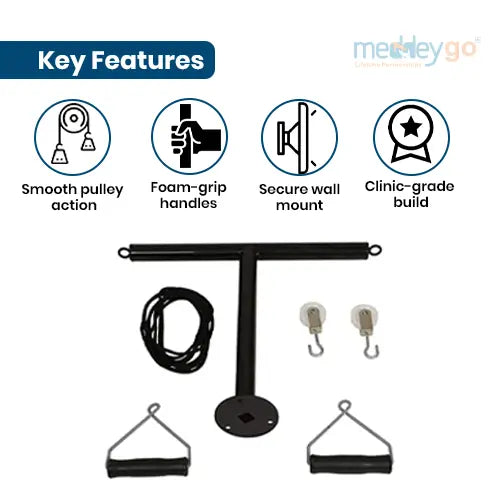

Shoulder T Pulley


Double-tap to zoom · drag to pan · swipe to browse
Shoulder T Pulley
In Stock
Check delivery
See if we deliver to you and when.
Delivering to
Delivery applicable
Free Shipping
on orders ₹999+
100% Genuine
Products
Dedicated
Support
Secure
Payments
Need help choosing or using this product?
Our team can help with product questions and orders.
Chat with support
Choose options

- Commonly used for the treatment of frozen shoulder and adhesive capsulitis
- Simple rope-and-pulley mechanism hooks over the top of any standard door
- Suited to elderly patients as a shoulder and elbow joint exerciser
- Helps stretch the shoulder in various directions to work on mobility
Check delivery
See if we deliver to you and when.
Delivering to
Delivery applicable
- Commonly used for the treatment of frozen shoulder and adhesive capsulitis
- Simple rope-and-pulley mechanism hooks over the top of any standard door
- Suited to elderly patients as a shoulder and elbow joint exerciser
- Helps stretch the shoulder in various directions to work on mobility
Check delivery
See if we deliver to you and when.
Delivering to
Delivery applicable
About this product
A Simple Door-Mounted Tool for Restoring Shoulder Movement
The Shoulder T Pulley is a rehabilitation exerciser built around one of the simplest and most widely used mechanisms in physiotherapy: a rope and pulley hooked over a door, with a handle on each end so one arm can assist the other through a range of motion the affected shoulder cannot yet complete on its own. It is manufactured using high-grade raw material and is tested on various parameters by quality analysts before it reaches a clinic or home, so the pulley action stays smooth and the frame holds up to repeated daily use.
How the Pulley Mechanism Helps the Shoulder
The T Pulley works on an assisted range-of-motion principle. The device is hooked over the top of a door, with a small pulley system near the top and a rope with handles hanging down on either side. By pulling down on the handle on the unaffected side, the patient uses the strength of the good arm to lift the affected arm through an overhead or outward arc — movement the injured or stiff shoulder could not manage using its own muscles alone. Because the assisting arm controls the speed and range, the exercise can be scaled back the moment discomfort appears, which makes it a relatively gentle way to work on mobility compared to exercises that rely on the affected shoulder's own strength from the start.
Who This Exercise Tool Is For
The Shoulder T Pulley is commonly used for the treatment of frozen shoulder (adhesive capsulitis), where the joint capsule tightens and normal movement becomes painful and restricted. It also sees regular use as a shoulder and elbow joint exerciser for elderly patients, whose shoulders may have lost range of motion through general stiffness, arthritis, or long periods of reduced activity, rather than a specific injury. Physiotherapists frequently include pulley work in post-surgical shoulder rehabilitation programmes, where restoring a safe, assisted range of motion is an early milestone before the patient progresses to active, unassisted exercises.
What Regular Pulley Exercise Aims to Achieve
Used consistently, pulley exercises can help stretch the shoulder in multiple directions — forward flexion, abduction out to the side, and other planes depending on how the patient stands relative to the door — with the general goal of improving mobility and, over time, the shoulder's overall function. Because the exercise is self-directed and assisted rather than passive, it also gives the patient a sense of control over their own rehabilitation pace, which many therapists consider valuable alongside the physical benefit of the stretch itself.
Setting Up and Using the Pulley
The unit hooks over the top of a standard door, so it can be set up in a clinic treatment room or at home without needing a dedicated piece of furniture or wall fixture. Once mounted, the patient stands facing or with their side to the door, holds one handle in each hand, and alternates pulling down on one side to raise the arm on the other. Sessions are typically short and repeated several times a day rather than long single sessions, which fits with how gradual, frequent stretching tends to be more comfortable for a stiff or recovering shoulder than infrequent, forceful stretching.
Key Benefits
- Commonly used for the treatment of frozen shoulder and adhesive capsulitis
- Simple rope-and-pulley mechanism hooks over the top of any standard door
- Suited to elderly patients as a shoulder and elbow joint exerciser
- Helps stretch the shoulder in various directions to work on mobility
- Assisted movement lets the patient control range and pace using the stronger arm
- Manufactured from high-grade material and quality-tested before dispatch
Frequently Asked Questions
Do I need a therapist present to use a shoulder pulley?
Many patients use a shoulder pulley independently at home once a physiotherapist has shown them the correct setup and movement pattern, since the assisted nature of the exercise makes it relatively straightforward to self-manage. That said, if pain is severe, new, or worsening, it is best to have a physiotherapist review your shoulder and confirm the exercise is appropriate before continuing on your own.
How is this different from actively lifting the arm without a pulley?
The key difference is that the unaffected arm does the work of pulling the rope, which lifts the affected arm through the pulley rather than relying on the affected shoulder's own muscles. This assisted approach allows a stiff or painful shoulder to move through a fuller range than it could manage unassisted, which is why pulleys are commonly introduced early in a rehabilitation programme.
Can this be used for conditions other than frozen shoulder?
Yes. Beyond frozen shoulder, it is also used generally as a shoulder and elbow joint exerciser, including for elderly patients working on age-related stiffness, and as part of broader post-surgical shoulder rehabilitation to help regain range of motion in a controlled, assisted way.
You may also need
FOR YOURecommended for you
Save 55%

Save 39%

Save 8%


Save 37%

Save 22%
Save 18%

Save 22%