Sale price
Rs. 119,499
Regular price
Rs. 151,800
21% OFF
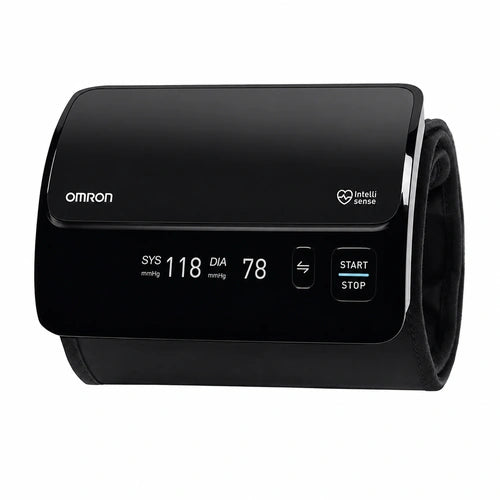
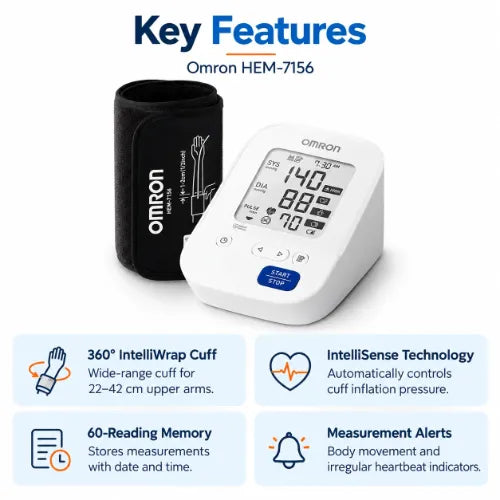
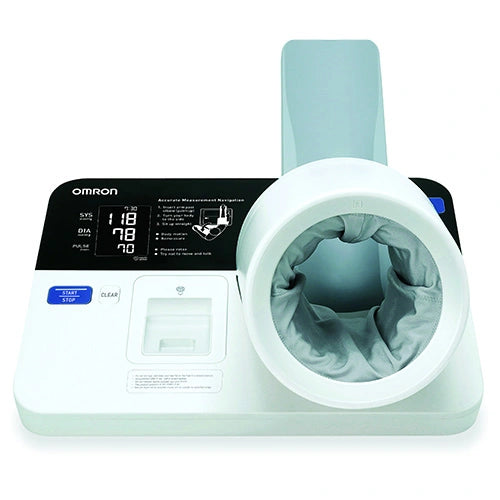
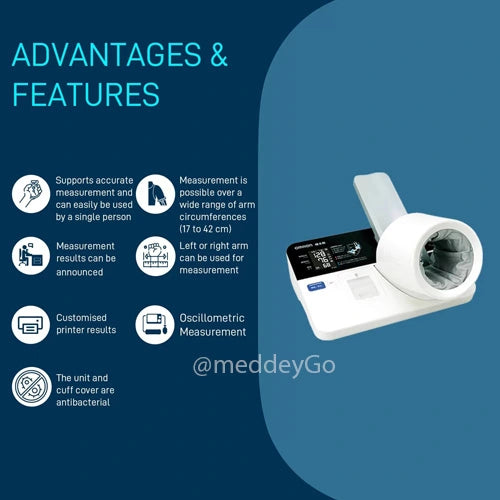
Professional self-measurement design: Suitable for self-check measurement stations...
Elbow detection sensor: Helps guide the user's arm towards the correct measurement...
Movable cuff: The cuff angle can adjust to support a comfortable sitting and arm p...
About this collection
Blood Pressure Monitors: Types, Accuracy, Price & Professional Buying Guide
Learn how blood pressure monitors work, what makes a BP machine reliable, how to choose the right cuff, and how to measure blood pressure correctly at home or in clinical settings.
What Is a Blood Pressure Monitor?
A blood pressure monitor is a medical device that measures arterial blood pressure. Usually, the result contains two values: systolic blood pressure and diastolic blood pressure. The reading is reported in millimetres of mercury, written as mmHg.
In everyday use, people may call the device a BP machine, blood pressure machine, or BP check machine. Healthcare professionals may also use the term blood pressure monitoring machine. Although these terms are common, the device category can vary by setting.
For example, an automatic upper-arm monitor is common for home monitoring. In contrast, a manual aneroid sphygmomanometer requires a cuff, pressure gauge, stethoscope, and trained technique. Meanwhile, an ambulatory blood pressure monitor records readings during normal daily activities.
Accurate measurement depends on more than the electronic unit. In practice, the exact device model, validation status, cuff size, patient position, rest period, and measurement technique all matter.
Clinical point: A good BP result comes from a validated device, the correct cuff, and a standardized measurement method. Therefore, buyers should evaluate the complete measurement system rather than the monitor alone.
Types of Blood Pressure Monitors
Blood pressure monitoring equipment is available in several formats. Each type serves a different purpose. Therefore, the intended use should guide the purchase.
Automatic Upper-Arm BP Machine
This monitor inflates the cuff and calculates the blood pressure automatically. It is the standard choice for many home users. The American Heart Association recommends an automatic upper-arm cuff-style monitor for home monitoring.
Manual Aneroid Monitor
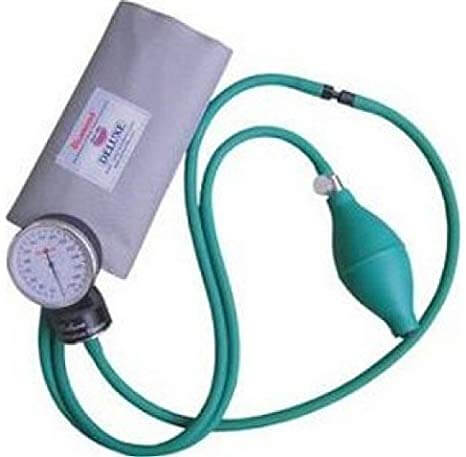
This system uses an inflatable cuff and a mechanical gauge. A trained person listens for Korotkoff sounds with a stethoscope. Consequently, technique and training are important.
Ambulatory BP Monitor
An ABPM device records blood pressure at programmed intervals over an extended period, often including daytime and nighttime measurements. It can provide information that a single office reading cannot.
Wrist BP Monitor
Wrist devices can be convenient, yet positioning is more sensitive. For routine home monitoring, upper-arm devices are generally preferred when an appropriate cuff can be used.
Importantly, device type does not by itself establish accuracy. Instead, look at validation evidence for the exact model. Also, check whether the device is validated for the intended population and cuff configuration.
What Makes a BP Machine Accurate?
People often ask, “Which BP monitor is most accurate?” There is no universal answer for every patient. Accuracy should be assessed at the exact model level, with attention to independent clinical validation and the population for which the device was tested.
STRIDE BP maintains lists of blood pressure devices that have passed its review process. Its current criteria use recognized validation protocols, including the AAMI/ESH/ISO Universal Standard. For home monitors, its preferred-device criteria also consider automated storage or data-transfer capability.
Furthermore, the 2025 AHA/ACC guideline recommends validated out-of-office BP devices and an appropriately sized cuff when using home or ambulatory monitoring. Thus, validation should be one of the first checks when comparing products.
Check the exact model number.
Look for independent validation evidence.
Measure the upper-arm circumference.
Select a compatible cuff size.
Follow the manufacturer's instructions.
Use a consistent measurement technique.
Why Cuff Size Matters
A cuff that is too small or too large can affect the reading. For that reason, users should measure the arm and compare the result with the cuff range stated by the manufacturer.
In addition, cuff placement matters. The cuff should sit on bare skin, with its middle positioned at heart level. A healthcare professional can check the fit and demonstrate correct placement.
Validation Is Not the Same as Brand Reputation
A familiar brand can offer useful products, but brand recognition alone does not validate every model. Instead, compare the exact model with a current independent validation list when possible. This approach is especially relevant for clinics and hospitals that purchase equipment for repeated clinical use.
How to Choose a Blood Pressure Monitor
Start by deciding where and how the monitor will be used. A patient monitoring BP at home has different needs from a hospital department that measures many patients each day.
Selection factor
What to check
Why it matters
Validation
Exact model and recognized validation evidence.
It provides evidence about measurement performance.
Cuff range
Supported upper-arm circumference.
Correct fit helps reduce measurement error.
Intended use
Home, clinic, hospital, or ABPM.
The workflow and device requirements can differ.
Memory
Number of stored readings and user profiles.
Stored data can support trend review.
Connectivity
Bluetooth, app, or data export if required.
Digital records can simplify follow-up.
Display
Screen size and readability.
Clear results can make routine use easier.
Replacement cuffs
Availability of compatible sizes.
A monitor remains useful only when suitable cuffs are available.
Warranty and service
Local support and service terms.
Support matters during long-term use.
Total cost
Device, cuffs, batteries, service, and accessories.
The purchase price is only one part of ownership cost.
Useful Features for Home Users
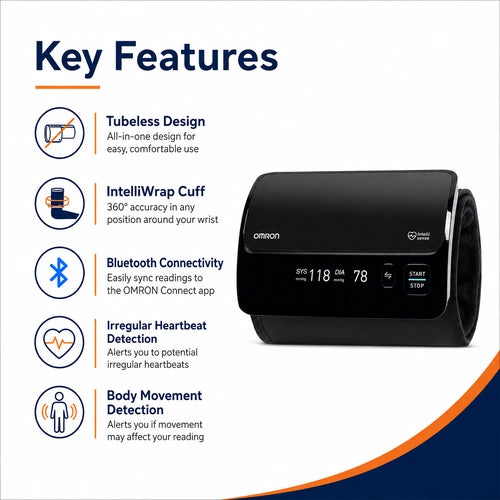
Memory storage can help users keep a record of repeated readings. Similarly, multiple-user profiles may help when one device is shared. Bluetooth can transfer readings to an app, although connectivity does not make a monitor more accurate.
Some devices also offer irregular-heartbeat notifications or averaging functions. These features can be useful, but they should not replace clinical interpretation. Therefore, choose features according to a real monitoring need.
Choosing a BP Machine for Medical Students
Medical students can benefit from understanding both manual and automated measurement. A manual device helps develop auscultatory measurement skills. Meanwhile, a validated automatic monitor demonstrates the workflow used in many home and clinical environments.
When learning, focus first on patient positioning, cuff selection, Korotkoff sounds, repeated readings, and documentation. Later, device-specific features become easier to understand.
How to Check BP Correctly at Home
Home blood pressure monitoring can provide repeated measurements outside the clinic. The 2025 AHA/ACC guideline describes home BP monitoring as a useful out-of-office approach for confirmation and management of hypertension. The American Heart Association also recommends home monitoring for people with high blood pressure.
However, home readings are useful only when the measurement process is consistent. Use the following routine unless a healthcare professional gives you a different protocol.
Prepare first. Avoid smoking, caffeine, and exercise for about 30 minutes before the reading.
Empty your bladder. A full bladder can affect a measurement.
Sit quietly. Rest for at least five minutes before measuring.
Use a supported chair. Keep your back supported and your feet flat on the floor.
Keep your legs uncrossed. Place both feet comfortably on the floor.
Expose the upper arm. Do not place the cuff over clothing.
Support the arm. Rest it on a flat surface so the cuff is approximately at heart level.
Stay still. Do not talk, use a phone, or move during the reading.
Take two readings. Wait about one minute between readings when following standard home-monitoring guidance.
Record the results. Note the readings, date, time, and any relevant clinical instructions.
Important: Home monitoring supports medical care. It does not replace clinical assessment. Also, do not stop or change prescribed BP medication because of a home reading unless your healthcare professional instructs you to do so.
What Is the Best Time of Day to Check BP?
There is no single clock time that is best for every patient. Instead, the useful approach is to follow a consistent schedule that matches the clinical purpose of monitoring.
Many home-monitoring protocols use morning and evening measurements. However, a clinician may recommend another schedule based on treatment, symptoms, work patterns, or a specific diagnostic question.
If morning measurements are requested, the clinician may ask the patient to measure before breakfast and before taking morning medication. The exact instruction should come from the treating professional because monitoring goals vary.
Most importantly, keep the measurement conditions similar each time. Consistency makes trends easier to interpret. In addition, recording readings over several days gives more information than relying on one isolated value.
Should You Check BP on the Right or Left Arm?
Either arm can be used for routine home monitoring. The American Heart Association notes that there is usually not a major difference between arms for many people.
Nevertheless, a healthcare professional may measure both arms when establishing a baseline or investigating a possible inter-arm difference. After that assessment, the clinician may recommend one arm for ongoing home measurements.
Whichever arm is used, apply the cuff correctly and support the arm at heart level. Then keep the same method for future readings unless your healthcare professional changes the plan.
Blood Pressure Monitoring Machines for Clinics and Hospitals
Clinical environments have different equipment requirements. A clinic may need a fast and easy-to-clean device. Meanwhile, a hospital may require multiple cuff sizes, durable construction, frequent measurements, and dependable service support.
Outpatient Clinics
Consider validated devices, readable displays, several cuff sizes, easy cleaning, and efficient repeated measurements.
Hospitals
Review durability, workflow, cuff availability, service arrangements, and suitability for the intended patient population.
Specialist Services
Where extended monitoring is required, consider an appropriate ABPM system and a workflow for reviewing the collected data.
Training Settings
Educational environments may benefit from manual devices for skill development and validated automated devices for modern monitoring practice.
For institutional procurement, price should be considered alongside validation, accessories, warranty, calibration or quality checks, replacement cuffs, and service support. As a result, the lowest purchase price is not always the same as the lowest long-term cost.
BP Machine Price: What Determines Cost?
BP machine price varies by device type, brand, validation evidence, cuff design, memory, connectivity, intended setting, warranty, and service support. Basic automatic home monitors usually have a different cost structure from professional monitors or ABPM systems.
Online prices can also change with promotions, stock, seller, model revisions, and included accessories. Therefore, a price shown on a website should be treated as a current listing rather than a permanent market price.
Device category
Typical use
Main cost considerations
Basic upper-arm monitor
Home BP monitoring
Validation, cuff range, display, memory, and warranty.
Connected monitor
Home monitoring with digital records
Connectivity, app support, memory, and data management.
Professional monitor
Clinic or hospital
Durability, workflow, cuff options, service, and accessories.
ABPM system
Extended out-of-office monitoring
Specialized hardware, software, accessories, and clinical workflow.
When comparing the price of a blood pressure machine, calculate the total ownership cost. Include the monitor, correct cuff, replacement cuff if needed, batteries or power accessories, warranty, service, and any required software.
Buying tip: A higher price does not automatically mean greater measurement accuracy. Therefore, check validation and cuff compatibility before paying for additional features.
Omron vs Dr. Morepen: How Should You Compare Them?
“Which is better, Omron or Dr. Morepen?” is best approached as a model-to-model comparison. A brand can have several BP machines, and those models may differ in validation, cuff range, memory, connectivity, and intended use.
First, identify the complete model number. Next, check current independent validation evidence. Then, confirm the cuff range and intended population. Finally, compare warranty, service, features, and current price.
Comparison point
What to check
Exact model
Record the complete model number rather than comparing brand names only.
Validation
Check current independent validation status for that model.
Cuff
Confirm the supported arm circumference and included cuff.
Memory
Review stored readings, averaging, and user profiles.
Connectivity
Decide whether Bluetooth or app features are actually needed.
Support
Check warranty, service, and replacement-cuff availability.
Price
Compare the complete package and current seller price.
Current STRIDE BP listings illustrate why model-level checking matters. For example, its database lists specific validated Omron models, while validation status is tied to the device model and intended use. Therefore, a general brand claim should not replace a model-specific validation check.
Blood Pressure Monitor Maintenance and Quality Checks
Good maintenance supports reliable long-term use. Keep the monitor and cuff clean according to the manufacturer's instructions. Also, protect the unit from moisture, impact, extreme temperatures, and unnecessary cable stress.
Inspect the cuff and tubing regularly. If the cuff becomes damaged or loses its shape, replace it with a compatible cuff. Likewise, check batteries or power accessories before important measurements.
For home users, bringing the monitor to a medical appointment can be useful. A healthcare professional can review the patient's technique and compare the home device with the equipment used in the clinical setting.
The American Heart Association recommends checking home equipment periodically according to manufacturer guidance and clinical advice. Consequently, routine verification can become part of long-term BP monitoring.
When Is a Very High BP Reading Urgent?
A very high reading should be handled carefully. If a reading is above 180/120 mmHg, repeat the measurement after at least one minute. If it remains very high, contact a healthcare professional promptly.
When very high blood pressure occurs with concerning symptoms, urgent medical attention is appropriate. Examples include chest pain, shortness of breath, weakness or numbness, vision changes, or difficulty speaking.
Do not rely on a home BP machine alone to determine the cause of a severe reading. Instead, follow the emergency or clinical instructions provided by your healthcare team.
Frequently Asked Questions About Blood Pressure Monitors
1. What is the best blood pressure monitor for home use?
An automatic, validated upper-arm monitor with a cuff that fits the user's arm is generally recommended for routine home monitoring. Check the exact model's validation status before buying.
2. What is the best time of day to check BP?
The schedule depends on the monitoring purpose. Many protocols use morning and evening readings. However, follow the schedule provided by the healthcare professional and keep the timing consistent.
3. Which BP monitor is most accurate?
No single monitor is universally the most accurate for every patient. Instead, check independent validation, correct cuff size, intended population, and measurement technique.
4. Which is better, Omron or Dr. Morepen?
Compare specific models rather than the brands as a whole. Check validation, cuff range, intended use, memory, service, warranty, and current price.
5. Is it better to check BP on the right or left arm?
Either arm can be used for routine monitoring. A clinician may check both arms first and then recommend one arm for ongoing measurements.
6. How do I choose a BP monitor?
Start with intended use. Then check independent validation, cuff range, display, memory, connectivity if needed, warranty, replacement cuffs, and service support.
7. Does Bluetooth make a BP machine more accurate?
No. Bluetooth helps transfer or organize readings. Accuracy depends on validation, cuff fit, device design, and correct measurement technique.
8. Can a BP machine diagnose hypertension by itself?
A monitor provides measurements, but diagnosis and treatment require clinical interpretation. Repeated home or ambulatory readings can support that assessment.
9. Can I take BP over clothing?
No. The cuff should be placed on bare skin. Clothing under the cuff can interfere with the measurement.
10. How many readings should I take at one time?
Standard home-monitoring guidance commonly uses two readings about one minute apart. Follow your clinician's protocol if it differs.
11. Can I use a wrist BP monitor instead of an upper-arm monitor?
Wrist monitors can be more sensitive to positioning. For routine home monitoring, the American Heart Association recommends an automatic upper-arm cuff-style monitor.
12. What should I look for in a BP machine for a clinic?
Consider validation, cuff sizes, durability, cleaning requirements, display readability, workflow, warranty, service, and replacement accessories. Also consider the patient populations served by the clinic.
Key Takeaways for Healthcare Professionals and Buyers
Choose a validated device for the intended use.
For routine home monitoring, prefer an automatic upper-arm cuff monitor.
Measure the arm and select the correct cuff size.
Standardize rest, posture, arm support, and measurement timing.
Take repeated readings when following a home-monitoring protocol.
Record readings so clinicians can review trends over time.
Compare exact models when reviewing brands such as Omron and Dr. Morepen.
For clinics and hospitals, evaluate validation, workflow, cuff availability, durability, and service.
Use ABPM when extended out-of-office monitoring is clinically indicated.
Remember that a BP machine supports assessment; it does not replace professional medical care.
Explore Blood Pressure Monitors on Meddey
Healthcare professionals, clinics, hospitals, and home users can explore blood pressure monitoring equipment on Meddey. Before purchasing, review the exact model, cuff size, specifications, availability, warranty, and current price.
This article provides general educational and equipment-selection information. It does not replace diagnosis, treatment, or professional medical advice. Device specifications, validation status, availability, and prices can change. Healthcare professionals should verify current manufacturer documentation and independent validation evidence before selecting equipment for clinical use.
Sale price
Rs. 1,379
Regular price
Rs. 1,840
25% OFF
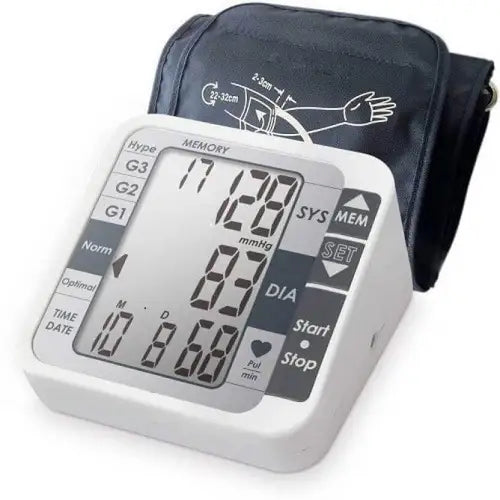
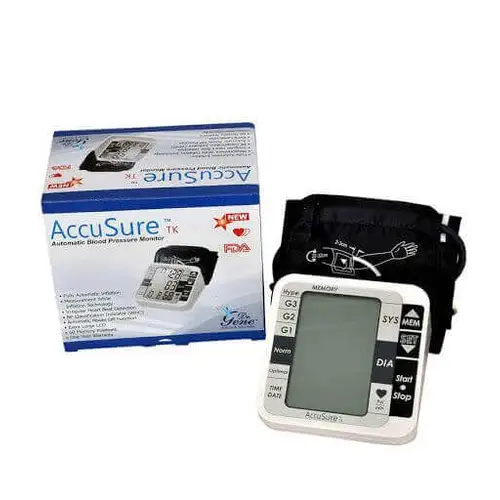
Fully Automatic Operation: Simple one-touch operation for convenient blood pressur...
MWI Technology: Measurement While Inflation technology for blood pressure measurem...
60-Reading Memory: Stores up to 60 readings with date and time for reviewing previ...
Trusted by 500k+ Customers
24x7 Customer Support
Free Shipping on Orders ₹999+
Pan-India Delivery
Meddey.com
How can we help?
Help and support
Order help
Choose what you need help with, select your order, and send the details to the store support team.
Where is my order and when will it arrive?
Open your order to see its latest fulfillment status and delivery estimate. Dispatch timing can vary by product and is shown on the product page or order confirmation. If tracking is missing, has stopped moving, or the promised date has passed, create an Order status complaint with your order number.
Can I change the delivery address after ordering?
Request the change immediately. The team can try to update an address only before dispatch; once dispatched, the courier address cannot normally be changed. Create an Order status complaint with the complete corrected address and pincode. The change applies only after support confirms it.
Payment was deducted but my order is not confirmed. What now?
Do not pay again until the first transaction is checked. Create a Payment issue complaint and include the checkout email or phone, payment reference or UTR, amount, date and time, and a screenshot or bank proof so the team can verify the payment and order records.
Can I return or replace my product?
Eligibility follows the return label and window on the product page. Eligible requests generally cover damaged, defective, wrong, materially different, incomplete, or short-shipped items. Customized items and opened or used hygiene, personal-care, or consumable products are generally not eligible.
I received a damaged, wrong, or incomplete item. What do I do?
Report damage on arrival, a wrong item, or a short shipment within 24 to 48 hours of delivery. Report a functional defect within 7 days unless the product page states another applicable window. Select the order and product, explain the issue, attach clear package and product photos or video, and keep all packaging.
What must I keep for a return or replacement?
Keep the invoice or order confirmation, original shipping and manufacturer packaging, MRP or price tags, manuals, warranty card, accessories, and every supplied part. Keep the item unused and unaltered. Do not self-ship it until support confirms the instructions and pickup availability for your pincode.
When and how will I receive my refund?
A refund starts after the returned item is received, inspected, and approved. Inspection may take up to 15 working days. Approved prepaid refunds are generally processed to the original source within 7-15 business days from approval, subject to bank time. COD refunds may require your own bank details or another approved method.
My product has a warranty issue. Who handles it?
Warranty coverage is product-specific, so check the product page, invoice, and warranty card. Keep the invoice, serial number, packaging, and card. Contact support before opening or repairing the device; the team may request evidence, arrange an assessment, or direct you to the manufacturer service centre.
How do I contact support or escalate an unresolved complaint?
Start from the same store where the order was placed and include the order number plus checkout email or phone. Meddey, Medansh, and MeddeyGo list cs@meddey.com and +91 8586 012345; published hours are Monday-Saturday, 10 AM-6 PM. The ordering store's current product page and policy remain the final terms.