
1
Motorized Gait Trainer Single Motor with Body Weight Support


Double-tap to zoom · drag to pan · swipe to browse
Motorized Gait Trainer Single Motor with Body Weight Support
In Stock
Size:Standard
Check delivery
See if we deliver to you and when.
Delivering to
Delivery applicable
Free Shipping
on orders ₹999+
Warranty
1 Year Brand Warranty
100% Genuine
Products
Dedicated
Support
Secure
Payments
Need help choosing or using this product?
Our team can help with product questions and orders.
Chat with support
Choose options
- Normal walker: mainly provides hand-held support during walking.
- Gait trainer: provides additional body support through a harness system.
- Motorized single-motor gait trainer: adds powered vertical lifting to assist positioning and body support.
- First, place the gait trainer on a dry, stable and suitable indoor floor.
Size:Standard
Check delivery
See if we deliver to you and when.
Delivering to
Delivery applicable
- Normal walker: mainly provides hand-held support during walking.
- Gait trainer: provides additional body support through a harness system.
- Motorized single-motor gait trainer: adds powered vertical lifting to assist positioning and body support.
- First, place the gait trainer on a dry, stable and suitable indoor floor.
Size:Standard
Check delivery
See if we deliver to you and when.
Delivering to
Delivery applicable
About this product
If a family member needs supported standing or walking practice, a motorized gait trainer single motor can help a rehabilitation professional support the person more safely during guided training.
The technical name may sound confusing at first. In simple words, gait means the way a person walks. A gait trainer supports the body while a person practises standing and walking with professional guidance.
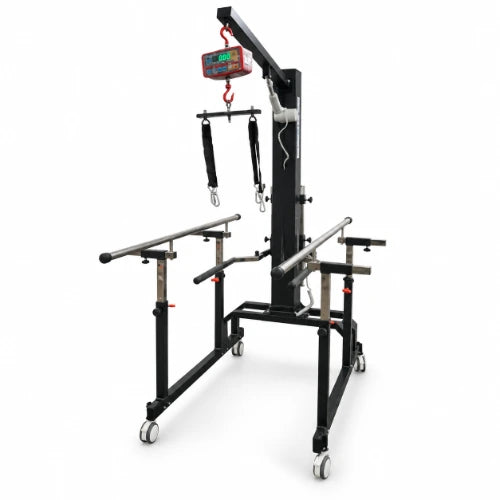
This Medansh model uses one electric motor to raise or lower the padded harness vertically. Therefore, the motor helps with lifting and positioning, but it does not automatically move the person's legs or make them walk.
For families arranging rehabilitation at home, this difference is important. The equipment can support guided practice, but a physiotherapist, rehabilitation professional or properly trained caregiver should supervise its use.
Motorized Gait Trainer Single Motor for Guided Walking Practice
Some people need more support than a normal walker can provide. For example, weakness, poor balance or difficulty standing may make regular walking practice challenging.
In these situations, a body-support system can help a professional position and support the person during rehabilitation. The padded harness carries part of the user's weight while the therapist guides the session.
Because of this, the motorized gait trainer can support structured standing and walking practice without requiring the therapist to manually lift the person's full body weight.
For household buyers: this is rehabilitation equipment rather than a normal household walker. Before arranging it for home use, ask the physiotherapist to confirm whether the trainer suits the user's condition, available space and rehabilitation plan.
Motorized Gait Trainer Terms Explained Simply
Gait Gait simply means the way a person walks.
Gait Training Gait training means guided walking practice used during rehabilitation.
Body Weight Support This means the harness supports part of the person's body while they practise standing or walking.
Vertical Lift Vertical lift means moving the supported person upward or downward.
Harness A harness is a padded support system fitted around the body to help support the user during lifting and gait practice.
Groin Support This means the harness also supports the lower pelvic area to help hold the person securely during lifting.
Castors Castors are the wheels fitted under the frame.
Rehabilitation Rehabilitation means guided therapy or training that aims to support recovery of movement or daily function.
Wired Remote A wired remote lets the operator control the powered lift while remaining close to the equipment.
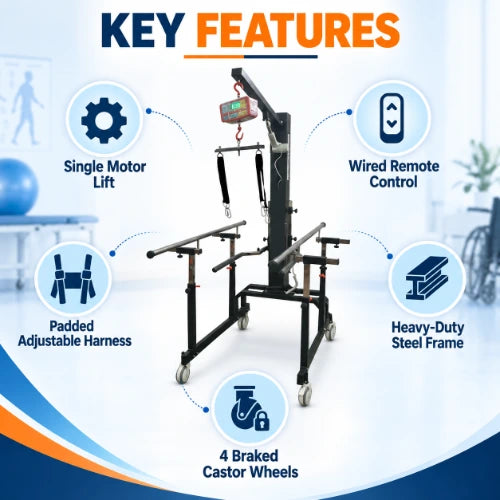
Key Features of the Single Motor Gait Trainer
Single-Motor Vertical Lift
The electric motor raises or lowers the harness vertically. Therefore, the operator can assist the user into a supported standing position before gait practice begins.
Padded Adjustable Harness
The harness provides body support and includes groin support. In addition, its adjustable design helps the professional fit the system to the user before lifting.
Wired Remote Operation
The operator controls the powered lifting function using a wired remote. As a result, the therapist or trained caregiver can remain near the person during positioning.
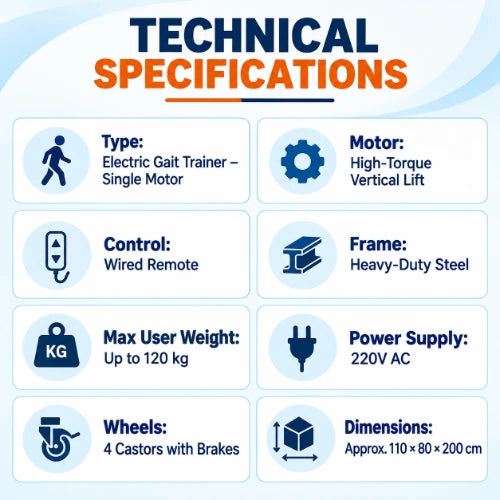
120 kg Listed User Capacity
Meddey currently lists a maximum user weight of up to 120 kg. Therefore, never use the system for a person above the listed limit.
Heavy-Duty Steel Frame
The frame uses heavy-duty steel with a protective coating. This provides the main supporting structure for the lifting and gait-training system.
Four Lockable Castors
Four castor wheels help position the equipment. Meanwhile, the brakes allow the operator to lock the wheels when the training setup requires the unit to remain stable.
How Does the Motorized Gait Trainer Work?
The single motor controls the vertical lifting system. First, the trained operator fits and checks the harness. Then, the motor can gradually raise the supported user.
Once the person reaches the required supported position, the physiotherapist can begin the planned standing or walking practice. Depending on the rehabilitation setup, the therapist may also use suitable parallel bars or other professional support.
Most importantly, the motor does not create the walking movement. The user still moves their legs according to their own ability and the rehabilitation professional's instructions.
Important difference: this product is not a treadmill and it is not an electrotherapy machine. Its electric motor provides vertical lifting for the body-support system.
Motorized Gait Trainer vs a Normal Walker
A normal walker mainly gives a person a frame to hold while walking. However, some users need additional support around the body.
The motorized gait trainer uses a harness and powered lift to provide more structured support. Therefore, it may suit rehabilitation sessions where a therapist wants to practise supported standing or walking.
- Normal walker: mainly provides hand-held support during walking.
- Gait trainer: provides additional body support through a harness system.
- Motorized single-motor gait trainer: adds powered vertical lifting to assist positioning and body support.
Can the Motorized Gait Trainer Be Used at Home?
Professionally supported home use may be possible when the user's rehabilitation team considers the equipment suitable. However, this should not become unsupervised self-use.
For home rehabilitation, families should first consider the available space, floor condition, power supply and who will operate the equipment.
Because the unit measures approximately 110 × 80 × 200 cm, families should also check that the intended room provides enough space for safe positioning and professional assistance.
A physiotherapist or rehabilitation professional should guide harness fitting and the training method. Meanwhile, any caregiver who operates the system should receive suitable instructions.
Who May Be Considered for Supported Gait Training?
Rehabilitation professionals may consider supported gait practice for people who have difficulty standing or walking independently.
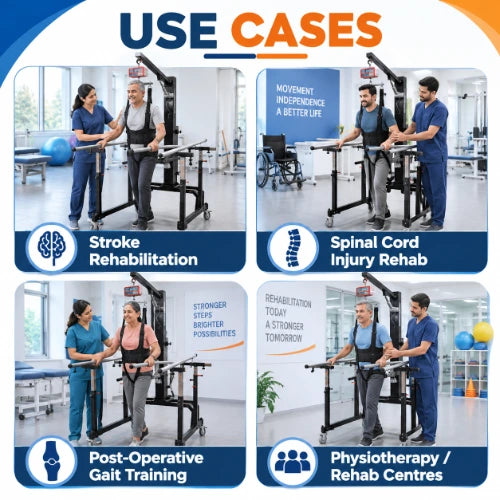
For example, the current Meddey listing mentions rehabilitation after stroke, spinal cord injury and surgery, as well as people with significant mobility limitations.
However, these are rehabilitation applications, not guaranteed treatment outcomes. The gait trainer does not treat stroke, spinal injury or another medical condition by itself.
Therefore, a healthcare professional should decide whether supported gait training is appropriate for the individual user.
How to Use the Single Motor Gait Trainer
- First, place the gait trainer on a dry, stable and suitable indoor floor.
- Check the frame, harness, straps, wheels and controls before the session.
- Position the trainer according to the rehabilitation professional's plan.
- Fit and secure the padded harness around the user.
- Check that the harness supports the user correctly before lifting.
- Use the wired remote to raise the user gradually into the required position.
- Begin guided standing or walking practice under trained supervision.
- Monitor the user's comfort, posture and fatigue throughout the session.
- Finally, use the remote to lower the user gradually after the session.
Always follow the instructions supplied with the exact unit and the rehabilitation plan given by the healthcare professional.
Safety Tips for the Motorized Gait Trainer Single Motor
- Do not exceed the listed maximum user weight of 120 kg.
- Check and secure the harness before lifting the user.
- Follow the correct wheel-locking procedure during use.
- Use the equipment indoors on a dry, stable floor.
- Do not operate the trainer without trained supervision.
- Check harness straps and support points before every session.
- Keep the user's feet and body correctly positioned during lifting.
- Stop the session if the user becomes dizzy, distressed or unusually uncomfortable.
- Do not allow children or untrained people to operate the powered lift.
Safety note: do not guess how much body weight the harness should support. The exact support and training setup should follow the user's rehabilitation assessment and professional guidance.
Motorized Gait Trainer Single Motor Specifications
| Specification | Current Listed Information |
|---|---|
| Brand | Medansh |
| Product Type | Electric / Motorized Gait Trainer – Single Motor |
| Motor Function | Powered vertical lifting |
| Control | Wired remote |
| Frame | Heavy-duty steel with protective coating |
| Harness | Padded adjustable harness with groin support |
| Maximum User Weight | Up to 120 kg |
| Power Supply | 220V AC |
| Wheels | 4 castor wheels with brakes |
| Approx. Dimensions | 110 × 80 × 200 cm |
| Warranty | 1 year on motor and mechanical parts, as currently listed by Meddey |
Single Motor vs Double Motor Gait Trainer
The main verified function of this single-motor model is powered vertical lifting.
Some double-motor gait-training systems offer additional adjustment. However, designs can differ between products, so buyers should compare the exact functions rather than choosing only by the number of motors.
For many families and clinics, the important question is whether the equipment provides the type of support recommended in the rehabilitation plan.
Motorized Gait Trainer for Physiotherapy and Rehabilitation Centres
Physiotherapists and rehabilitation professionals can use the system for structured supported standing and walking sessions.
The powered lift may also reduce how much manual lifting the staff need during positioning. Meanwhile, the harness provides body support as the professional guides the session.
Clinics should create their own operating, inspection and cleaning procedures based on the instructions supplied with the equipment.
Frequently Asked Questions About the Motorized Gait Trainer
What is a motorized gait trainer?
It is rehabilitation equipment that supports a person during guided standing and walking practice. This model also uses an electric motor for vertical lifting.
What does gait training mean?
Gait means the way a person walks. Therefore, gait training simply means guided walking practice.
What does the single motor do?
The single motor raises and lowers the body-support harness vertically. It does not automatically move the person's legs.
Is this motorized gait trainer a treadmill?
No. The verified motor function is vertical lifting of the harness system. It should not be described as a powered treadmill.
What does body weight support mean?
It means the harness supports part of the user's body while they practise standing or walking. The professional should decide the appropriate setup for each person.
Can this gait trainer be used at home?
Guided home rehabilitation may be possible if a professional considers the equipment suitable and a trained person operates it. Families should also confirm suitable space, flooring and power supply.
What is the maximum user weight?
Meddey currently lists a maximum user weight of up to 120 kg. Do not exceed this limit.
Does the machine make the person's legs walk automatically?
No. The motor provides vertical lifting. Walking movement depends on the user's ability and the rehabilitation method guided by the professional.
Can it be used during stroke or spinal injury rehabilitation?
Supported gait practice may form part of rehabilitation for some people with neurological or mobility limitations. However, a healthcare professional must first decide whether it is suitable for the individual.
Is the harness washable?
The current Meddey information describes the harness as detachable and suitable for cleaning. Follow the supplied cleaning instructions for the exact harness.
What should be done if the power goes off during use?
Before every session, the operator should know the correct procedure for safely supporting and lowering the user if power is interrupted. Confirm the emergency-lowering arrangement supplied with the exact unit instead of assuming that a manual release is included.
Motorized Gait Trainer Single Motor for Supported Rehabilitation
For a family arranging professionally guided rehabilitation, this Medansh gait trainer combines powered vertical lifting, a padded support harness, wired control and a mobile steel frame.
Most importantly, use it as part of a professionally planned gait-training programme rather than as an independent walking machine.
Need product or order guidance?
Call or WhatsApp Meddey: +91 8586-012345
Call or WhatsApp Meddey: +91 8586-012345
You may also need
FOR YOURecommended for you
Save 55%

Save 39%

Save 8%

Save 37%

Save 30%

Save 27%

Save 50%

Save 25%