


Featured Choice

What customers say
★★★★★ 5.0 · 2 reviews
Shoulder Immobilizer Benefits: Injury Support Guide
Understanding the Benefits of a Shoulder Immobilizer
A shoulder immobilizer supports the arm and limits shoulder movement when a clinician recommends protection after an injury or operation. Its benefits depend on using the right immobilizer, maintaining a suitable fit, and following an individual treatment plan—not simply keeping the shoulder still. Understanding its purpose, daily care, and warning signs can help you use it more confidently without replacing advice from your orthopedist, surgeon, or physiotherapist.

What is a shoulder immobilizer used for?
Clinicians use a shoulder immobilizer to support the arm and restrict shoulder movement after certain injuries or surgical procedures. Many designs combine a forearm sling with an additional strap around the torso, helping hold the arm in the position prescribed by a clinician. Other designs use different arrangements of wraps, straps, or positioning supports. The appropriate design depends on the condition your clinician treats and the movement restrictions it requires.
The shoulder immobilizer is part of a care plan rather than a treatment for every painful shoulder. A shoulder injury may involve bone, tendons, ligaments, nerves, or several structures together, so a diagnosis matters before deciding how much support is appropriate. Some injuries require immobilization, while others need a different balance of protection and movement.
Think of the immobilizer as a way to follow a positioning instruction. It does not establish the injury, determine whether surgery is necessary, or tell you when normal activity is safe. Those decisions belong to the professionals assessing your shoulder. Before leaving an appointment, ask what the immobilizer should protect and which movements it should restrict. That explanation makes the rest of the instructions easier to understand and follow.

Practical benefits of a prescribed shoulder immobilizer
One important benefit is limiting unwanted movement while injured or repaired tissues need protection. After some operations, a sling or immobilizer helps support the shoulder while the surgical team decides which activities you may do. That protection is especially relevant when an ordinary action, such as reaching or pushing, could place stress on a repair.
A properly fitted support also carries the arm's weight rather than leaving you to hold it in position continuously. The intended result is a supported, relaxed arm—not an elevated shoulder, a tightly compressed torso, or a hand dangling beyond the intended support. Comfort therefore matters, but comfort alone is not enough: the shoulder immobilizer must also maintain the prescribed position.
These benefits have limits. A shoulder immobilizer does not guarantee that an injury will heal without complications, prevent every accidental movement, or make lifting safe. After shoulder replacement, for example, the immobilizer is only one part of a broader program that includes activity precautions and rehabilitation. The useful question is not whether an immobilizer is universally beneficial, but whether it serves a clear purpose in your treatment plan.
For everyday use, ask your clinician to connect the shoulder immobilizer to a specific goal: supporting the arm, maintaining a particular position, restricting selected movements, or protecting a repair. A clear goal helps you recognize when the immobilizer is slipping or becoming difficult to use.

Using a shoulder immobilizer after a shoulder injury
Clinicians may use shoulder immobilizers after selected fractures, dislocations, or other traumatic shoulder injuries. The exact support depends on the injured structures and the treatment chosen. Two people who both describe having a “shoulder injury” may therefore receive different shoulder immobilizers and different instructions about movement.
A shoulder sling for dislocation is commonly part of care after a clinician has restored the joint to its correct position. The immobilizer helps keep the shoulder still during the protected stage of treatment, but follow-up assessment remains important. A dislocation can also involve damage to surrounding tissues, nerves, or blood vessels, which a sling cannot diagnose or correct.
If you suspect a new dislocation, do not try to force the joint back into place or use an immobilizer as a substitute for urgent assessment. Supporting the arm while awaiting medical help is different from treating the dislocation yourself. A shoulder sling for a dislocated shoulder becomes part of an ongoing plan only after a clinician evaluates the injury and arranges appropriate treatment.
At follow-up, describe any change in pain, swelling, sensation, or the feeling that the shoulder is unstable. Bring the shoulder immobilizer so the team can assess the actual fit rather than relying only on a description. Also ask whether the original instructions still apply; do not assume that feeling more comfortable automatically means the immobilizer is no longer needed.
Shoulder immobilizer use after shoulder surgery
After surgery, the purpose of a shoulder immobilizer ties directly to the procedure performed. A tendon repair, a stabilization procedure, and a joint replacement can have different protection requirements. The surgeon's instructions should explain how to support the arm and which movements or activities could interfere with the repair.
This is why general advice from another patient's experience can be misleading. Even when two people wear similar-looking shoulder slings, their operations may involve different tissues and restrictions. Therapists design rehabilitation programs around the specific surgery, and the clinical team should explain both the shoulder immobilizer and the activities permitted alongside it.
Before discharge, request a demonstration that includes any helper who will assist you at home. Ask which parts of the immobilizer may be opened, whether any positioning component must remain in place, and how to manage personal care. Some postoperative instructions are deliberately more restrictive than standard sling advice, including during washing and dressing.
Keep your written instructions accessible, and use the surgical team's contact route when something is unclear. A useful handover should leave you knowing the purpose of the shoulder immobilizer, the allowed exceptions, the warning signs to watch for, and who can help with fitting problems. Do not improvise a less restrictive arrangement because the original setup feels inconvenient or unfamiliar.
Shoulder immobilizer vs sling: what is the difference?

A simple shoulder sling mainly supports the forearm, while a shoulder immobilizer generally adds a way to restrict shoulder movement more closely, often with a body strap. The terms sometimes overlap because a sling can become part of an immobilizing system. What matters is the immobilizer's actual structure and prescribed function, not its name alone.
| Feature | Simple sling | Shoulder immobilizer |
|---|---|---|
| Main role | Supports the arm | Supports the arm and adds movement restriction |
| Common arrangement | Forearm support with a shoulder or neck strap | Sling or wrap with additional torso attachment |
| Body strap | May be absent | Often included when required for protection |
| Clinical decision | Selected for the injury and support needs | Selected for the required position and restrictions |
Do not turn a shoulder immobilizer into a simple sling
These are general distinctions rather than a universal specification. A clinician may provide a sling with a separate body strap and explain when that strap is needed. Another shoulder immobilizer may use a wrap-based arrangement instead of a conventional pouch. Both can look different while serving an immobilizing purpose.
Do not remove a body strap simply to turn an immobilizer into a more convenient sling. Equally, do not add an improvised belt to a simple sling because more restriction seems safer. Ask the treating team whether the arrangement matches your injury. An immobilizer that restricts more movement is not automatically the better choice, particularly when your care plan also includes prescribed movement to limit stiffness.
Available at Meddey
Click the product to open its Meddey product page.
 Velpeau EpBloc Classic Shoulder Immobilizer₹3,449View product
Prices and offers can change. Check the live product page for the latest price and availability.
Shoulder immobilizer designs and overlapping terms
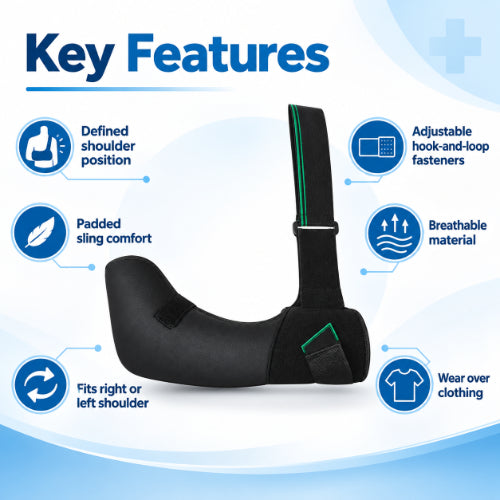
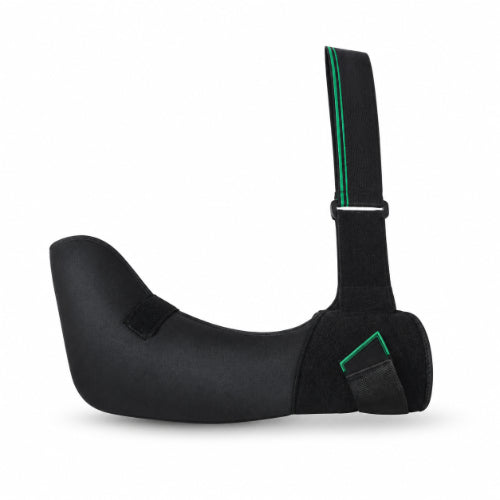
Shoulder immobilizers are not all constructed in the same way. Some use a fabric forearm pouch and waist strap. Others have a torso wrap with separate arm and wrist attachments, while certain postoperative systems include a positioning pillow. These differences affect fitting, cleaning, and use during approved personal care.
A positioning pillow is not merely an optional cushion. In an immobilizer designed to hold the arm in a particular relationship to the body, its placement contributes to the prescribed setup. Ask before moving, removing, or substituting that component, even if a different arrangement initially feels more comfortable. The required arm position should come from your healthcare professional.
Terms such as shoulder support, shoulder splint, and arm brace are broad descriptions rather than precise instructions. They may refer to shoulder immobilizers with different purposes, and a brace designed for another part of the arm does not necessarily provide the same shoulder protection. Clinical services distinguish between slings, upper-arm braces, and other splints because their functions differ.
For clarity, ask the team to identify the exact immobilizer you have and explain each component. If you receive written information, check that its diagrams match your support. When the picture and your shoulder immobilizer differ, ask which instructions apply rather than trying to translate unfamiliar straps or buckles into a new arrangement yourself.
Universal and elastic shoulder immobilizer types
A universal shoulder immobiliser usually has adjustments that accommodate a range of users. “Universal” describes adjustability, not suitability for every shoulder problem or every body shape. Forearm support, strap position, and the required shoulder position still need checking, and an appropriate healthcare professional should complete or review the initial fit.
The same principle applies when the wording is “universal shoulder immobilizer.” The spelling and word order do not tell you whether the immobilizer meets your treatment needs. Ask whether the forearm section supports your arm correctly, whether the torso attachment sits as intended, and whether you can manage the permitted openings without losing the prescribed fit. These are more useful questions than relying on the universal label alone.
An elastic shoulder immobilizer, also called an elastic shoulder immobiliser, may use a torso wrap with separate arm and wrist straps. Its instructions can differ from those for a pouch-style sling. Manufacturer guidance for such designs emphasizes avoiding overtightening and recognizing that changes in swelling may affect adjustment. Follow the instructions for your own shoulder immobilizer rather than borrowing fitting directions from another model.
Do not treat elastic material as an invitation to pull the immobilizer as tight as possible. If the fit feels wrong, ask for review. More tension is not a substitute for correct positioning, and a label cannot resolve a clinical fitting problem.
Basic fit checks for a shoulder immobilizer

A suitable fit should support the arm without feeling binding or excessively tight. The fit should keep your shoulder, elbow, and wrist in the relaxed position your clinician demonstrated. If the shoulder immobilizer leaves you repeatedly shrugging, gripping, or holding the arm up yourself, arrange a fitting review rather than assuming that discomfort is unavoidable.
Use this plain checklist to guide observations—not to replace the original fitting:
- The arm rests in the position demonstrated by your clinician.
- The forearm and elbow sit within the intended support.
- Straps and fabric lie smoothly rather than twisting or bunching.
- Fastenings remain secure during permitted activity.
- The support does not feel binding or create a concentrated pressure point.
- You can identify any new swelling, skin damage, or change in sensation.
- You know whom to contact if the position or comfort changes.
A fit that was initially appropriate may need reassessment when swelling changes or the immobilizer repeatedly slips. Some supports have specific adjustment points; others allow changes only in ways the treating team demonstrates. Do not cut, reshape, or reposition components unless those changes are explicitly part of professional fitting instructions.
Normal-looking fingers do not prove that every aspect of the fit is correct. The shoulder position, pressure areas, and clinical restrictions also matter. If you are uncertain, bring the whole shoulder immobilizer to a review and explain what happens during sitting, walking, and personal care.
Strap positioning without overtightening
Strap routes vary between immobilizers, so follow the demonstrated arrangement rather than a generic diagram. On many pouch-style supports, a shoulder strap carries the forearm while a separate body strap helps hold the arm close to the torso. A shoulder immobilizer belt serves a positioning role, so do not treat it as a compression band to tighten aggressively.
Look for twisted straps, folded edges, or a fastening sitting against a sensitive area. Padding, where supplied, should remain in its intended location. If a strap persistently rubs or pulls, ask whether the route, length, or shoulder immobilizer needs adjustment. Avoid solving the problem by loosening everything until the arm hangs unsupported.
Some immobilizers allow approved removal through quick-release openings while leaving the main strap lengths unchanged. That can help preserve an established fit, but the relevant openings depend on the design. Ask the clinician to identify them and demonstrate their use with the arm appropriately supported.
A helpful fitting conversation is specific: “This strap presses here when I sit,” or “The pouch slides forward when I stand.” That gives the clinician something concrete to assess. If tightening causes pain, altered sensation, or worsening swelling, do not keep experimenting with tension. New or worsening symptoms need medical assessment, not increasingly forceful adjustment.
Skin care beneath the shoulder immobilizer
Skin care is part of using a shoulder immobilizer safely. Pressure, rubbing, and moisture can affect areas covered by the immobilizer, including skin creases and places where straps contact the body. Follow the permitted inspection routine, and ask for help if you cannot see or reach an area without moving the shoulder beyond its restrictions.
Pay attention to soreness, broken skin, persistent redness, or a pressure point that returns after refitting. These are reasons to contact the treating team. Do not assume that a painful patch is simply part of recovery or something you must tolerate until your clinician discontinues the immobilizer.
Clean and dry the skin as instructed, especially around the underarm and elbow crease. Moisture left beneath a support can contribute to irritation, and a damp brace can damage skin when worn for a prolonged period. After surgery, incision care is separate: do not apply lotion or ointment to the wound unless the surgical team approves it.
Before adding padding, creams, powders, or an extra clothing layer, ask whether the change could affect the fit or wound care. Explain exactly where the problem occurs and whether the skin is intact. A targeted review is preferable to repeatedly adding material under a strap without knowing why the pressure is developing.

Hygiene and cleaning basics
Cleaning instructions are model-specific. Some shoulder supports can be hand washed with mild soap and air dried, while other designs have removable panels or components that require different handling. Read the care label and the instructions supplied with your immobilizer before washing it. Do not assume that every fabric support is machine washable.
For immobilizers whose instructions permit hand washing, thorough rinsing and complete drying matter. Residual soap can irritate skin, and wearing a damp support can create skin problems. Some positioning pillows may need wiping rather than immersion, so cleaning the sling pouch and cleaning the whole shoulder immobilizer are not necessarily the same task.
Avoid heat, bleach, strong detergents, or tumble drying unless the immobilizer instructions explicitly allow them. Certain supports specify air drying away from heaters and warn against wringing. Following those directions helps preserve the materials and avoids introducing an unapproved cleaning method.
Plan the cleaning arrangement with your clinician if the immobilizer must remain in use except for approved activities. Do not create an unsupported break simply because the shoulder immobilizer needs washing. Ask what arrangement is acceptable while it dries and whether you need assistance. Also report damaged seams, stretched straps, or fastenings that no longer hold securely; cleanliness alone does not establish that an immobilizer is functioning properly.
Dressing while protecting the shoulder
Loose-fitting, front-opening clothing is often easier to manage than tight garments pulled overhead. The aim is to reduce unnecessary shoulder movement while keeping the arm supported as instructed. A clinician or occupational therapist can demonstrate an appropriate method for your restrictions, particularly if you need help with sleeves or fastenings.
General patient guidance often recommends dressing the affected arm first and removing it from clothing last. However, the technique still has to fit your operation and support arrangement. Some surgical instructions require the arm to remain within the brace during personal care, so do not follow a general clothing technique if it conflicts with your discharge plan.
Clothing should not pull across an incision or force the shoulder immobilizer out of position. Consider which garments you can manage with the unaffected hand and whether you need a helper. Sitting for dressing may be useful when recommended by the therapy team, especially if handling clothing makes balance or arm support difficult.
Prepare clothing before starting, and allow enough time to avoid rushing. If a garment repeatedly requires prohibited movement, ask for a different approach rather than forcing the shoulder through it. Dressing successfully should mean completing the task within your restrictions—not merely getting the garment on. Ask for another demonstration if the technique remains confusing once you are at home.
Bathing and washing considerations
Bathing requires a plan because it combines personal hygiene, arm support, wound protection, and balance. Ask your treating team whether your current instructions permit showering, bathing, or only a supported wash with a cloth. Do not assume that permission to remove a sling for one purpose covers every type of washing.
After surgery, dressings and wounds may need to stay dry, and your team may restrict soaking. The shoulder support itself may also need protection from water. Ask how to support the arm during washing and whether someone should assist you; do not lift it into a convenient position without checking that your team allows the movement.
Underarm hygiene deserves particular attention, but the method depends on the prescribed restrictions. Patient leaflets describe different approaches because they address different procedures and supports. Your own team should show you how to access and dry the area without compromising shoulder protection.
Keep towels, clothing, and permitted washing supplies within easy reach before beginning. If you cannot manage the task without leaving the arm unsupported or feeling unsteady, ask for assistance or a therapy review. A bathing plan is only useful if you can carry it out safely in your actual bathroom. Once washing is complete, follow your instructions for drying the skin and restoring the approved support arrangement.
Making daily life more manageable
Using a shoulder immobilizer changes how you approach ordinary tasks. Your team may restrict reaching, carrying, pulling, and pushing even when they seem minor. After some shoulder operations, using the affected hand to lift an object or pushing through the arm can place unwanted stress on the shoulder. Clarify these activities rather than deciding only by whether they hurt.
A practical home setup reduces the need to improvise. Keep frequently used items where the unaffected arm can reach them comfortably, and ask for help with demanding household tasks. Therapy guidance specifically highlights the difficulty of heavier housework and handling hot or heavy items while you protect one arm.
| Daily task | Useful planning point |
|---|---|
| Meals | Arrange help with heavy pans, hot containers, and difficult packaging. |
| Personal care | Keep supplies accessible and identify tasks requiring assistance. |
| Household chores | Delegate tasks involving lifting, pulling, or repetitive effort. |
| Moving between seats | Ask how to manage without loading the protected arm. |
| Phone and paperwork | Place items within reach before settling into a chair. |
Use the table as a discussion aid, not permission to perform every listed task. An activity can look one-handed while still involving the protected shoulder through balance, bracing, or reaching. If you find yourself repeatedly working around the immobilizer, tell the therapy team what you need to accomplish so they can suggest an appropriate alternative.
Can I sleep with a shoulder immobilizer?
You may need to sleep with a shoulder immobilizer, but the answer depends on your injury, operation, immobilizer, and individual instructions. Ask your surgeon, orthopedist, or physiotherapist whether it must remain in place during sleep and how to support your arm. There is no single sleeping rule that safely applies to every person wearing a sling or immobilizer.
Resolve the details before bedtime. Ask whether any straps or positioning components must remain unchanged, what to do if discomfort interrupts sleep, and how to manage getting into or out of bed without stressing the shoulder. If the shoulder immobilizer presses on the skin or repeatedly loses position, request a fit review rather than changing the arrangement yourself.
A clinician's advice may include pillows and other positioning aids, but they should support the prescribed arrangement rather than replace it. Ask for a demonstration if verbal instructions leave you uncertain. A helper should understand the same plan so that assistance does not accidentally move the arm into a restricted position.
Do not use sleep as a test of whether the shoulder has recovered enough to go without support. Likewise, do not assume that poor sleep means you should simply tighten the immobilizer. Describe the difficulty to your treating team, including where discomfort occurs and whether symptoms change when lying down. Seek urgent care for the warning signs listed below.
Work, travel, and activities outside the home
Returning to work depends on more than being able to tolerate the immobilizer. Job demands, the surgical procedure or injury, and the movements required all matter. A desk role may still involve reaching, commuting, carrying equipment, or prolonged positioning. Ask for activity-specific advice and written restrictions when needed.
Do not assume that wearing a shoulder immobilizer makes driving safe. Patient guidance commonly advises against driving while wearing a sling, and the treating team should guide your return to driving. Taking the shoulder immobilizer off for a journey is not a workaround if you still need it for protection.
For appointments or other necessary outings, plan how you will travel as a passenger and who can help with doors and belongings. Ask the clinical team about any concerns specific to your operation or mobility. After shoulder surgery, discharge planning may include arranging a responsible person to assist with transport home.
Before returning to an activity, describe the actual task rather than using a broad label such as “light work.” Explain what you lift, how far you reach, and whether you must react quickly or use both arms. That gives the clinician a clearer basis for advice. Keep the immobilizer's purpose in view: it is there to maintain prescribed protection, not to make an otherwise restricted activity acceptable.
Immobilization and rehabilitation work together
A shoulder immobilizer protects movement during a prescribed stage of care, while rehabilitation addresses movement, strength, and function according to the treatment plan. These are complementary roles rather than competing approaches. Many traumatic shoulder injuries require both a period of protection and a professionally guided return to activity.
Keeping the arm still indefinitely is not automatically safer. Prolonged immobilization can contribute to stiffness, but that does not mean you should remove the immobilizer or begin shoulder exercises without permission. Your physiotherapist should explain which joints may move, which movements you must avoid, and how exercises fit around shoulder immobilizer use.
After surgery, the rehabilitation plan should reflect the repair performed. Exercises that are appropriate for another patient may not be appropriate for you, even if the supports look similar. Follow the surgeon's and physiotherapist's instructions together, and ask them to resolve any apparent conflict rather than choosing the least restrictive advice.
Ask for clarification if an exercise demonstration appears to contradict a movement precaution. It may be that you can do the activity only with assistance or under specific conditions. Equally, tell the team if you cannot perform a prescribed activity without pain or loss of support. The goal is a plan you understand well enough to carry out accurately, not an exercise routine assembled from unrelated videos or other patients' experiences.
Problems that deserve a clinician's review
Not every difficulty is an emergency, but do not ignore persistent fitting problems. Contact your treating team if straps repeatedly slip, fastenings no longer hold, the shoulder immobilizer fails to support the arm as demonstrated, or skin becomes sore or damaged. An appropriate healthcare professional should review the initial fitting and later concerns.
Also ask for help if you cannot manage dressing, washing, or the approved opening and closing of the immobilizer. A support that is technically appropriate may still require additional teaching or assistance at home. Therapy services routinely address personal care and daily activities alongside the shoulder's medical treatment.
When calling, make the problem easy to picture. Useful details include where pressure occurs, whether the arm slips forward, what activity triggers the difficulty, and whether the issue began after washing or refitting. Keep your discharge instructions nearby so you can explain what you were originally told.
Do not downgrade a new symptom to a routine fitting problem just because it appeared beneath a strap. Increasing swelling, altered sensation, or severe pain may need urgent assessment. If you are unsure which service to contact, use the urgent advice route provided by your treatment team rather than waiting for a scheduled review.
Warning signs while wearing a shoulder immobilizer
Seek urgent medical care for new or worsening severe pain, numbness or tingling, blue or cold fingers, increasing swelling, fever, or wound drainage after surgery. Do not manage these symptoms solely by tightening, loosening, or removing the shoulder immobilizer. They can require assessment of the injury, circulation, nerves, wound, or other postoperative concerns.
Call emergency services for trouble breathing, particularly if it is sudden or accompanied by chest pain. Do not assume that breathlessness is simply the torso strap's fault. Seek urgent assessment after a new fall as well, especially if pain increases, the shoulder looks different, or the shoulder immobilizer no longer holds the arm as before.
| Change you notice | Appropriate response |
|---|---|
| New or worsening severe pain, numbness, or tingling | Seek urgent medical assessment. |
| Blue or cold fingers, or increasing swelling | Seek urgent medical assessment. |
| Fever or wound drainage after surgery | Contact the surgical team urgently or use urgent care. |
| Trouble breathing or chest pain | Call emergency services. |
| A new fall affecting the shoulder | Seek urgent reassessment rather than relying on the device. |
Do not wait for a routine appointment when these warning signs appear. An immobilizer is a protective aid, not a way to rule out complications. If possible, bring your treatment information and describe when the change began, but do not delay urgent care to gather paperwork.

Shoulder immobilizer FAQs
1. What is a shoulder immobilizer used for?
A shoulder immobilizer supports the arm and limits shoulder movement when a clinician recommends protection after an injury or operation. Many designs combine a forearm sling with a torso strap to hold the arm in the prescribed position. It is one part of a care plan and does not diagnose the injury or decide when normal activity is safe.
2. What is the difference between a shoulder immobilizer and a sling?
A simple sling mainly supports the forearm, while a shoulder immobilizer usually adds a body strap or wrap to restrict shoulder movement more closely. The terms overlap, so the actual structure and prescribed function matter more than the name. Ask your clinician which arrangement suits your injury.
3. How should a shoulder immobilizer fit?
It should hold the arm in the relaxed position your clinician demonstrated, without feeling binding or creating a pressure point. The forearm and elbow sit inside the support, straps lie smoothly, and fastenings stay secure. If you keep shrugging or holding the arm up yourself, arrange a fitting review.
4. Can I sleep with a shoulder immobilizer?
You may need to, but the answer depends on your injury, operation, and instructions. Ask your surgeon, orthopedist, or physiotherapist whether it must stay on during sleep and how to position the arm. If sleep is uncomfortable, request a fit review instead of tightening or rearranging the straps yourself.
5. How do I clean the fabric and straps?
Follow the care label and instructions for your model. Some fabric supports can be hand washed with mild soap and air dried, while pillows or panels may need wiping only. Avoid bleach, heat, and tumble drying unless the instructions allow them, and let everything dry fully before wearing it again.
6. How do I dress and wash with my arm immobilized?
Loose, front-opening clothing is usually easier to manage, and general advice is to dress the affected arm first. Washing depends on your operation, so ask whether you may shower and how to support the arm. Some post-surgery plans require the arm to stay in the brace during personal care.
7. Can I drive while wearing one?
Patient guidance commonly advises against driving while wearing a sling or immobilizer. Taking it off for the journey is not a workaround if you still need it for protection. Your treating team should tell you when it is safe to return to driving.
8. How long should I wear it?
Your clinician sets the duration, and it depends on the injury or the surgery performed. Feeling more comfortable does not automatically mean the support is no longer needed. Keep following your plan, and ask when you may move the arm and begin rehabilitation exercises.
9. What skin problems should I watch for under a shoulder immobilizer?
Watch for soreness, broken skin, persistent redness, or a pressure spot that returns after refitting, especially in the underarm and elbow crease. Keep the skin clean and dry as instructed. Contact your treating team instead of simply tolerating a painful patch.
10. When should I seek urgent help with a shoulder immobilizer?
Seek urgent care for new or worsening severe pain, numbness or tingling, blue or cold fingers, increasing swelling, fever, or wound drainage after surgery. Call emergency services for trouble breathing or chest pain. Do not rely on tightening or loosening the immobilizer to manage these symptoms.
Explore Medical Collections
All Categories
Abdominal Belt: Support After Surgery, in Pregnancy and After Delivery

Accessories
Accu-Chek Instant Strips: Use, Compatibility, Price & Blood Sugar Testing Guide
Accu-Chek Instant Strips: Uses, Features & Complete Guide

accupuncture

Acupuncture Needles & Supplies

Advanced Physiotherapy Machines & Lumbar Physiotherapy

AED Defibrillator: How It Works, Who Can Use It and Where to Place It

Airways
Alcohol Swab: Uses, Safe Use and Disposal Guide
Ambu Bag Full Form: Is There an Official Meaning?
Ambu Bag: Parts, Uses and Safety Guide
Ambu Full Form: What the Name Means and BVM Basics

Ambulance

Anatomy Models
You may also need
FOR YOURecommended for you