


Featured ChoiceSave 44%
Save 26%
Save 26%

About this collection
Stadiometer: Uses, Types, Accuracy, Price and Buying Guide for Healthcare Professionals
This guide explains what a stadiometer is and why it is the standard tool for height measurement. It also covers the types, age groups, stadiometer vs tape, correct technique and the cost of a stadiometer in India.
Key Takeaways
- First, a stadiometer is a device with a fixed vertical rod and a sliding headpiece that measures a person's standing height.
- In practice, it is used for BMI, growth monitoring in children, drug dosing and nutrition checks in clinics, schools and hospitals.
- For infants and toddlers under two years, staff use an infantometer to measure length lying down, and not a standing stadiometer.
- According to a study on stadiometry, it is precise and reproducible, and the tape and book method was about three times less reliable.
- Finally, choose a stadiometer by its range, graduation, stability, portability and whether you also need a weighing scale, and not by price alone.
Contents
- Stadiometer meaning and purpose
- Main uses of a stadiometer
- Types of stadiometers
- Reading the stadiometer scale
- Age groups for a stadiometer
- Stadiometer vs measuring tape accuracy
- Steps for correct height measurement
- Common measurement errors
- Stadiometers in India and public health
- Stadiometers available at Meddey
- Stadiometer price: what decides the cost?
- Height measurement in different settings
- Buying checklist
- Care and calibration
- Frequently asked questions
Height looks like the simplest measurement in a clinic. However, a small error of one or two centimetres can change a child's growth chart, a BMI value or a drug dose. Therefore, every OPD, ward, school health camp and nutrition centre needs a reliable stadiometer.
This guide is for doctors, nurses, nutritionists, medical students and buyers of clinic equipment. In addition, it uses simple words and answers the most common questions. To see products, you can visit the stadiometer collection at Meddey.
Latest public health note: India's Ministry of Women and Child Development uses the WHO growth standards for children under five. According to the Odisha WCD department, height and length measurement started after Poshan Abhiyaan in 2018, when infantometers and stadiometers were supplied to Anganwadi centres. Therefore, correct measurement now feeds directly into the Poshan Tracker data.
What Is a Stadiometer, and What Is Its Purpose?
A stadiometer is a medical measuring device for standing height. In detail, it has a vertical scale, a base and a horizontal headpiece that slides down to rest on the top of the head. As a result, it gives a true vertical reading, which a hand-held tape cannot match.
The purpose of a stadiometer is to record height in a standard, repeatable way. For example, accurate height is the base for BMI, growth charts, body surface area, nutritional status and pre-operative assessment. Meanwhile, it also helps detect short stature, spinal changes and height loss in older adults.
For students, one line is enough. A stadiometer is a vertical measuring device that records standing height accurately and repeatably.

What Is a Stadiometer Used For?
A stadiometer for height measurement has many uses in healthcare.
BMI and nutrition First, staff need height and weight to calculate BMI and to screen for nutrition problems, such as low body weight or higher body weight for height.
Child growth monitoring Also, height for age and weight for height help find stunting and wasting early.
Drug and fluid dosing In addition, some doses depend on body surface area, which uses height.
Pre-operative and ICU care Moreover, teams use height to estimate ideal body weight and ventilator settings.
Screening camps and schools Because they are light, portable stadiometers help teams measure many children in one day.
Research and public health Finally, surveys and health programmes use standard stadiometers to collect comparable data.
What Are the Different Types of Stadiometers?
There is no single official list, but most stadiometers fall into a few clear groups. However, they differ by mounting, reading method and extra features.
1. Wall-mounted stadiometer It attaches to a wall and gives stable readings. Therefore, it suits fixed rooms in clinics and hospitals.
2. Floor-standing portable stadiometer It stands on its own base and often splits into sections. As a result, teams can carry it to camps and schools.
3. Mechanical stadiometer It uses a printed scale and a sliding headpiece. Also, it needs no power and is easy to maintain.
4. Digital stadiometer It shows the reading on a screen. Since it reduces reading errors, busy clinics often like it.
5. Infantometer (length board) It measures length in babies who lie down. Thus, it is used for children under two years.
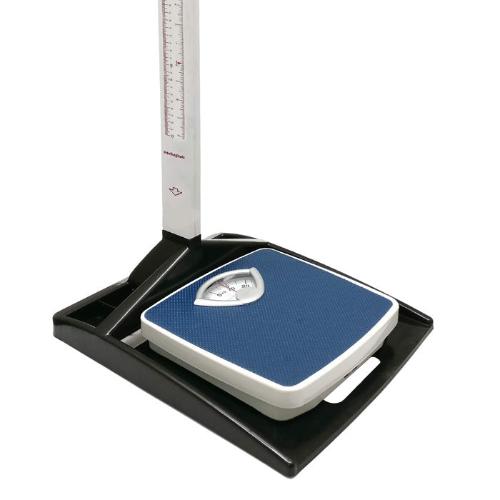
6. Height and weight stand It combines a stadiometer with a weighing scale. Therefore, staff record two readings in one step.
7. Ultrasonic or laser devices They measure height without touching the head. However, studies show that contact stadiometry remains the reference method.
8. Wall tape stature meter It is a simple retractable tape with a sliding block. Still, it is less rigid than a full stadiometer.
Understanding the Stadiometer Scale
The stadiometer scale is the printed or digital ruler along the vertical rod. It is the part you read to get the height. Because of this, a good scale must be clear, sharp and must not fade with use.
What to check on the scale
- Range: First, a wide range, such as 20 cm to 210 cm, covers children and tall adults.
- Graduation: Next, fine marks, such as 1 mm, allow precise reading and support small changes over time.
- Units: Also, a dual scale in centimetres and inches helps different users.
- Readability: In addition, large numbers and a sharp pointer reduce reading mistakes.
- Zero point: Finally, the zero must match the floor level, so check it during set-up.
Therefore, a stadiometer scale with 1 mm graduation and a stable rod gives the best chance of a correct reading.
What Age Group Is a Stadiometer Typically Used For?
A standing stadiometer is used for children who can stand steadily, usually from about two years of age, and for adolescents and adults. Also, it works for all older ages, including older adults, as long as the person can stand straight.
For babies and children under two years, WHO practice is to measure length lying down, and not standing height. Therefore, staff use an infantometer, also called a length board, for this group. Two people usually take part: one holds the head, and the other straightens the legs and reads the value.
| Age or situation | Suitable device | Measure |
|---|---|---|
| Under 2 years | Infantometer or length board | Length, lying down |
| 2 years to adolescence | Stadiometer | Standing height |
| Adults and older adults | Stadiometer | Standing height |
| People who cannot stand | Length board or alternative methods, such as knee height | Estimated height |
Which Is More Accurate, a Stadiometer or a Measuring Tape?
A stadiometer is more accurate and more repeatable than a measuring tape. The reason is simple: a tape bends, moves and cannot guarantee that the top mark sits flat on the head. In contrast, a stadiometer has a rigid rod and a headpiece that stays horizontal.
What the studies show
A study that compared a stadiometry method with a book-and-tape method found that stadiometry was precise and reproducible, and it should remain the standard way of observing growth. The tape method was about three times less reliable, although it gave acceptable estimates at home every few months. Meanwhile, a study of 81 schoolchildren found a very small average difference of 0.08 cm between a stadiometer and a tape when a trained person used a strict technique.
| Feature | Stadiometer | Measuring tape |
|---|---|---|
| Rigidity | Rigid rod, fixed vertical | Flexible, can bend or tilt |
| Headpiece | Sliding piece that stays level | Needs a book or ruler held by hand |
| Repeatability | High | Lower, depends on the user |
| Best use | Clinics, hospitals, schools, research | Rough home checks |
Therefore, use a stadiometer for clinical decisions, and use a tape only for a rough home estimate.
How to Measure Height Correctly
The steps below give a general idea. However, always follow your protocol and the device manual, since methods can differ.
1. Prepare the device
First, place the stadiometer on a flat, hard floor, or fix it to a wall. Then, check that it is vertical and that the headpiece slides freely.
2. Prepare the person
Next, ask the person to remove shoes, hats and hair ornaments. Also, ask them to undo tall hairstyles that may block the headpiece.
3. Position the body
Then, ask the person to stand straight with heels together and the back of the heels, buttocks and shoulder blades touching the rod or wall. The arms should hang loose at the sides.
4. Set the head
After that, position the head in the Frankfort plane. This means that the lower edge of the eye socket and the notch above the ear are in a horizontal line. Ask the person to look straight ahead.
5. Lower the headpiece
Now, bring the headpiece down until it touches the top of the head, with gentle pressure. Ask the person to take a deep breath and stand tall.
6. Read and record
Finally, read the value at eye level, and record it to the nearest 0.1 cm. Measure three times, and the differences should be no more than 0.3 cm, as one paediatric guideline advises. Then, record the mean.
Tip: Height changes a little through the day, so measure at the same time of day when you track growth. Also, use the same person to measure whenever possible.
Common Measurement Errors
A study of growth monitoring in India found that many children were positioned incorrectly on the height equipment, which increases the risk of wrong readings and wrong referrals. Therefore, staff should watch for these common errors.
- First, shoes, hair or hats left on, which add height.
- Next, slouching, bent knees or heels lifted off the floor.
- Also, a head tilted up or down, and not in the Frankfort plane.
- In addition, a stadiometer placed on a carpet, a slope or an uneven floor.
- Moreover, a loose or tilted headpiece that does not sit flat.
- Then, reading the scale at an angle, so the value looks higher or lower.
- Also, rounding the result, and not recording it to the nearest 0.1 cm.
- Finally, skipping repeat measurements, which hides mistakes.
Stadiometers in India and Public Health
In India, growth monitoring is a key activity in Anganwadi centres under Poshan 2.0. Here, staff measure children from birth to five years and record the data on the Poshan Tracker app. As a result, the values decide if a child is stunted, wasted or underweight against the WHO standards.
Because of this, the accuracy of the infantometer and the stadiometer matters for the whole programme. In addition, hospitals, schools and private clinics use stadiometers for BMI checks, sports medicine, nutrition counselling and screening camps. Therefore, staff training is as important as the device itself.
Stadiometers Available at Meddey
Meddey lists several height measuring devices in its stadiometer collection. The table below shows the products and their prices as listed on Meddey on 29 September 2026. However, prices and stock can change, so please check the live product page before you order.
| Product | Type | Key detail | Meddey price |
|---|---|---|---|
| Stature Meter for Measuring Height | Wall tape stature meter | Retractable tape, range up to 200 cm | ₹491 |
| Infantometer, Baby Height Measurement Scale | Infantometer | 18 x 5 inch, markings in inches and centimetres | ₹1,699 |
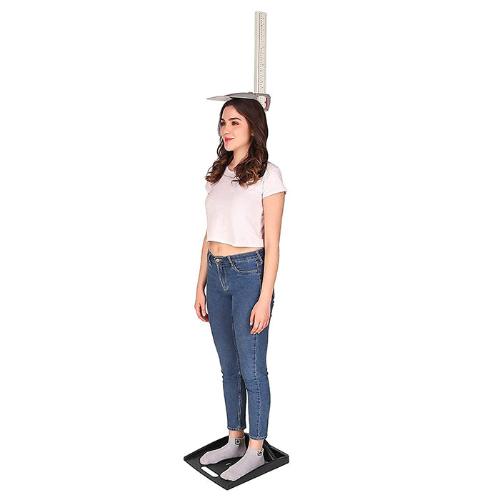
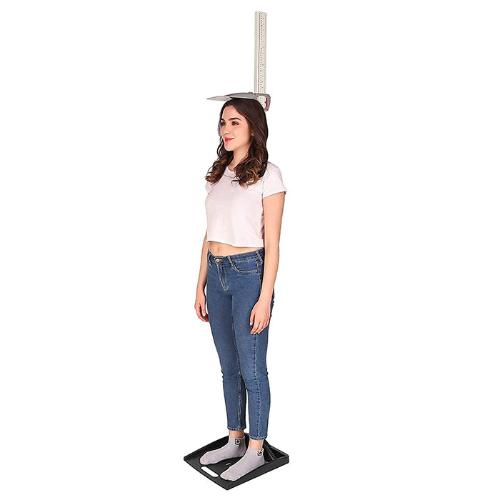
| Height Measuring Scale Stadiometer | Floor-standing portable | 20 to 210 cm, 1 mm graduation, splits into four sections | ₹1,849 |
| Height Measuring Scale with Mechanical Weighing Scale | Height and weight stand | 20 to 205 cm, weighing up to 130 kg, 0.5 kg graduation | ₹2,799 |
| Height cum Weight Measure Stand, Mechanical Scale | Height and weight stand | Acrylic build, analog dial, no batteries | ₹2,999 |
| Height Measuring Scale with Digital Weighing Scale | Height and weight stand | 20 to 205 cm, weighing up to 150 kg, digital display | ₹3,499 |
| 2-in-1 Digital Baby Weight and Height Machine | Baby growth station | Digital display, AC 220V, 6-hour battery backup | ₹13,499 |
For a clinic that only needs height, the portable stadiometer is a common starting point. On the other hand, a busy OPD may prefer a height and weight stand. Always read the product page for the full specification before you choose.
Stadiometer Price: What Decides the Cost?
The stadiometer price depends on the type, the range, the scale, the material, the extra functions and the brand. Therefore, a simple wall tape costs far less than a portable stadiometer, and a combined height and weight stand or a baby growth station costs more. At Meddey, a stature meter is listed at ₹491, the portable stadiometer at ₹1,849 and the digital height and weight stand at ₹3,499, as of 29 September 2026.
How much does a stadiometer cost?
In practice, most clinics choose between a stadiometer alone and a height and weight stand. A stadiometer alone is the lower-cost choice, while a stand with a weighing scale adds the cost of the scale. However, the extra scale saves time. In the Meddey range, the mechanical version costs less than the digital version, and it needs no battery.
What pushes the price up?
- First, a weighing scale built into the stand adds to the cost.
- Second, a digital display costs more than a mechanical dial.
- Third, a wider range and finer graduation need better parts.
- In addition, a stronger frame, such as acrylic or metal, raises the price.
- Finally, brand, warranty and service support also affect the final cost.
Price note: Prices and offers change often. Therefore, please check the live listing, or contact Meddey for bulk and clinic pricing.
Stadiometer for Height Measurement in Different Settings
The best set-up depends on where the device will work. For example, a hospital OPD sees many adults each day, so it needs a stable stadiometer that is fast to read. In contrast, a school health camp needs a light unit that packs into a bag and sets up in a few minutes.
Similarly, a paediatric clinic needs both an infantometer for babies and a stadiometer for older children. Therefore, one device rarely fits every patient group. Also, nutrition and sports centres often prefer a height and weight stand, because it records BMI inputs in a single visit. As a result, staff spend less time and make fewer transcription mistakes.
In every setting, the same rule applies. First, place the device on a firm, level floor. Then, train the team to use one method. Finally, record every value with the date, so that growth trends are easy to see over time.
Buying Checklist for a Stadiometer
Define the use First, decide if you need height only, or height and weight, and for which age group.
Range and graduation Next, check the measuring range and the 1 mm graduation on the scale.
Stability Also, look for a firm base and a rod that stays vertical.
Portability In addition, check if it splits into sections for camps and school visits.
Power and reading type Since batteries can fail, decide between mechanical and digital versions.
Warranty and service Finally, confirm warranty, spare parts and after-sales help.
As a simple rule, buy an infantometer as well if you see infants. Then, train all staff in the same measurement technique.
Care and Calibration
- Check the zero: First, confirm that the scale starts at floor level, and check the reading against a known height.
- Check verticality: Then, use a spirit level or a plumb line to check that the rod is upright.
- Keep it clean: Also, wipe the rod, the headpiece and the base with a mild disinfectant between patients.
- Inspect the headpiece: In addition, make sure it slides smoothly, sits flat and has no cracks.
- Store it safely: Finally, keep portable units dry, and pack the sections so that the scale does not get scratched.
- Check regularly: Test the device often, and replace it if the scale is worn or the rod is bent.
Frequently Asked Questions About Stadiometers
What is a stadiometer used for?
A stadiometer is used to measure standing height for BMI, growth monitoring, nutrition checks, drug dosing and pre-operative care.
What are the different types of stadiometers?
The main types are wall-mounted, floor-standing portable, mechanical, digital, height and weight stands, infantometers for babies, and ultrasonic or laser devices.
What age group is a stadiometer typically used for?
A standing stadiometer suits children from about two years, adolescents and adults. For babies under two years, staff use an infantometer to measure length lying down.
Which is more accurate, a stadiometer or a measuring tape?
A stadiometer is more accurate and more repeatable, because it has a rigid rod and a level headpiece. A tape is acceptable only for rough home estimates.
What is the purpose of a stadiometer?
The purpose is to record height in a standard, repeatable way, so that BMI, growth charts and doses are correct.
How much does a stadiometer cost?
At Meddey, a stature meter is listed at ₹491, a portable stadiometer at ₹1,849 and a height and weight stand from ₹2,799, as of 29 September 2026. Please check the live listing for the latest price.
What is a stadiometer scale?
It is the printed or digital ruler along the rod that you read to get the height. A good scale has fine graduation, such as 1 mm, and a clear zero point.
What is the correct head position for a stadiometer?
The head should be in the Frankfort plane, with the lower edge of the eye socket and the notch above the ear in a horizontal line, and the person should look straight ahead.
Where to Buy a Stadiometer Online in India?
Clinics, hospitals, schools and screening teams can buy stadiometers from medical equipment stores. Before you buy, compare the range, scale, stability, portability and price. Meddey lists portable stadiometers, height and weight stands and infantometers, and its support team can help you choose.
View StadiometersContact MeddeyVisit MeddeyDisclaimer
This article is for general education. Therefore, it does not replace maker instructions, measurement protocols or clinical judgement. Trained staff should measure height and follow the device manual. Also, prices and product details may change over time.
Explore Medical Collections
All Categories
Abdominal & Maternity Support

Accessories

Accu-Chek Instant Strips: Use, Compatibility, Price & Blood Sugar Testing Guide
Accu-Chek Instant Strips: Uses, Features & Complete Guide

Accupressure Products for Pressure Point Therapy, Pain Relief & Wellness

accupuncture

Acupuncture Needles & Supplies

Advanced Physiotherapy Machines & Lumbar Physiotherapy

Airways

Ambulance

Anatomy Models
Anesthesia Machine

Anesthesia Products
Ankle Support, Braces & Walker Boots for Recovery
Ankle Weights & Exercise Weights for Home & Rehab
You may also need
FOR YOURecommended for you
Save 44%
Save 26%
Save 26%