


Featured ChoiceSave 21%


About this collection
Theraloop: Uses, Exercises, Resistance Levels & Professional Buying Guide
Learn what Theraloop bands are used for, how a thera loop band differs from a flat resistance band, common thera loop exercises, resistance progression, safety and professional buying guidance.
Theraloop is a term commonly used for continuous-loop resistance bands designed for exercise, physiotherapy, rehabilitation and strength training. Unlike a long flat band that has two open ends, a loop band forms a complete circle. As a result, users can place it around the legs, arms or another suitable area without tying a knot first.
In physiotherapy, a thera loop band can support hip, knee, ankle, shoulder and general strengthening exercises. For example, a therapist may use a loop during side-stepping, hip-abduction work or lower-limb activation. Meanwhile, fitness users may include loops in squats, warm-ups and strength routines.
One major advantage is portability. Because loop bands are small and lightweight, clinics can keep several resistance levels without using much storage space. In addition, suitable exercises can often continue at home after a healthcare professional teaches the correct technique.
However, the correct resistance still matters. A loop that is too strong may reduce movement quality, while a very light band may not create enough challenge. Therefore, professionals should select resistance according to the exercise, user ability and stage of rehabilitation.
This guide explains the purpose of Theraloop, the difference between regular Thera Bands and loops, common thera loop exercises, resistance levels, safety and buying considerations.
You can also browse the Theraloop collection available on Meddey.
What Is a Theraloop?
A Theraloop is a continuous elastic resistance loop. In simple terms, it is a resistance band that has no open ends.
The closed shape makes it convenient for exercises that require the band to stay around the legs, knees, ankles or arms.
Common uses include:
- Hip strengthening
- Glute activation
- Knee rehabilitation
- Ankle exercise
- Shoulder exercise
- Warm-up routines
- Balance training
- General resistance exercise
In addition, loop bands come in different resistance levels. Therefore, clinicians can increase exercise difficulty as strength improves.
What Is a TheraBand Used For?
TheraBand products provide elastic resistance during exercise. As the band stretches, the user must produce force against increasing tension.
Healthcare professionals commonly use resistance bands for:
Strength Training Adds external resistance without large weights or machines.
Rehabilitation Supports controlled strengthening during suitable recovery programmes.
Mobility Work Can assist or resist selected movements according to the exercise.
Balance Training May be combined with lower-limb exercises that challenge balance and control.
Sports Preparation Useful for selected warm-up, activation and conditioning exercises.
Home Exercise Compact equipment can support professionally prescribed home routines.
Therefore, TheraBand products are not limited to one body area or one type of user.
What Is the Difference Between Thera Bands and Thera Loops?
The main difference is shape.
A standard resistance band is usually a long flat strip with open ends. By contrast, a thera loop band forms a continuous circle.
| Feature | Flat Thera Band | Thera Loop |
|---|---|---|
| Shape | Long strip with open ends | Continuous closed loop |
| Grip | User holds or anchors the ends | Often placed around limbs |
| Lower-body use | Useful | Especially convenient |
| Knot needed | May require tying for some exercises | No knot required |
| Resistance progression | Available in several levels | Available in several levels |
| Typical use | Upper and lower body | Hip, glute, leg and other loop-based exercises |
Therefore, neither option is automatically better. Instead, the better design depends on the planned exercise.
Why Use a Continuous Loop Band?
A continuous loop offers convenience because users do not need to tie the material before many exercises.
For example, the band can sit above the knees during lateral stepping. Meanwhile, it can be placed around the ankles for selected hip movements.
In addition, a closed loop reduces the need to repeatedly make and undo knots.
Official THERABAND information also describes its professional loop bands as useful for lower-body strength, balance and rehabilitation.
As a result, loops are especially popular in lower-limb training.
Do Resistance Loop Bands Actually Work?
Yes. Elastic resistance can create a meaningful strength-training stimulus when the exercise and resistance level are appropriate.
As the band stretches, tension increases. Therefore, the muscles must work against the resistance during the movement.
Recent research also supports elastic-band training. A 2025 systematic review and meta-analysis involving older adults reported improvements in several measures of lower-limb strength and balance after elastic-band resistance programmes.
In addition, recent clinical literature supports the use of elastic resistance within shoulder rehabilitation.
However, results depend on proper exercise selection and progression. Simply wearing or stretching a band without a clear programme does not guarantee improvement.
Clinical point: loop bands can provide effective resistance, but exercise dose, technique and progression still determine the quality of training.
Theraloop Resistance Levels
Professional loop bands commonly use color coding to identify resistance.
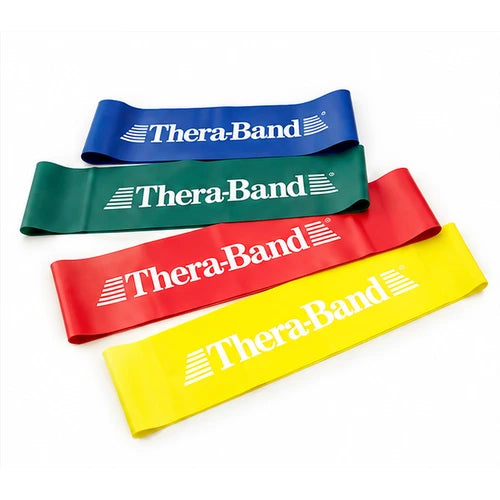
Current Meddey Theraloop products include Yellow, Red, Green and Blue options. These colors provide a simple progression from lighter to stronger resistance.
| Color | General Level | Possible Use |
|---|---|---|
| Yellow | Light | Beginners, lower-load exercise and selected rehab work |
| Red | Medium-Light | Progressive strengthening and general exercise |
| Green | Medium / Heavy | Stronger users and later-stage training |
| Blue | Higher Resistance | More demanding strength exercises where suitable |
Official THERABAND documentation also places its loop products within a progressive color-based resistance system.
However, color systems can differ between manufacturers. Therefore, clinicians should check the exact product rather than assuming every brand uses identical resistance.
How to Choose the Right Theraloop Resistance
The correct resistance should challenge the target muscles without causing poor form.
For example, a user performing hip abduction should be able to complete the movement without excessive trunk leaning or uncontrolled motion.
In addition, the same person may need different loop levels for different exercises.
A useful progression approach is:
- Start with controlled movement
- Select a resistance that allows good technique
- Complete the planned repetitions
- Increase resistance only when the exercise becomes too easy
- Reduce resistance if form worsens
Therefore, stronger resistance is not automatically better.
Common Thera Loop Exercises
Thera loop exercises can target several body regions. However, exercise selection should match the user's condition and goal.
1. Side-Stepping
Place the loop around the legs at the level recommended by the therapist. Then, maintain controlled tension while stepping sideways.
This movement often targets the hip muscles. In addition, it can support lower-limb control.
2. Standing Hip Abduction
Position the loop around the legs and move one leg outward while maintaining trunk control.
Therefore, this exercise can challenge the hip-abductor muscles.
3. Glute Bridge with Loop
Place the band above the knees while performing a bridge. Meanwhile, maintain gentle outward pressure against the loop.
4. Seated Hip Abduction
Sit in a stable chair with the loop around the thighs. Next, move the knees outward against the resistance.
5. Squat with Loop
Place the loop above the knees and perform a controlled squat. However, the user should maintain proper knee alignment throughout the movement.
6. Ankle-Control Exercises
A therapist may position the loop to add resistance to selected ankle movements.
Therefore, loop bands can support ankle strengthening when used correctly.
Theraloop for Hip and Glute Strengthening
Hip and glute exercises are among the most common loop-band applications.
For example, side steps, clam-type movements and hip abduction can use elastic resistance to challenge the hip muscles.
Meanwhile, loop resistance can encourage controlled muscle activation during warm-up exercises.
However, simply placing a band around the knees does not guarantee good muscle recruitment. Movement quality still matters.
Therefore, clinicians should watch alignment, trunk control and range of motion.
Theraloop for Knee Rehabilitation
Loop bands can form part of selected knee rehabilitation programmes.
For example, therapists may use them during hip strengthening because hip control can influence lower-limb movement.
In addition, loops may be added to suitable squats, stepping drills or functional exercises.
However, knee pain has many possible causes. Therefore, exercise selection should follow assessment rather than using one standard routine for every patient.
Theraloop for Ankle Rehabilitation
A thera loop band can also add resistance to selected ankle exercises.
Depending on setup, clinicians may use resistance for ankle control, strength and movement practice.
Meanwhile, loop exercises may be combined with balance work when appropriate.
As a result, one compact tool can support more than one part of lower-limb rehabilitation.
Theraloop for Shoulder and Upper-Body Exercise
Although loop bands are especially popular for lower-body work, they can also support selected upper-body exercises.
For example, a small loop may be used during shoulder activation drills when the technique is appropriate.
Recent 2025 clinical literature also discusses elastic resistance as a useful tool for shoulder rehabilitation and exercise prescription.
However, the correct resistance and movement depend on the shoulder condition.
Therefore, painful shoulder exercises should not simply be made harder by using a stronger loop.
Theraloop for Older Adults
Elastic resistance can offer a practical strength-training option for older adults because it allows gradual progression.
Recent research is encouraging. A 2025 review of 25 studies involving 1,318 participants found improvements in lower-limb strength and balance measures after elastic-band resistance training.
In addition, loop bands are compact and can support chair-based or standing exercises.
However, balance ability and fall risk should be considered. Therefore, some users may require supervision or stable support during standing exercises.
Theraloop for Physiotherapy Clinics
Clinics can use Theraloop bands as simple, space-saving exercise tools.
Key advantages include:
- Compact storage
- Several resistance levels
- Easy progression
- Lower-body exercise options
- Home-exercise continuity
- Low equipment footprint
- Simple transport between treatment areas
Moreover, clinics can stock several colors so the therapist can adjust resistance for different patients.
Therefore, loop bands can be a practical addition to a rehabilitation department.
How to Use a Theraloop Correctly
Correct use starts with inspecting the band.
First, check for tears, cuts, weak areas or other visible damage. Next, choose a resistance level that matches the exercise.
During movement, maintain slow and controlled tension. In addition, avoid sudden snapping or jerking.
Good technique includes:
- Stable posture
- Controlled speed
- Appropriate resistance
- Safe band position
- Normal breathing
- Proper exercise range
Finally, stop the exercise if the user develops sharp pain or another unexpected symptom.
Safety point: inspect loop bands before every use and replace damaged products. Patients recovering from injury or surgery should follow professional exercise guidance.
How Far Should a Theraloop Be Stretched?
The correct amount of stretch depends on the product and resistance system.
Official THERABAND information reports resistance according to elongation. For example, its professional loop bands use defined pull forces at specific stretch levels.
However, users should not treat maximum stretch as an exercise target.
Instead, the loop should provide enough tension for the planned movement while remaining within manufacturer guidance.
Therefore, controlled exercise is more important than stretching the band as far as possible.
Theraloop vs Resistance Tubes
| Feature | Theraloop | Resistance Tube |
|---|---|---|
| Shape | Continuous flat loop | Round elastic tube |
| Handles | Usually no handles | May include handles |
| Common use | Leg, hip and activation exercises | Upper and lower-body strengthening |
| Position | Often around limbs | Held or anchored |
| Storage | Very compact | Compact |
Both designs can provide useful elastic resistance. Therefore, clinics may keep both options for different exercises.
Which Brand of TheraBand Is Best?
“TheraBand” is itself a specific brand name, although people sometimes use the term informally for resistance bands in general.
There is no single resistance-band product that is best for every user. Instead, clinicians should compare resistance consistency, material, size, intended use and patient needs.
THERABAND is widely used in rehabilitation and offers a structured color-based progression system. Its manufacturer also provides professional loop, flat-band, tubing and CLX options.
However, brand name should not replace clinical judgement.
Therefore, the best product is the one that provides the correct resistance and format for the planned exercise.
How Much Do TheraBands Cost?
The price varies by band type, size, resistance level and whether the product comes as a single band or set.
Current Meddey listings provide several examples.
Current Meddey Examples
Theraband Loop Band Combo Yellow, Red, Green and Blue: approximately ₹3,949
Theraband Loop Band Set: approximately ₹4,249 on another current listing
Original TheraBand Blue Latex-Free Band 1.5 m: approximately ₹949
Original TheraBand Black Latex-Free Band 1.5 m: approximately ₹1,049
Prices may change because of stock, offers and product updates. Therefore, buyers should check the current product page before ordering.
Theraloop Products Available on Meddey
Meddey currently offers a dedicated Theraloop collection.
The collection includes continuous-loop resistance products intended for:
- Hip activation
- Glute strengthening
- Lower-body exercise
- Rehabilitation
- Home training
- Fitness programmes
The current Theraband Loop Band Combo includes Yellow, Red, Green and Blue bands.
In addition, the compact loop design requires little storage space.
View Theraband Loop Combo Browse Theraloop CollectionHow to Progress Thera Loop Exercises
Progression does not always mean using the strongest band immediately.
Instead, therapists can make an exercise harder in several ways:
- Move to a stronger loop
- Increase repetitions
- Add an extra set
- Slow the movement
- Increase movement range
- Change body position
- Add a balance challenge when suitable
However, movement quality should remain stable.
Therefore, the next resistance level should only be added when the user can control the current exercise well.
How to Choose a Theraloop
1. Define the Goal
First, decide whether the loop is for rehabilitation, warm-up, strength or general exercise.
2. Select Resistance
Next, choose a level that challenges the user without causing poor form.
3. Check Loop Size
Then, make sure the loop length suits the planned exercise.
4. Review Material
Afterwards, check whether the product contains latex if allergy is a concern.
5. Compare Progression Levels
In addition, a set with several resistance levels can make progression easier.
6. Review Durability
Check the material regularly for wear and tear.
7. Confirm Intended Use
Finally, choose a product suitable for the clinical or exercise setting.
Latex and Allergy Considerations
Some professional loop resistance bands use natural rubber latex.
For example, official THERABAND professional loop information states that these bands contain natural rubber latex.
Therefore, users with known latex allergy should not assume that every loop is safe for them.
Instead, the exact material should be checked before use.
In addition, clinics may want to keep suitable latex-free resistance products available for patients who need them.
Theraloop Safety Tips
Resistance loops are simple tools, but damaged bands can fail suddenly.
Therefore, inspect them before every session.
Important safety points include:
- Check for cuts or tears
- Replace damaged loops
- Avoid sharp surfaces
- Do not use uncontrolled jerking movements
- Use stable exercise positions
- Keep the band away from the face when possible
- Follow manufacturer stretch limits
- Stop if pain increases
Official THERABAND safety information also recommends eye protection when using professional loop bands because elastic products can recoil if they fail or slip.
Professional point: equipment safety is only one part of safe exercise. The resistance level, patient condition and movement technique also need attention.
How to Care for Theraloop Bands
Regular care can improve hygiene and help identify worn bands before they fail.
After use, follow the cleaning instructions supplied with the exact product.
In general, resistance products should be stored away from excessive heat and direct sunlight.
In addition, clinics should inspect the material for:
- Cuts
- Punctures
- Thin areas
- Cracks
- Sticky surfaces
- Damaged edges
Therefore, visibly damaged bands should be replaced rather than repaired for continued clinical use.
Common Mistakes with Thera Loop Exercises
The most common mistake is choosing too much resistance.
For example, a very strong band may cause the user to lean or rotate instead of using the intended muscle group.
Other common problems include:
- Moving too quickly
- Allowing the knees to collapse inward
- Using poor posture
- Holding the breath
- Using damaged loops
- Using one resistance level for every exercise
- Ignoring pain
- Progressing before technique is ready
Therefore, good movement should come before stronger resistance.
Frequently Asked Questions About Theraloop
What is a TheraBand used for?
TheraBand products provide elastic resistance for strength, mobility, rehabilitation, balance and exercise programmes.
What is the difference between Thera Bands and Thera Loops?
A flat band has open ends, while a Thera Loop forms a complete circle. Therefore, loops are often more convenient for lower-body exercises.
Which brand of TheraBand is best?
TheraBand is itself a resistance-product brand. The best product depends on the exercise, resistance level, material and user needs.
How much do TheraBands cost?
Prices vary by type and resistance. Current Meddey examples range from under ₹1,000 for selected single flat bands to around ₹3,949–₹4,249 for loop sets.
What is Theraloop used for?
Theraloop is commonly used for hip and glute activation, lower-body strength, knee and ankle rehabilitation, warm-ups and other resistance exercises.
Do loop bands actually work?
Yes. Elastic resistance can support strength and rehabilitation when the exercise provides enough load and the user follows a suitable programme.
Which Theraloop resistance should a beginner use?
A beginner should start with a resistance that allows controlled movement. Therefore, lighter resistance is often a better starting point.
Can Theraloop be used for knee rehabilitation?
Yes, selected loop exercises may form part of knee rehabilitation. However, a healthcare professional should choose exercises according to the condition.
Can Theraloop be used every day?
Frequency depends on the exercise, resistance and training plan. Therefore, users should follow the programme provided by their therapist or trainer.
Are Theraloop bands suitable for hospitals and clinics?
Yes. Their small size, resistance progression and exercise versatility can make them useful in physiotherapy and rehabilitation departments.
Do Theraloop bands contain latex?
Some professional loop bands do contain natural rubber latex. Therefore, check the material before use when latex allergy is a concern.
Professional Theraloop Buying Checklist
- Define the exercise goal
- Choose suitable resistance levels
- Check loop length
- Confirm material
- Check for latex where relevant
- Review resistance progression
- Choose several levels for clinic use
- Review durability
- Check cleaning guidance
- Inspect packaging and safety instructions
- Compare current price
Overall, a good Theraloop should provide reliable resistance, suitable progression and a size that works for the planned exercise.
Where to Buy Theraloop Bands Online in India?
Physiotherapists, clinics, hospitals, trainers and home users can purchase loop bands from rehabilitation and exercise-equipment suppliers.
Before buying, compare:
- Resistance level
- Number of bands
- Loop size
- Material
- Latex content
- Product quality
- Intended use
- Current price
Meddey currently provides Theraloop, original TheraBand products and wider exercise and rehabilitation equipment.
Browse Theraloop View Loop Band Combo Browse TheraBand Products Exercise & Rehabilitation EquipmentConclusion
Theraloop is a practical elastic-resistance tool for physiotherapy, rehabilitation, strength training and general exercise.
The continuous loop format makes it especially convenient for hip, glute and lower-body movements. Meanwhile, selected thera loop exercises can also support the ankle, shoulder and wider functional training.
Recent research continues to support elastic resistance as a useful training method for strength and balance. However, effective exercise still depends on the correct resistance, movement technique and progression.
In addition, the difference between a standard flat band and a thera loop band is mainly the shape and setup. Therefore, both can be useful when chosen for the right exercise.
Safety also matters. Users should inspect bands regularly, avoid excessive stretch and replace damaged products.
Ultimately, the best Theraloop is the one that matches the user's ability, exercise goal and stage of rehabilitation.
You can compare current Theraloop resistance bands available on Meddey.
Medical & Exercise Disclaimer
This article provides professional education and general exercise guidance only. It does not replace individual medical assessment or a prescribed rehabilitation programme. Patients recovering from injury, surgery or a significant medical condition should perform resistance exercises according to guidance from a qualified healthcare professional. Stop exercising if sharp pain, dizziness, unusual weakness or another concerning symptom occurs.
Explore Medical Collections
All Categories
Abdominal & Maternity Support

Accessories

Accu-Chek Instant Strips: Use, Compatibility, Price & Blood Sugar Testing Guide
Accu-Chek Instant Strips: Uses, Features & Complete Guide

Accupressure Products for Pressure Point Therapy, Pain Relief & Wellness

accupuncture

Acupuncture Needles & Supplies

Advanced Physiotherapy Machines & Lumbar Physiotherapy

Airways

Ambulance

Anatomy Models
Anesthesia Machine

Anesthesia Products
Ankle Support, Braces & Walker Boots for Recovery
Ankle Weights & Exercise Weights for Home & Rehab
You may also need
FOR YOURecommended for you
Save 21%