


Featured ChoiceSave 27%

Save 21%


Bed table: how to pick the right height and check stability

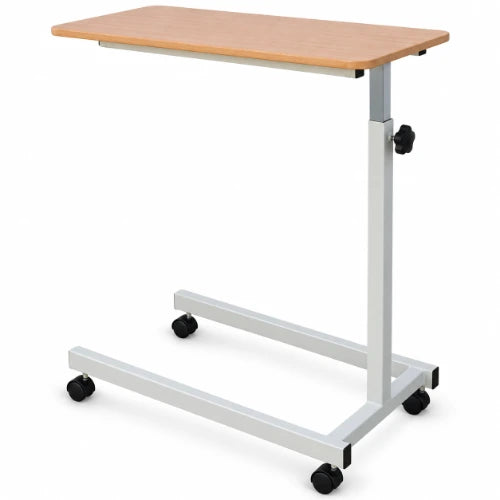
Bed table means a movable or portable surface for meals, reading, or laptop use while sitting in bed. Choose one that reaches a comfortable working height, clears your legs, and stays secure during ordinary use. Start with your sitting position and available space, rather than choosing by appearance alone.
What height should a bed table be for eating comfortably?
Set the bed table around your seated elbow height as a starting point, then check the fit. Your elbows should bend comfortably, with shoulders relaxed and forearms resting lightly on the surface. Sit upright, or slightly forward if comfortable and consistent with professional advice. Do not bend towards a low plate or raise your shoulders towards a high surface.
There is no single height that suits every person in bed. Measure while sitting in the position you will actually use. A measurement taken while lying back will not represent your upright eating position.
Try the position with an empty plate before bringing food to bed. Place a spoon beside it and practise reaching without twisting. Notice whether you lift your shoulders, stretch your arms, or bend your neck.
Use these observations to guide small adjustments, rather than chasing a particular number. Ask a family member to watch from the side. They may notice an awkward reach that you miss.
For medically guided use, ask your doctor or trained professional about suitable positioning. Follow their advice if it differs from general setup suggestions. A table adjustment should support your care plan, not replace it.
How do you measure for a bed table?
Prepare a simple measurement sheet before comparing options. Record the height you need, the available floor space, and the clear space beneath your bed. Keep all measurements in the same unit, such as centimetres.
Ask someone to help while you sit comfortably in bed. Avoid stretching down to hold the measuring tape yourself. The aim is to record your normal position, not a position created by measuring.
Use this practical sequence:
-
Sit in your usual supported position for the planned activity.
-
Bend your elbows and relax your shoulders.
-
Measure from the floor to the intended tabletop level.
-
Record the space needed above your thighs and knees.
-
Measure the route the base must follow beneath the bed.
-
Check the space available when moving it away.
These measurements form a personal fit checklist, not a universal sizing rule. Compare them with the maker’s drawings and adjustment range. Product dimensions differ, including the height and shape of the base.
Also write down the main task: meals, reading, or laptop use. If two people will share the table, record both users’ needs. This makes comparisons clearer than relying on a broad description such as adjustable.

Choose an adjustable bed table with a useful height range
An adjustable bed table needs to reach your working height, not merely offer several settings. Check both its lowest and highest positions. Confirm that the measurement refers to the tabletop, rather than another frame component. Makers publish different height ranges for different designs.

Treat your recorded height as a target within that range. Ask how the adjustment works and whether you can use it comfortably. A suitable range is less useful when the release control feels difficult to operate.
Before deciding, request answers to these practical points:
-
Can the surface reach your measured eating position?
-
Can you adjust it without stretching across the bed?
-
Does the control require gripping, squeezing, or turning?
-
Can a family member reach the control from the available side?
-
Does the manual explain how to confirm that it has locked?
Try the mechanism with the surface empty. Follow the model’s instructions rather than assuming every adjustable design works alike. Some tops rise with light upward pressure, while lowering requires a release control.
Keep a note of your preferred setting. Recheck your posture whenever you change activities or sitting position.

How big should a bed table top be?
Choose tabletop width from the items you need together, not from the largest item alone. A laptop may fit while leaving no useful space for a mouse. A meal plate may fit while pushing the drinking cup towards an edge.
Before choosing, arrange your usual items within a measured rectangle. Use an empty thali, katori, spoon, and cup for a meal layout. For work, use the actual laptop, keyboard, and mouse where possible.
Check these practical details:
-
Your plate sits fully inside the usable surface.
-
You can reach each item without crossing over another.
-
Your forearms have comfortable room near the front.
-
A mouse can move beside the keyboard.
-
Raised edges do not reduce the working area unexpectedly.
-
You can remove one item without disturbing everything else.
For laptop use, enough space for the keyboard and mouse matters alongside device width. A small top may hold the computer but fail to support the whole task. Keep the pointing device close enough to avoid reaching sideways.
Ask for usable dimensions inside any raised rim. Overall width alone may not answer your layout question. Photograph your trial arrangement so you can compare it with the product drawing later.
Compare bed table features by the problem they solve
Start with the task that matters most in bed. Then identify which features support that task without complicating daily use. This comparison offers questions to investigate, rather than a ranking.
|
Feature |
Practical purpose |
What to check |
|---|---|---|
|
Adjustable height |
Positions the surface for different users or tasks |
Whether its range includes your measured height |
|
Lockable wheels |
Secure a mobile base before use |
Which wheels lock and how each brake operates |
|
Tilting main surface |
Offers an angled position for reading |
Whether the angle locks securely |
|
Separate level section |
Provides a level area beside a tilted section |
Whether it has enough usable space |
|
Raised edge |
Provides a boundary around part of the surface |
Whether it obstructs wrists or cleaning |
|
Low-profile base |
Helps the base enter limited space beneath a bed |
Actual clearance along the full insertion route |
|
Accessible controls |
Lets the intended person operate adjustments |
Grip, reach, and release method |
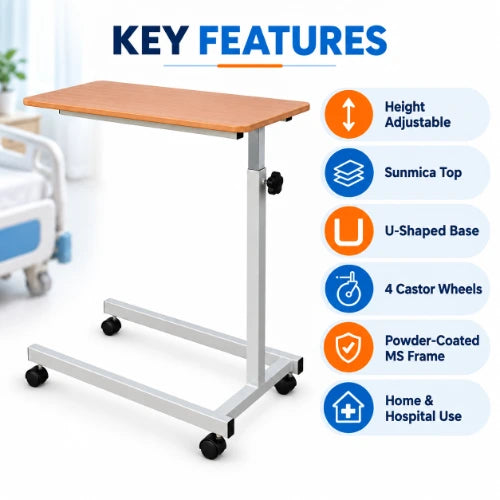
These features appear in different combinations across manufacturers’ designs. A tilting surface does not automatically include a separate level section. A wheeled base also does not automatically mean every wheel has a brake.
Mark each feature as essential, useful, or unnecessary for your household. This keeps attention on fit and operation. It also helps you avoid choosing extra mechanisms that nobody expects to use.

Check bed table clearance beneath and beside the bed
Check the whole base, not just the part visible beside the bed. Measure the narrowest point along its intended route. Compare that space with the maker’s base dimensions and clearance requirements. Low-clearance designs exist, but their dimensions still need checking against your bed.
Plan the approach before placing anything on the surface. Decide which side offers the clearest access for the user and helper. Keep the intended route free from loose objects.
During an empty trial, ask someone to observe the base. Note where it stops and whether the top reaches the required position. Do not force the base past an obstruction.
Check movement away from the bed as carefully as movement towards it. You need a practical place to leave it between activities. Plan this before it carries a meal or computer.
Make these notes during the trial:
-
Side used for approaching the bed.
-
Narrowest point beneath the bed.
-
Available reach over the bed.
-
Position of the adjustment control.
-
Space needed to move it clear.
If the base cannot enter far enough, reconsider the design. Extra tabletop height will not solve a blocked approach. Treat clearance and height as separate checks.
Learn the bed table controls before loading it
Read the operating instructions before adjusting the bed table beside someone in bed. Identify the height release, tilt control, and wheel brakes separately. Keep fingers clear of moving joints and release mechanisms.
Practise with an empty surface first. Ask another household member to read the relevant instructions while you operate each control. Stop if a movement differs from what the manual describes.
Build a repeatable routine: empty, adjust, secure, then load. This gives you time to notice an incomplete lock before adding a plate. It also avoids learning an unfamiliar release while managing a spill.
If two controls look similar, explain their functions to everyone helping at home. Do not assume the larger handle controls height. Use the names and diagrams provided by the maker.
After assembly, confirm that the required fittings are secure. Do not remove screws simply because they appear to block movement. Some manufacturers specify particular assembly or shipping-screw procedures.
Ask for help if the instructions are unclear. Keep the manual somewhere the household can find easily. Knowing how to stop an adjustment matters as much as knowing how to start one.
How do I keep a bed table steady during use?
Keep the bed table on a level floor, secure its adjustments, and engage the fitted wheel brakes before use. Inspect the frame and moving parts each time. Stop using it if the surface slips, the base rocks, or parts appear damaged.
Begin with the table empty and nobody relying on it. Check that it sits as intended on the floor. Look for a wheel resting against an obstruction or a visibly loose connection.
Next, follow the manual’s method for securing height and tilt. Use only light hand contact when checking ordinary operation. Never test stability by leaning heavily or pushing down with body weight.
Then rehearse the planned activity with empty items. Place the plate where it will sit during a meal. Try normal spoon movements and reaching for an empty cup.
Watch the top and base separately. Record whether movement comes from the wheels, adjustment column, or tabletop joint. This description will help when seeking technical support.
A careful trial is not a strength test or certification. It is a chance to identify obvious fit or operating problems. If anything feels uncertain, remove the items and resolve the concern before continuing.
Lockable wheels help secure a mobile bed table
Unlocked wheels can let an overbed table move when someone reaches or touches the surface. Lockable wheels provide a way to secure the mobile base during use. Engage the fitted brakes according to the manual, then confirm that the table stays positioned.
Check which wheels actually have locks. Some designs combine locking and nonlocking wheels. Learn where the brake pedals sit before moving the table beside the bed.

During your empty trial, approach from the side you will use daily. Ask the intended helper to operate each brake. Note whether they can reach it without an awkward stretch.
Do not treat a clicked pedal as the only check. Observe the base during ordinary, light contact. If the base still moves unexpectedly, stop and investigate.
Make locking part of one clear household sequence: position first, brake next, then place the items. When moving away, remove the items before releasing the brakes.
Brakes do not turn the bed table into a standing support. Keep that distinction clear when explaining the controls to an older family member. A secured meal surface still has a different purpose from body-weight support.

What kind of floor does a bed table need?
Use the table on the level surface required by its maker. Mobile models may also specify smooth, clean indoor flooring. Uneven or dirty surfaces can affect movement, while damaged castors can reduce stability.
Before each setup, look at the floor around the bed. Remove small objects from the intended base route. Check again after cleaning or rearranging the room.
Treat a change in floor position as a reason to repeat the empty trial. Do not assume a bed table will behave identically in every location. Watch all contact points as you position it.
If it rocks, identify the cause rather than covering it with extra weight. Move it away from the user while you investigate. Do not improvise packing beneath one wheel as a routine solution.
Keep this floor check separate from the wheel-brake check. A brake may be engaged while the base is poorly positioned. Both need attention before the surface carries food.
For shared use, agree on a usual approach route beside the bed. Keep that route clear between activities. This makes daily setup easier to repeat and inspect.
Keep body weight off the bed table
Do not lean heavily, sit, or stand on an ordinary overbed table. Never use it for standing or transferring unless the maker explicitly permits that exact use. Manufacturer instructions commonly prohibit leaning and using the table when getting up.
Light forearm contact during an activity is different from pushing yourself upright. Explain this difference clearly before the first use. If someone instinctively grabs the top when moving, pause and seek professional advice.
Check the stated load limit for your specific model. Count all items placed on the surface together. Do not borrow a limit from a similar-looking model or another product description.
Plan the layout before bringing items to bed:
-
Include the weight of the meal tray and filled containers.
-
Include the laptop and any additional equipment.
-
Follow any instructions about spreading the load.
-
Remove items that are unnecessary for the current activity.
-
Keep the manual available for anyone sharing the table.
Do not use the load rating to judge whether body-weight support is acceptable. Those are different uses. Ask the maker about unclear wording rather than assuming a high rating permits leaning.
When is a tilting bed table useful for reading?
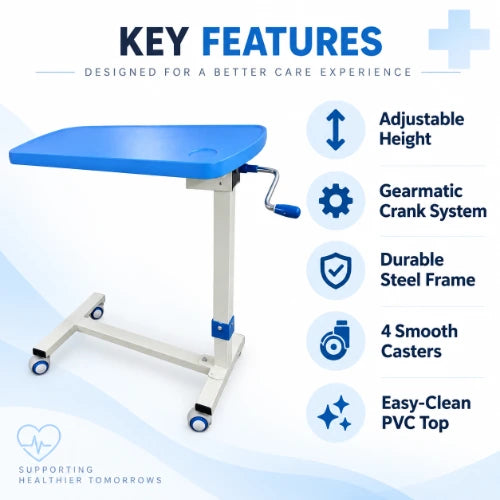
A tilting tabletop can be useful for reading in bed when the design supports that activity. Some designs offer a tilting main section and a separate section that remains level. Check the exact arrangement before choosing.
For meals, choose a level surface rather than placing dishes on a slope. Remove food and drinks before changing the angle. Secure the tilt mechanism before returning items to the tabletop.
Try an empty reading setup first. Place your usual book on the surface and practise turning pages. Notice whether a raised stop interferes with your hands or covers part of the page.
Use the trial to answer practical questions. Can you reach the angle control from bed? Can a helper adjust it from the available side? Does the chosen position leave enough room for your hands?
Do not assume the maximum tilt will feel comfortable. Start with the activity you want to perform and adjust gradually. A useful angle is one you can actually use without an awkward reach.
For a split top, check both sections separately. Confirm which part moves before setting anything down. Keep drinks away from a moving or tilted section.

What do bed table edge stops and raised rims do?
Edge stops provide a boundary for items on the tabletop. Depending on the design, raised edges may help retain objects or contain small spills. Check the maker’s description rather than assuming every raised rim serves the same purpose.
Think about the objects you plan to use. A book needs a different trial from a thali or laptop. Place each item on the usable surface and check how the edge affects it.
For reading, try turning pages without lifting the whole book. For typing, check whether the front edge touches your forearms or wrists. For meals, confirm that dishes sit flat rather than resting partly on the rim.
Examine the corners and joints during a cleaning demonstration. Ask how to clean the area beside a removable stop, if fitted. Avoid choosing a feature you cannot maintain comfortably.
Do not treat an edge stop as a substitute for careful placement. Keep cups and dishes well inside the surface. Continue checking the height, locks, and base position as separate tasks.
A useful rim should suit your activity without becoming an obstacle. Test that balance with your own items wherever possible.
How should you set out a meal on a bed table?
Start with only the items needed for that meal. Use an empty thali, one katori, a spoon, and an empty cup during rehearsal. Add other dishes only after checking the basic arrangement.
Ask the person in bed to choose the plate position. Then practise reaching for each item without lifting or moving the table. Notice which objects force a sideways stretch or cross-body reach.
Try this layout check:
-
Put the main plate directly ahead of the user.
-
Place the spoon where the usual hand can reach it.
-
Leave a clear route for lifting the cup.
-
Keep serving containers outside the immediate eating area.
-
Leave enough free space to set the cup down again.
These are trial suggestions, not a prescribed arrangement. Adjust them to the person’s reach, hand preference, and professional advice. Discuss repeated difficulty with an occupational therapist rather than continually adding equipment.
Practise clearing the surface too. Decide who will remove dishes and when the table will move away. A workable meal setup includes both placing items and taking them away without rushing.
Helping an older adult eat in bed
An older adult may use a bed table for meals when the setup and their individual abilities allow it. Age alone does not establish whether eating in bed is appropriate. Consider alertness, sitting position, reach, and any existing eating or swallowing advice.
Bring the empty bed table into position before serving. Ask whether the person can see the plate and reach the spoon comfortably. Let them describe what feels difficult instead of assuming the setup works.
For medically guided use, involve the doctor or relevant trained professional. Follow any individual instructions about positioning or assistance. The table provides a surface; it does not assess eating ability.
Make the first trial calm and unhurried. Explain which controls the person can use and which require help. Agree that nobody should grab the tabletop to stand.
If the person becomes tired, drowsy, or starts coughing during eating, stop and assess the concern. Seek clinical advice about persistent or new difficulties. Do not assume changing tabletop height will resolve the problem.
Keep the person involved in decisions. A practical table setup should reflect their preferences as well as the household’s routine.
Keep hot drinks away from bed table edges
Do not place hot tea, coffee, or other hot drinks near the tabletop edge. Choose a level area well inside the surface. Keep the cup clear of adjustment controls and the path used for moving other items.
Rehearse the arrangement with an empty cup first. Ask the person to lift it and return it several times. Watch whether the handle position or nearby plate makes the movement awkward.
Use the rehearsal to decide whether the drink belongs on the tabletop at that moment. If space is cramped, remove unnecessary items first. Do not squeeze a cup beside a laptop merely because it fits.
Before adjusting or moving the bed table, remove the drink. Avoid carrying a hot cup while simultaneously operating wheel brakes. Give each task your full attention.
If shaking hands or a weak grip makes drinking difficult, ask an occupational therapist about suitable options. Adapted cups and other equipment need individual consideration, especially when swallowing difficulties are also present.
A raised rim should not encourage edge placement. Keep the layout simple and leave a clear place for setting the cup down. Recheck the arrangement whenever the activity changes.
How much room does a laptop need on a bed table?
A laptop table for bed needs room for the whole task, including keyboard and mouse use. Device width alone is not enough. Keep the mouse nearby, your shoulders relaxed, and your hands aligned comfortably with your forearms.
Measure your laptop with the screen open. Add the space used by your mouse during normal movement. If you use a separate keyboard, include its actual footprint in the trial.
Mark the proposed tabletop dimensions on a clear surface. Arrange the equipment inside that area and practise a short task. Notice whether your elbows move outward or you reach repeatedly towards the mouse.
Check these details during the trial:
-
Keyboard and mouse both fit within the usable area.
-
The laptop sits fully supported.
-
Raised edges do not interfere with typing.
-
The screen faces you rather than sitting off to one side.
-
Cables can leave the surface without crossing your hands.
-
A drink is not competing for the remaining space.
A laptop combines screen and keyboard positions, which can create setup compromises. Raising the screen may require a separate keyboard and mouse. Reassess whether the bed table has enough room for that arrangement.
Do not keep using an uncomfortable arrangement simply because the computer fits. Change the task or seek setup advice when repeated adjustments do not help.

Can one bed table work over a bed and a chair?
Some overbed tables are designed for use with both beds and chairs. That does not mean every model will fit both places in your home. Compare the height range, base shape, and reach separately for each position.
Make two measurement records rather than relying on one. For the bed, record your upright working position and the base approach. For the chair, record your seated position and available space around your legs.
Rehearse the intended activity in both places with the surface empty. Ask the same person to operate the controls each time. Note whether the adjustment remains easy to reach.
A model may reach the right height but still approach poorly. Another may fit beside the bed yet leave an awkward reach from the chair. Treat those as fit problems, not minor details to overlook.
If shared use is important, make it a requirement before choosing. If bed use is the priority, judge that setup first. Avoid accepting an uncomfortable bed position just to gain occasional chair use.
After each move, repeat the position, lock, and stability checks. A familiar table still needs checking in its new location.
How do you clean a bed table after a spill?
Remove food, drinks, and electronics before cleaning. Blot the spill, then use a soft cloth and the cleaning product permitted by the maker. Avoid excessive wetting, especially around tabletop joints and adjustment parts. Dry the surface before returning items.
Use a simple cleanup sequence:
-
Move loose items away from the wet area.
-
Lift away food without dragging it into joints.
-
Wipe with the approved cleaning solution.
-
Remove cleaner residue as directed.
-
Dry the tabletop and inspect its edges.
-
Check the frame or floor if liquid ran downwards.
Check the manual before using a disinfectant, abrasive pad, or strong household cleaner. A method suitable for one tabletop may not suit another. Manufacturer cleaning instructions may specifically restrict abrasive products or excessive moisture.
For dal, curry, or sweet tea spills, include the rim and nearby corners in your inspection. Look beneath the surface if liquid reached the edge. Do not return a laptop until the area is dry.
If a spill reaches a mechanism and operation changes, stop using the table. Describe what happened when requesting technical help. Cleaning should not involve dismantling an unfamiliar height or tilt assembly.
When should you stop using a bed table?
Stop using the table when you find a damaged frame, loose component, or failed lock. Do not continue with lighter items as a workaround. Manufacturer guidance advises removing defective units from use and following repair instructions.
Record what you observe before requesting help. Useful descriptions include a dropping top, a brake that does not hold, or a loose wheel. State whether the problem appears during adjustment or ordinary use.
Check the manual for permitted maintenance. Some instructions allow routine tightening or debris removal from wheels. Follow the stated method rather than overtightening every visible fitting.
Keep a short household maintenance record:
-
Date the concern was first noticed.
-
Part or movement affected.
-
Whether it was loaded.
-
Any recent spill or impact.
-
Advice received and action taken.
Do not add homemade braces, replacement wheels, or extra screws without approval. Use the maker’s repair guidance and appropriate replacement parts.
Before returning the table to bed use, confirm that the fault has been resolved. Repeat the empty setup and operating checks. Make sure everyone helping at home knows that the table is ready again.
When to ask a therapist about eating in bed
Ask for professional help when eating remains difficult despite a sensible bed table setup. Occupational therapists can assess tremors, repeated spilling, severe arthritis, or difficulty holding a cup. Speech therapists can assess swallowing difficulties or coughing during meals.
Contact a doctor promptly about new or repeated coughing while eating or drinking. A wet-sounding voice or food feeling stuck also deserves assessment. Do not treat these signs as a tabletop-height problem.
For an occupational therapy discussion, describe the exact task that fails. Explain whether the person struggles to scoop food, steady a dish, lift a cup, or reach. Include any trouble operating the table’s controls.
Bring practical information to the assessment:
-
The table’s model and operating instructions.
-
Its current height and tabletop dimensions.
-
The person’s usual position in bed.
-
The dishes and cup normally used.
-
A clear account of spills or difficult movements.
An occupational therapist may suggest changes to task setup or eating equipment after assessment. Recommendations should reflect the person’s abilities, rather than a general product list.
If swallowing advice already exists, follow it during bed table use. Do not independently change food texture, drinks, or swallowing techniques. Ask the treating professional to review anything that no longer seems workable.
Build one shared bed table routine at home
Agree on the setup sequence with everyone who helps. Decide who positions the empty table, operates the brakes, and checks the adjustments. Keep the routine simple enough to repeat during an ordinary morning.
Invite the person in bed to take part wherever possible. Ask them to confirm comfort before placing food or equipment. Use their feedback rather than relying only on how the setup looks.
Prepare a short household note covering:
-
The preferred approach side.
-
The usual eating and reading settings.
-
The location of wheel brakes and controls.
-
The items normally used together.
-
Who to contact when a fault appears.
Keep personal preferences separate from safety limits. A preferred layout can change, but the maker’s load and operating restrictions still apply. Make sure new helpers read the relevant instructions.
Review the routine when the user’s reach, strength, or care advice changes. Repeat measurements if their usual sitting position changes. Seek help instead of forcing the old arrangement to work.
Use this bed table checklist before each activity
Check the bed table before loading it, not after the activity has started. Include the frame, moving parts, floor position, and locks. Follow the model’s instructions whenever they specify an additional check.
-
The frame and tabletop show no obvious damage.
-
No fitting appears loose or missing.
-
The height and tilt controls secure correctly.
-
The base sits on a level, clear floor area.
-
Fitted wheel brakes are engaged.
-
The surface stays positioned during light, ordinary contact.
-
The top clears the user’s legs.
-
The working height allows relaxed shoulders and bent elbows.
-
Planned items fit without crowding the edges.
-
The combined load stays within the maker’s limit.
-
Drinks will remain on a level area, away from edges.
-
The user understands not to push up from the tabletop.
-
Any individual clinical positioning advice is being followed.
Use the checklist as a pause point, not a speed test. If one item raises concern, leave the surface empty while resolving it. Do not ask the person in bed to hold an unstable table steady.

Choose a bed table that fits the person and the task
Choose by working height, usable space, clearance, and secure operation. Measure in the actual bed position, then rehearse with empty items. Check meals, reading, and laptop use separately rather than assuming one arrangement suits everything.
Keep the daily routine straightforward: inspect, position, secure, then load. Follow the maker’s limits and any individual professional advice. When eating difficulties continue, seek an assessment instead of expecting the table to solve them.
Explore Medical Collections
All Categories
Abdominal Belt: Support After Surgery, in Pregnancy and After Delivery

Accessories
Accu-Chek Instant Strips: Use, Compatibility, Price & Blood Sugar Testing Guide
Accu-Chek Instant Strips: Uses, Features & Complete Guide

accupuncture

Acupuncture Needles & Supplies

Advanced Physiotherapy Machines & Lumbar Physiotherapy

AED Defibrillator: How It Works, Who Can Use It and Where to Place It

Airways

Alcohol Swab: Uses, Safe Use and Disposal Guide

Ambu Bag Full Form: Is There an Official Meaning?

Ambu Bag: Parts, Uses and Safety Guide

Ambu Full Form: What the Name Means and BVM Basics

Ambulance

Anatomy Models
You may also need
FOR YOURecommended for you
Save 27%
Save 21%