


Featured ChoiceSave 39%


About this collection
Infusion Pumps: Uses, Types, Working Principle, Safety & Buying Guide
Learn how infusion pumps work, where hospitals use them, the difference between volumetric and syringe pumps, important safety features and professional buying considerations.
Infusion pumps are medical devices that deliver fluids, medicines or nutrients into a patient's body in controlled amounts. Hospitals use them when a therapy requires more precise delivery than a basic gravity IV setup can provide.
For example, clinicians may use an infusion pump to deliver intravenous fluids, antibiotics, pain medicines or other prescribed therapies. Meanwhile, a syringe pump can support carefully controlled delivery of smaller fluid volumes.
Modern infusion devices also include alarms and monitoring functions. As a result, staff can receive alerts for conditions such as occlusion, low battery, air detection or infusion completion when the specific model supports those features.
However, safe infusion therapy depends on much more than the machine itself. Trained staff must select the correct device, use compatible consumables, enter the right settings and monitor the patient during treatment.
In addition, hospitals should review battery performance, alarm design and service support before purchase. Therefore, procurement teams should not choose equipment only by infusion pump price.
This guide explains what infusion pumps are used for, how they work, common hospital types, safety features and professional buying factors. Moreover, it answers common questions about syringe pumps, infusor pumps and hospital use.
You can also explore infusion therapy equipment available on Meddey.
What Is an Infusion Pump?
An infusion pump is an external medical device that moves fluid into a patient's body at a controlled rate or programmed interval.
The fluid may contain:
- Intravenous fluids
- Prescribed medicines
- Antibiotics
- Pain medicines
- Hormones
- Certain chemotherapy medicines
- Nutrition in suitable applications
Different pump designs support different therapies. For instance, a volumetric pump usually moves fluid from an IV bag through tubing. By contrast, a syringe pump pushes the plunger of a compatible syringe.
Consequently, one pump design cannot meet every clinical requirement.

What Is an Infusion Pump Used For?
The main purpose of infusion pumps is controlled delivery. Instead of relying only on gravity, the pump moves fluid according to settings chosen by trained healthcare staff.
IV Fluid Administration Supports controlled delivery of prescribed intravenous fluids.
Medication Infusion Helps administer medicines over a defined time or at a selected rate.
Critical Care Supports controlled therapy in ICUs and other closely monitored areas.
Operation Theatre Helps clinicians manage selected infusions during surgery and anaesthesia care.
Emergency Department Supports controlled delivery when patients require close observation.
Long-Duration Therapy Certain portable pumps support selected prolonged or ambulatory treatments.
Therefore, infusion pumps become especially useful when both the amount and timing of fluid delivery matter clinically.
What Are Infusion Pumps Used for in Hospitals?
Hospitals use infusion pumps across many clinical departments. The exact pump type depends on the treatment and the level of monitoring required.
For example, intensive care units may use several syringe pumps for carefully controlled medicines. Meanwhile, general wards may use volumetric pumps for IV fluids and selected medication infusions.
Common hospital areas include:
- Intensive care units
- Emergency departments
- Operation theatres
- Recovery rooms
- General wards
- Paediatric units
- Neonatal units
- Oncology departments
Moreover, some portable infusion devices support patient movement or selected treatment outside a fixed bedside setting.
As a result, hospitals usually keep more than one category of pump.
What Is the Basic Working Principle of an Infusion Pump?
At the most basic level, a pump creates controlled fluid movement from one location to another.
An infusion pump adds mechanical and electronic control so the device can move fluid according to a programmed rate, volume or treatment plan.
However, the exact mechanism changes according to pump type.
| Pump Type | Basic Working Principle |
|---|---|
| Peristaltic / Volumetric Pump | Mechanical elements compress flexible tubing in sequence and move fluid forward. |
| Syringe Pump | A motor advances the syringe plunger at a controlled rate. |
| Elastomeric Pump | An elastic reservoir creates pressure that drives fluid through the system. |
| PCA Pump | The pump delivers analgesic therapy within limits set by clinical staff and may allow patient-triggered doses. |
Thus, different mechanisms achieve the same broad goal: controlled fluid delivery.
How Do Infusion Pumps Work?
Most electronic hospital infusion pumps follow a similar general process. First, trained staff prepare the correct infusion set, syringe or fluid container according to the prescribed therapy.
Next, they configure the device using the pump controls. The chosen settings depend on the treatment plan and the exact pump model.
During the infusion, the motor or pumping mechanism moves fluid through the delivery path. At the same time, sensors and software monitor selected operating conditions.
Depending on the device, the pump may provide alarms for:
- Occlusion or blocked flow
- Air detection
- Low battery
- End of infusion
- Incorrect set loading
- Other device-specific faults
Therefore, infusion pump operation combines fluid movement, programmed control and safety monitoring.
Important: staff should investigate an alarm and identify its cause rather than simply silencing it.
What Is the Most Common Type of Infusion Pump?
No single pump type dominates every department or hospital. However, volumetric infusion pumps and syringe pumps rank among the most widely used categories.
Volumetric pumps suit many IV fluid and medication applications. In contrast, syringe pumps work well when clinicians need controlled delivery from a syringe.
Therefore, many hospitals use both types rather than relying on only one.
Main Types of Infusion Pumps
| Type | Main Characteristics | Common Setting |
|---|---|---|
| Volumetric Infusion Pump | Controls fluid through compatible IV tubing. | Ward, ICU, OT and emergency care |
| Syringe Pump | Moves the plunger of a compatible syringe. | ICU, OT, neonatal and critical care |
| PCA Pump | Supports controlled analgesic delivery within prescribed limits. | Postoperative and pain-management care |
| Ambulatory Pump | Provides portable infusion support for selected therapies. | Hospital and selected home-care programmes |
| Enteral Pump | Controls delivery of liquid nutrition into the digestive tract. | Nutrition support |
| Elastomeric Pump | Uses pressure from an elastic reservoir rather than an electronic motor. | Selected ambulatory therapies |
What Is a Syringe Infusion Pump?
A syringe infusion pump uses a compatible syringe as the fluid source. After correct loading, the pump motor advances the plunger at a programmed rate.
This design suits clinical situations that require controlled delivery of relatively small fluid volumes.
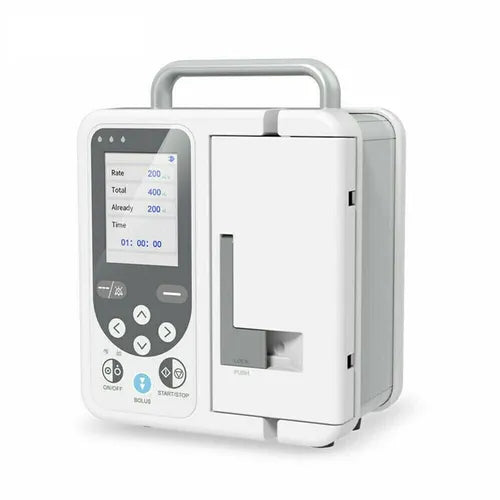
For example, Meddey currently lists the SP08 Syringe Infusion Pump for hospital and ICU use.
Current product information lists compatibility with 5–60 mL syringes, multiple infusion modes and a 3.8-inch display. However, healthcare facilities should always verify the latest manufacturer specifications before purchase.
Therefore, syringe size compatibility deserves careful review during procurement.
Infusion Pump vs Syringe Pump
| Feature | Volumetric Infusion Pump | Syringe Pump |
|---|---|---|
| Fluid source | IV bag or bottle with tubing | Compatible syringe |
| Typical use | Often used for larger-volume infusion | Often used for smaller-volume delivery |
| Mechanism | Controls fluid through tubing | Motor moves syringe plunger |
| Common setting | Ward, ICU, OT and emergency care | ICU, OT and neonatal care |
| Consumable | Compatible infusion set | Compatible syringe |
Neither type is universally better. Instead, clinicians choose the pump according to the prescribed therapy and required delivery method.
What Is an Infusor Pump?
The term infusor pump often describes portable infusion systems, particularly elastomeric devices.
An elastomeric infusor contains fluid inside an elastic reservoir. As that reservoir contracts, it creates pressure and moves the fluid through the delivery tubing.
Unlike many electronic pumps, this type does not usually rely on an electric motor.
However, device performance can depend on specific operating conditions. Therefore, users must follow the manufacturer's instructions and clinical protocol.
What Is the Main Purpose of a Pump?
From an engineering perspective, a pump moves fluid by creating a pressure difference.
In infusion therapy, the goal becomes more specific. The pump must move the prescribed fluid while controlling how much reaches the patient and how quickly delivery occurs.
Therefore, an infusion pump supports controlled administration rather than simple fluid movement.
This distinction matters because both excessive and insufficient delivery can create clinical risk.
Why Are Infusion Pumps Important?
Gravity infusion remains useful in healthcare. However, some treatments need more controlled delivery than a simple gravity system can provide.
Infusion pumps can support:
- Programmed flow rates
- Small-volume delivery
- Timed administration
- Continuous infusion
- Alarm-based monitoring
- Standardised workflows
As a result, these devices play an important role in modern hospital care.
Nevertheless, a pump cannot prevent every medication error. Safe treatment still depends on correct prescribing, preparation, programming and patient monitoring.
What Is a Smart Infusion Pump?
A smart infusion pump adds software-based safety features to standard pump operation.
For example, some systems use drug libraries and alert users when programmed values fall outside predefined limits.
However, this technology acts as an additional safety layer rather than a replacement for clinical judgement.
Moreover, hospitals must maintain drug libraries and staff training if they want the system to work effectively.
Important Safety Features in Infusion Devices
Occlusion Alarm Warns staff when the device detects excessive pressure or blocked flow.
Air Detection Selected models monitor the delivery path for air.
Low Battery Alert Warns users before battery power becomes critically low.
End-of-Infusion Alert Signals completion or near completion according to the model.
Set-Loading Alert May warn when staff load tubing incorrectly or leave the mechanism open.
Audible & Visual Alerts Help staff recognise conditions that require attention.
Therefore, healthcare buyers should review alarms and usability together with flow specifications.
Infusion Pump Safety and Staff Training
Infusion pumps can provide precise control. However, incorrect programming or equipment problems can cause over-infusion, under-infusion or treatment delays.
For this reason, hospitals should train staff on the exact models they use.
Training should include:
- Correct setup
- Approved consumables
- User interface
- Alarm interpretation
- Battery operation
- Cleaning requirements
- Fault response
In addition, medical-equipment teams should review manufacturer notices, recalls and service updates.
Patient safety: only appropriately trained personnel should programme infusion devices and administer therapy according to the prescribed treatment plan and institutional protocol.
How to Start an Infusion Pump Safely
The exact start-up sequence varies according to the pump model, therapy, tubing and hospital policy. Therefore, one generic procedure cannot safely apply to every infusion device.
At a professional level, staff should first confirm the prescribed therapy, correct pump and compatible consumables.
Next, trained users should follow the manufacturer's instructions for loading, priming, programming and connecting the system.
Before starting therapy, staff should verify the entered parameters according to institutional policy. Afterwards, they should monitor the patient, infusion site and pump.
Important: staff should never use a generic online procedure to programme a clinical infusion. Always follow the exact device instructions, medication order and hospital protocol.
Common Infusion Pump Alarms
| Alarm | General Meaning |
|---|---|
| Occlusion | The device detects resistance or blocked flow. |
| Air | The sensor detects air according to the pump design. |
| Low Battery | The remaining battery power requires attention. |
| End of Infusion | The programmed infusion has completed or is close to completion. |
| Door / Set Error | The pump may detect incorrect tubing or mechanism position. |
The exact alarm meaning depends on the model. Therefore, staff should check the approved device instructions before taking corrective action.
Infusion Pump Price in India
The infusion pump price in India varies according to pump category, display, flow range, battery, alarm functions and software features.
Current Meddey Price Examples
SP08 Syringe Infusion Pump: approximately ₹13,600
Contec Syringe Pump: approximately ₹17,499
Flight 750 Infusion Pump: approximately ₹17,999
Byond Syringe Pump: approximately ₹19,999
These prices can change with stock, discounts and product updates.
Therefore, buyers should check the current product page before purchase.
What Affects Infusion Pump Price?
Several factors influence the final price of infusion equipment.
- Pump type
- Flow-rate range
- Display technology
- Infusion modes
- Alarm system
- Battery backup
- Consumable compatibility
- Accuracy specification
- Software functions
- Warranty
- Service support
Consequently, procurement teams should compare clinical value rather than simply choosing the lowest-cost device.
Flight 750 Infusion Pump
Meddey currently lists the Flight 750 Infusion Pump for hospital IV therapy.
The product targets clinical areas such as ICUs, operation theatres, emergency departments and general wards.
Before buying, hospitals should confirm the latest flow range, compatible infusion sets, alarm functions and battery details.
Therefore, the current manufacturer specification should guide procurement decisions.
SP08 Syringe Infusion Pump
The SP08 Syringe Infusion Pump provides one option for hospitals comparing syringe delivery systems.
Current product details include:
- 3.8-inch display
- Support for 5–60 mL syringes
- Multiple infusion modes
- Battery operation
In addition, the product supports hospital and ICU applications.
Therefore, facilities should compare syringe compatibility and workflow requirements before purchase.
How to Choose an Infusion Pump
1. Define the Clinical Application
First, decide whether the device will support general IV therapy, critical care or syringe-based treatment.
2. Choose the Pump Type
Next, select a volumetric pump, syringe pump or another category according to the intended therapy.
3. Review Flow Specifications
Then, confirm that the device supports the required flow-rate and volume range.
4. Check Consumable Compatibility
Afterwards, verify the approved tubing or syringe sizes.
5. Evaluate Alarm Functions
In addition, review occlusion, air, battery and end-of-infusion alerts.
6. Compare Battery Performance
Battery backup matters during transport and temporary power interruption.
7. Review Display and Controls
A clear interface can help trained staff work more efficiently.
8. Check Service Support
Finally, review warranty, maintenance, calibration and technical support.
Hospital Infusion Pump Buying Checklist
- Define the intended clinical use
- Select the correct pump type
- Review supported flow rates
- Check delivery accuracy specification
- Confirm compatible consumables
- Review occlusion detection
- Check air-detection features
- Compare alarm visibility and audibility
- Review battery backup
- Check display readability
- Confirm cleaning requirements
- Review mounting options
- Check service availability
- Review maintenance needs
- Confirm warranty
- Compare current infusion pump price
Overall, hospitals should focus on clinical suitability, safe operation and long-term support rather than initial price alone.
Infusion Pump vs Gravity IV Infusion
| Feature | Infusion Pump | Gravity IV Infusion |
|---|---|---|
| Flow control | Uses programmed mechanical or electronic control | Relies on gravity and a flow regulator |
| Small-volume control | Can support controlled delivery depending on pump type | More limited |
| Alarms | Many electronic pumps provide alarms | Usually no electronic alarms |
| Power | Often uses mains power and battery | Does not require electricity |
| Operation | Requires model-specific training | Uses a simpler setup |
Both approaches have clinical roles. Therefore, clinicians should choose the method that best matches the prescribed therapy.
Common Problems With Infusion Pumps
Infusion pumps offer important clinical benefits. Nevertheless, device problems can occur.
Possible issues include:
- Software faults
- Alarm problems
- Occlusion detection errors
- Battery failure
- User-interface problems
- Mechanical damage
- Incorrect set loading
Therefore, hospitals should maintain inspection, servicing and incident-reporting systems for infusion equipment.
Frequently Asked Questions About Infusion Pumps
What is an infusion pump used for?
An infusion pump delivers fluids, medicines or nutrients into the body in controlled amounts or at programmed rates.
What is the most common type of infusion pump?
Volumetric infusion pumps and syringe pumps rank among the most common hospital categories. The preferred type depends on the treatment and department.
What is the basic working principle of a pump?
A pump creates controlled fluid movement. In infusion therapy, the device moves fluid through a delivery pathway at a selected rate.
How do infusion pumps work?
The pump moves fluid through tubing or from a syringe using a motor or mechanical mechanism. Meanwhile, sensors and alarms monitor selected operating conditions.
What are infusion pumps used for in hospitals?
Hospitals use them for controlled delivery of IV fluids and medicines in ICUs, operation theatres, emergency departments and wards.
What is the main purpose of an infusion pump?
The main purpose is to deliver prescribed fluid in a controlled manner according to the treatment plan.
How do you start an infusion pump?
Only trained staff should prepare and operate the pump. They must follow the exact manufacturer instructions, medication order and hospital protocol.
What is a syringe pump used for?
A syringe pump supports controlled delivery from a compatible syringe, especially when clinicians need smaller-volume infusion.
What is an infusor pump?
The term often refers to portable infusion systems such as elastomeric pumps, which use reservoir pressure to move fluid.
Do infusion pumps have alarms?
Many electronic pumps provide audible or visual alarms for conditions such as occlusion, low battery, air detection or infusion completion.
Can patients use infusion pumps at home?
Some devices support home or ambulatory care. However, patients and caregivers need device-specific training and a clear clinical plan.
Is a syringe pump the same as an infusion pump?
A syringe pump is one type of infusion pump. It delivers fluid by moving the plunger of a compatible syringe.
Where to Buy Infusion Pumps Online in India?
Hospitals and clinics can purchase infusion pumps through medical-equipment suppliers and healthcare eCommerce platforms.
Before ordering, compare:
- Model number
- Pump category
- Flow range
- Accuracy specification
- Alarm functions
- Consumable compatibility
- Battery backup
- Warranty
- Technical support
- Current price
Meddey offers infusion pumps, syringe pumps and related infusion therapy equipment.
Browse Infusion Equipment View Flight 750 Infusion Pump View SP08 Syringe PumpConclusion
Infusion pumps play an important role in hospitals because they support controlled delivery of fluids, medicines and selected nutritional therapies.
Volumetric pumps work well for many IV applications. Meanwhile, syringe pumps provide controlled delivery from a compatible syringe.
However, equipment choice is only one part of safe infusion therapy. Staff training, correct consumables, careful programming, alarm response and patient monitoring remain essential.
In addition, the infusion pump price can vary according to pump type, flow specification, battery, alarms and software features.
Therefore, hospitals should compare clinical requirements, service support and long-term value before purchase.
Ultimately, the most suitable pump is the one that matches the intended therapy, hospital workflow and clinical environment.
Healthcare facilities can compare current infusion pumps and infusion therapy equipment on Meddey.
Medical & Safety Disclaimer
This article provides professional education and general healthcare guidance only. It is not an operating manual and does not provide patient-specific dosing, programming or medication instructions. Appropriately trained personnel should prepare, programme and operate infusion pumps according to the prescribed therapy, manufacturer instructions, institutional policy and applicable clinical standards.
Explore Medical Collections
All Categories
Abdominal & Maternity Support

Accessories

Accu-Chek Instant Strips: Use, Compatibility, Price & Blood Sugar Testing Guide
Accu-Chek Instant Strips: Uses, Features & Complete Guide

Accupressure Products for Pressure Point Therapy, Pain Relief & Wellness

accupuncture

Acupuncture Needles & Supplies

Advanced Physiotherapy Machines & Lumbar Physiotherapy

Airways

Ambulance

Anatomy Models
Anesthesia Machine

Anesthesia Products
Ankle Support, Braces & Walker Boots for Recovery

Ankle Weights & Exercise Weights for Home & Rehab
You may also need
FOR YOURecommended for you
Save 39%