
1
Head Immobilizer for Spine Board & Trauma Care


Double-tap to zoom · drag to pan · swipe to browse
Head Immobilizer for Spine Board & Trauma Care
In Stock
Check delivery
See if we deliver to you and when.
Delivering to
Delivery applicable
Free Shipping
on orders ₹999+
100% Genuine
Products
Dedicated
Support
Secure
Payments
Need help choosing or using this product?
Our team can help with product questions and orders.
Chat with support
Choose options
- First, assess the patient and follow the appropriate emergency-care protocol.
- Next, position the patient on a suitable transfer or spine-board system when indicated.
- Place the immobilizer base according to the equipment instructions.
- Position the side supports around the head without blocking the airway or communication.
Check delivery
See if we deliver to you and when.
Delivering to
Delivery applicable
- First, assess the patient and follow the appropriate emergency-care protocol.
- Next, position the patient on a suitable transfer or spine-board system when indicated.
- Place the immobilizer base according to the equipment instructions.
- Position the side supports around the head without blocking the airway or communication.
Check delivery
See if we deliver to you and when.
Delivering to
Delivery applicable
About this product
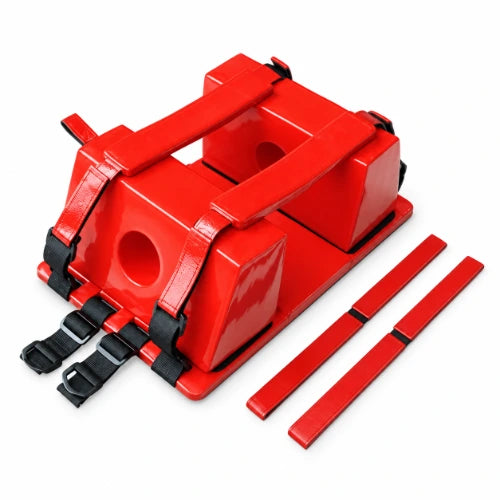
The head immobilizer for spine board is an emergency support device that helps trained responders limit unwanted head movement during patient transfer. It uses supportive side blocks and securing straps around the head while the patient remains on a suitable spine board.
The immobilizer uses polyurethane foam and comes in a high-visibility orange colour. In addition, its open-ear design keeps the ear area accessible so responders can communicate with and monitor the patient.
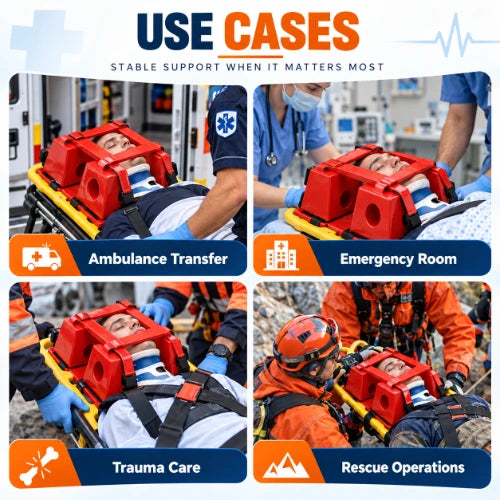
Therefore, this product can support ambulance, hospital, trauma and rescue teams during planned patient handling. However, people with a suspected neck or spinal injury should only be moved according to suitable emergency-care guidance.
Need help choosing or want bulk pricing? Chat with our team for hospital pricing, COD / partial payment and GST invoice. 👉 WhatsApp +91 8586-012345
Head Immobilizer for Spine Board – Key Features
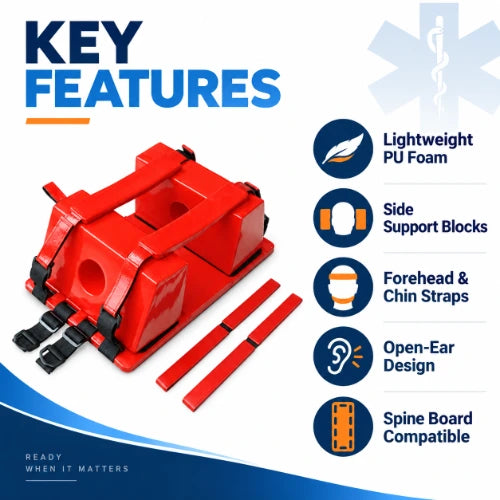
Polyurethane Foam The support blocks use polyurethane foam. Therefore, they provide a lightweight structure for emergency head support.
Side Support Blocks The blocks sit beside the patient's head and help limit unwanted side-to-side movement during suitable transfer procedures.
Securing Straps The system includes straps that help trained users maintain the planned head position during patient handling.
Open-Ear Design The ear area remains accessible. As a result, responders can continue communicating with and monitoring the patient.
High-Visibility Colour The bright orange colour makes the equipment easier to identify with other emergency-care supplies.
Spine Board Use The product is designed for use with suitable spine boards as part of a wider emergency patient-transfer setup.
What Is a Trauma Head Immobilizer?
A trauma head immobilizer is a support device that emergency teams may use when they need to control head movement during patient handling.
In simple terms, the side blocks sit around the head while straps help maintain the selected position. Therefore, the device provides extra support while trained staff prepare or move a patient.
However, the immobilizer does not treat a neck or spinal injury. Instead, it forms one part of a wider emergency-care setup.
Emergency Head Immobilizer for Patient Transfer
An emergency head immobilizer may be useful during ambulance transfer, rescue work and hospital patient movement. For example, responders may use it while a patient rests on a compatible spine board.
In addition, the side supports help responders manage unwanted side-to-side head movement. The straps then help maintain the planned position.
Still, trained staff should decide when and how to use the device. Emergency handling should always consider the patient's condition and current care protocol.
Spine Board Head Immobilizer with Side Supports
The spine board head immobilizer includes a base structure, side support blocks and securing straps. The listed configuration also includes forehead and chin straps.
First, trained staff position the system according to their emergency procedure. Next, they place the side supports beside the patient's head.
Finally, they secure the system according to the required transfer setup. Throughout the process, responders should continue monitoring the patient.
Open-Ear Design for Communication and Monitoring
The open-ear design leaves space around each ear. Therefore, the responder can speak with the patient without the side blocks fully covering this area.
In addition, the design provides access for basic observation around the ears during patient handling.
This feature can be useful in ambulances, emergency rooms and rescue situations where staff need to maintain communication during transfer.
Foam Head Immobilizer for Ambulance and Hospital Use
The foam head immobilizer can suit ambulances, emergency departments, hospitals, rescue services and trained first-aid teams.
Because polyurethane foam forms the support structure, the equipment stays relatively light and practical to handle with other emergency supplies.
Moreover, its bright colour makes it easier to identify in a busy emergency-care environment.
Head Immobilizer for Spine Board – Specifications
| Product Name | Head Immobilizer Premium Quality |
|---|---|
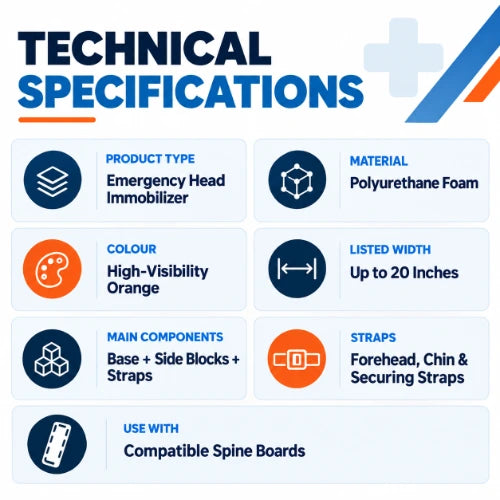
| Product Type | Emergency Head Immobilizer |
| Material | Premium Polyurethane Foam |
| Colour | High-Visibility Orange |
| Listed Width | Up to 20 Inches |
| Main Components | Base, Side Support Blocks and Securing Straps |
| Straps | Forehead, Chin and Securing Straps |
| Design | Open-Ear Design |
| Listed Compatibility | Standard Spine Boards and Scoop Stretchers |
| Suitable Settings | Ambulances, Hospitals, Emergency Rooms and Rescue Teams |
| Country of Origin | India |
How Trained Responders Use a Patient Head Immobilizer
The exact method can vary according to emergency protocol and the patient's condition. Therefore, trained responders should follow their approved procedure.
- First, assess the patient and follow the appropriate emergency-care protocol.
- Next, position the patient on a suitable transfer or spine-board system when indicated.
- Place the immobilizer base according to the equipment instructions.
- Position the side supports around the head without blocking the airway or communication.
- Then, apply the appropriate securing straps.
- Check the patient's position, breathing and comfort.
- Finally, monitor the patient throughout transfer.
Important Safety Guidance
A suspected neck or spinal injury requires careful handling. Therefore, this equipment should be used by trained emergency or healthcare personnel.
- Do not move a trauma patient unnecessarily.
- Follow the emergency protocol used by your organisation.
- Do not block the patient's airway while applying straps.
- Continue monitoring the patient during transfer.
- Do not rely on the immobilizer alone as a complete trauma-management system.
- Check the equipment for damage before use.
- Replace or remove damaged equipment from service.
Does a Cervical Head Support Replace a Cervical Collar?
A cervical head support and a cervical collar perform different roles in an emergency-care setup. Therefore, buyers should not assume that one automatically replaces the other.
The head immobilizer provides side support around the head. A cervical collar, when clinically indicated, provides a different type of neck support.
However, trained healthcare staff should decide which equipment the patient requires according to the situation and current protocol.
Who Should Buy a Head Immobilizer for Spine Board Use?
This product mainly suits professional emergency-care buyers. These may include ambulance services, hospitals, emergency departments, rescue teams and healthcare procurement teams.
In addition, organisations running first-aid or rescue training may use suitable head immobilizers during supervised demonstrations.
Household customers may also purchase emergency equipment for an organisation or care setup. However, untrained people should not attempt advanced spinal immobilization procedures themselves.
What to Check Before Buying an Emergency Head Immobilizer
- Check which spine board or stretcher system your organisation uses.
- Confirm whether the listed dimensions suit your existing equipment.
- Check that the side supports and straps meet your operational needs.
- Confirm your organisation's cleaning and infection-control requirements.
- Inspect the product before placing it into an emergency kit.
- Contact Meddey if you need compatibility information before ordering.
Head Immobilizer for Spine Board FAQs
What Is a Head Immobilizer Used For?
It helps trained responders limit unwanted head movement during suitable emergency patient handling and transfer.
Can This Trauma Head Immobilizer Be Used with a Spine Board?
Yes. The product is listed for use with spine boards during emergency and trauma handling.
What Material Does the Foam Head Immobilizer Use?
The exact product listing specifies premium polyurethane foam.
Why Does the Head Immobilizer Have Open Ear Areas?
The open-ear design helps responders communicate with and monitor the patient during transfer.
Does the Head Immobilizer Replace a Cervical Collar?
Not automatically. The products have different roles, and trained healthcare staff should decide which support the situation requires.
Is the Head Immobilizer Suitable for Ambulance Use?
Yes. The exact product information lists ambulance, emergency and rescue use among its intended settings.
Can an Untrained Person Use a Patient Head Immobilizer?
This product is intended for trained emergency and healthcare use. Untrained people should avoid unnecessary movement of someone with a suspected spinal injury.
Does the Product Include the Spine Board?
The listing describes the head immobilizer as equipment for use with spine boards. Therefore, buyers should not assume that a spine board comes included unless the package details specifically confirm it.
Need Help Choosing a Head Immobilizer?
Contact Meddey for compatibility questions, hospital orders, bulk pricing, COD / partial payment options and GST invoices.
Meddey Technologies Pvt. Ltd.
C-75, First Floor, DDA Sheds
Industrial Area, Phase 1
Okhla, New Delhi – 110020
Call / WhatsApp: +91 8586-012345
You may also need
FOR YOURecommended for you
Save 55%

Save 39%

Save 8%

Save 37%

Save 41%