


Featured ChoiceSave 39%

Save 14%


Save 41%


Save 37%


Save 44%


Save 17%

Save 14%

Save 24%

What customers say
★★★★★ 5.0 · 20 reviews
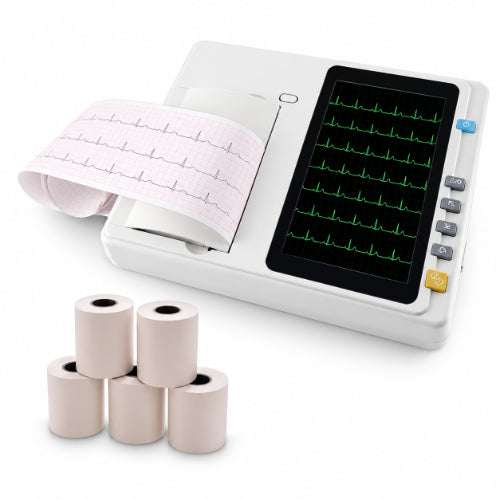
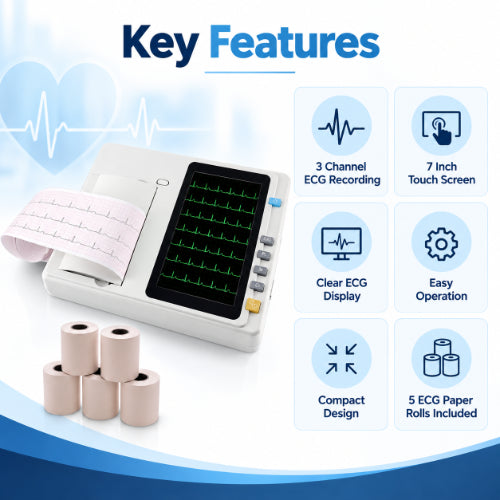
 3 Channel ECG Machine 7 Inch Touch Screen and 5 ECG Paper Rolls with 1 Year Warranty
“Easy to use with a responsive 7-inch touchscreen and clear ECG readings. Comes with 5 ECG paper rolls and a...”
“I have used multiple ECG machines, but this one stands out. The print quality, accuracy, and ease of use ar...”
 Portable Holter ECG System 12 Channel 5000H – Advanced ECG Monitoring System
“Compact, efficient, and delivers precise ECG tracking. Perfect for clinics and home use”
“Comfortable to wear, accurate results, and long battery life. Highly recommended for heart patients”
 Portable Finger Touch ECG Monitor PM-10-ECG machine
“Portable, accurate, and easy to operate. Ideal for patients and professionals who need quick ECG monitoring”
“This ECG monitor is lightweight, user-friendly, and gives instant heart readings. A must-have for heart hea...”
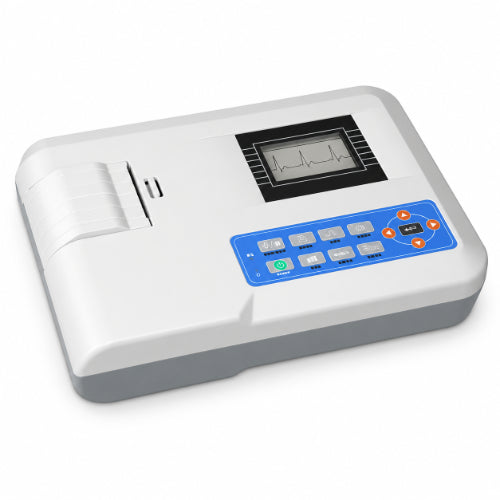
 Single Channel ECG Machine – Compact ECG Recording Solution
“Simple operation, precise results, and durable build. Excellent for quick ECG monitoring”
“Provides clear ECG reports, lightweight and user-friendly. A must-have for medical professionals”
ECG Machine: Types, Channels & Electrodes Guide
ECG machine: types, channels & electrodes guide
ECG machines record the heart’s electrical activity and show it as a tracing for a doctor or trained healthcare professional to review. This guide explains ECG machine and ECG electrodes in simple language for families, caregivers, nursing students, and small care setups in India. You will learn about single channel, 3 channel, 6 channel, and 12 channel ECG machines, along with portable ECG options, Holter systems, and electrode types.
If anyone has chest pain, breathlessness, fainting, heavy sweating, or any worrying heart symptoms, seek medical help immediately. Visit a doctor or emergency room and do not rely only on an ECG machine for home use or any home recording.
What does an ECG machine do?
An ECG machine records tiny electrical signals that come from the heart. These signals are shown as lines and waves on a screen or printout. A doctor reads this tracing along with the person’s symptoms, medical history, and other checks. An ECG recording by itself is not a diagnosis.

The word ECG means electrocardiogram. Some people also call it an EKG. The test is usually quick and painless. Small ECG electrodes are placed on the skin, and the ECG device records the heart’s electrical activity from different views. A standard ECG uses electrodes on the limbs and chest to create 12 different views, called leads. (merckmanuals.com)
In a clinic, hospital, nursing home, or small diagnostic setup, an ECG machine helps create a clear record that a doctor can review. In home care, a portable ECG machine may help record a tracing when advised by a healthcare professional. But the machine does not replace medical advice. It only creates a record.
ECG machine and ECG electrodes work together
An ECG machine cannot record properly without good contact on the skin. That is where ECG electrodes are used. The electrodes are small pads that touch the body and carry the heart’s electrical signals to the machine through lead wires.

For families, this may sound technical. Think of the ECG machine as the recorder and the electrodes as the contact points. If the contact points are loose, dry, wrongly placed, or not connected well, the tracing may not be useful for the doctor.
In small clinics, the quality of the ECG recording depends on three basic things:
- Correct electrode placement
- Good skin contact
- Proper machine setup
- A calm patient who stays still during recording
- Clean lead wires and safe use
The ECG machine and ECG electrodes are therefore bought, used, and maintained as one system. A good machine with poor electrodes can still give a poor tracing. Good electrodes with wrong placement can also create confusion. Training and careful use matter.
Leads, channels, and electrodes in simple words
Many people get confused between leads, channels, and electrodes. These words are related, but they do not mean the same thing.

Electrodes are the pads placed on the body. Leads are the views of the heart’s electrical activity made by the machine. Channels show how many lead waveforms the machine can print or display at one time.
For example, a 12-lead ECG does not always mean 12 physical pads are used. A standard 12-lead ECG commonly uses limb and chest electrode positions to create 12 views. These include limb leads and chest leads V1 to V6. (jacc.org)
Electrodes are body contact points
ECG electrodes are placed on selected body areas. Some are placed on the arms and legs, or near these areas. Some are placed on the chest.

They may be adhesive pads used once. They may be round or square in shape. The aim is simple: the electrode must sit properly on the skin so that the ECG device can record the heart’s electrical signals.
Leads are views of the heart
A lead is not just a wire. It is a view of the heart’s electrical activity from a certain direction. A 12-lead ECG gives 12 such views.
These views help a doctor study the tracing in an organised way. The machine records and displays the waves. The interpretation must be done by a doctor or trained professional.
Channels are display or print paths
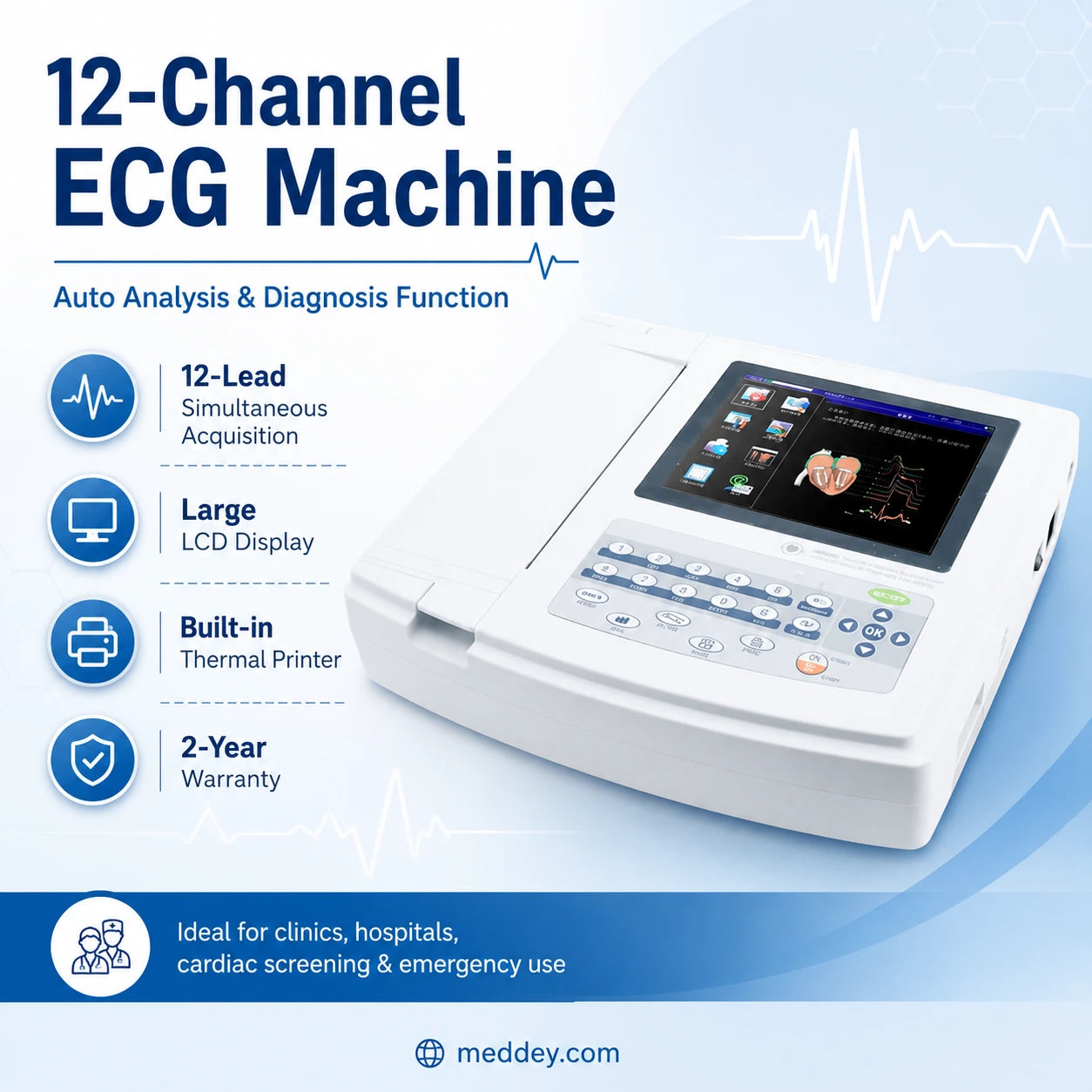
Channels describe how many ECG waveforms are shown or printed at one time. A single channel ECG machine prints or shows one waveform at a time. A 3 channel ECG machine shows three at a time. A 6 channel ECG machine shows six at a time. A 12 channel ECG machine can show or print all 12 together, depending on the model.


This affects speed and ease of reading. More channels can make clinic workflow faster. Fewer channels may still be useful when the need is basic and patient load is low.
Types of ECG machines used in homes and clinics
There is no single best ECG machine for everyone. A small clinic, a nursing student, a home caregiver, and a busy diagnostic centre may all need different models. The right choice depends on use, patient load, space, budget plan, and the level of detail needed by the doctor.
Below are the main types explained in simple words.

Single channel ECG machine
A single channel ECG machine records one ECG waveform at a time. It is usually simple to use and easy to understand. It may suit basic use, training, camps, and low-volume settings where speed is not the main concern.
The main benefit is simplicity. A user can focus on one line at a time. It may also be easier for beginners to learn the basic flow of electrode placement, recording, and printout handling.
The limitation is time. Since it records fewer waveforms at once, the complete ECG may take longer to print. For a busy clinic, this can slow down work.
3 channel ECG machine
A 3 channel ECG machine records or prints three waveforms at a time. It is a common choice for small clinics because it gives a good balance of simplicity and speed.

Compared with a single channel model, it can complete recordings faster. The printout is also easier to review because more information is grouped together. For many general practice setups, this type can be practical.
It is still compact and usually not too complex. Staff can learn it with proper training. It works well when the clinic needs regular ECG recordings but does not have very heavy patient flow.
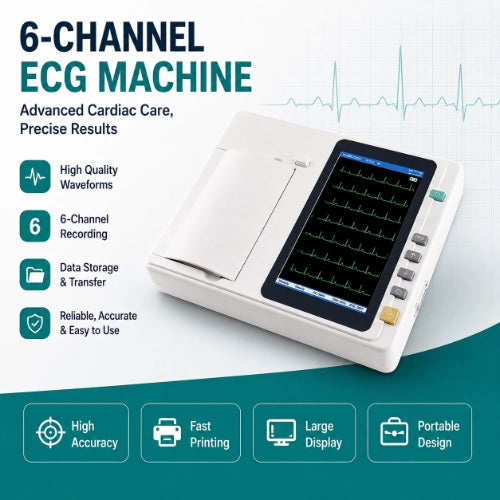
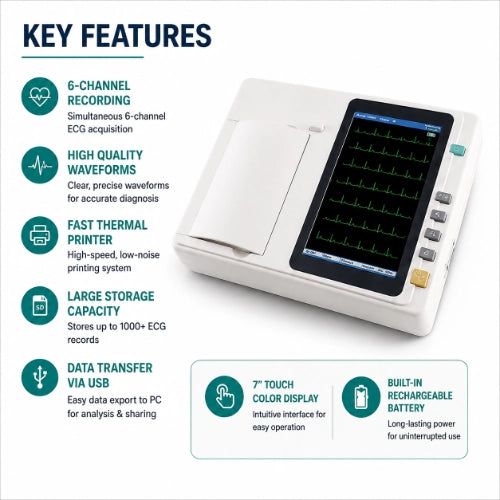
6 channel ECG machine
A 6 channel ECG machine shows or prints six waveforms at one time. It is faster than a 3 channel model and gives a wider view on the printout.

This can help in clinics that take ECG recordings often. It can also help when the doctor prefers a more organised printout with fewer sections. The machine may have a bigger display and more settings than basic models.
A 6 channel ECG machine is often a middle choice. It is more capable than a basic unit, but it may still be easier to manage than a full 12 channel ECG machine.
12 channel ECG machine
A 12 channel ECG machine can show or print all 12 leads at the same time, depending on its design. This can be useful in busy clinics, diagnostic centres, and hospitals where speed and organised records matter.
The biggest advantage is workflow. The full tracing can be captured and printed in a clear layout. This saves time when many patients need ECG recordings in a day.
It may also have a larger screen, more storage options, and more print settings. Staff should still be trained to place electrodes correctly. A higher-channel machine does not remove the need for correct use and doctor review.
Portable ECG options for home and travel use
A portable ECG machine is smaller and easier to carry than a standard table-top machine. It may run on battery and may be useful for home visits, camps, ambulances, nursing homes, and small clinics with limited space.
Portable does not mean casual use. The recording still needs correct handling. The result must still be read by a doctor or qualified healthcare professional.
Portable finger-touch ECG monitor
A portable finger-touch ECG monitor is a small ECG monitor that records a short tracing when the user places fingers on the contact points. It is easy to carry and may be used at home when advised by a doctor.
This type is not the same as a full standard 12-lead ECG machine. It usually records a limited tracing. It can be useful for keeping a short record, but it should not be used as the only basis for decisions during symptoms.
For families, the main benefit is convenience. The main caution is interpretation. A home user may see lines on the screen, but only a doctor can explain what those lines mean in that person’s case.
Portable Holter ECG system
A portable Holter ECG system is used to record heart electrical activity over a longer period. Many people call it a holter machine. It is usually worn while the person continues normal daily activities, as advised by a doctor.

A Holter system has small electrodes that stay attached to the skin and connect to a portable recorder. The recording is later reviewed by a doctor or trained professional. The person may also be asked to note symptoms and timing, depending on medical advice.
This type is different from a normal short ECG. A standard ECG records for a short time. A Holter system records for longer, but it still creates a recording, not a diagnosis.
Portable ECG machine for home visits
A portable ECG machine used by a nurse, technician, or doctor for home visits is usually closer to a clinic machine. It may have lead wires, a screen, battery backup, and a printout option.
This can help in home care, elderly care, or remote area service. It is useful when moving the patient to a clinic is difficult. Still, the recording must be reviewed properly by a doctor.
When choosing a portable ECG machine, check the display size, battery life, charging method, printout quality, and ease of cleaning. Also check whether spare electrodes and lead wires are easy to arrange.
Standard ECG machines for clinics and diagnostic rooms
A standard ECG machine is usually placed on a table or trolley. It is used in clinics, nursing homes, hospitals, and diagnostic centres. It may be single channel, 3 channel, 6 channel, or 12 channel.
These machines are made for repeated daily use. They often have a larger screen, stronger body, better buttons, and stable printout features. Some may store recordings for later review, depending on the model.
In a small clinic in India, a standard 3 channel or 6 channel ECG machine may be enough for routine recording work. A busier centre may prefer a 12 channel ECG machine for faster output. The final choice should match the doctor’s workflow and the skill level of the staff.
Portable and standard ECG machines compared
Portable and standard ECG machines both record heart electrical activity. The difference is mainly size, use case, power option, screen size, and workflow. One is not always better than the other.
Use this simple comparison while planning a purchase.
| Point | Portable ECG | Standard ECG machine |
|---|---|---|
| Best use | Home visits, camps, small spaces, travel | Clinics, diagnostic rooms, regular daily use |
| Size | Small and easy to carry | Larger and more stable |
| Power | Often battery supported | Usually mains power with backup in some models |
| Screen | May be small | Often bigger and easier to view |
| Printout | May be built in or limited, based on model | Usually stronger printout support |
| Workflow | Good for mobility | Good for repeated patient flow |
| User need | Careful handling during movement | Fixed setup and routine staff training |
A portable ecg option is helpful when the machine must move to the patient. A standard ECG machine is helpful when patients come to the clinic. For some clinics, having both can be useful, but only if there is real need and trained use.
Screen, printout, and battery features to understand
Before buying an ECG machine, do not look only at the number of channels. Also check how the machine feels during daily use. A machine that is difficult to read or operate may slow down the clinic.
Screen size and readability
The screen helps the user see the tracing before printing or saving. A larger screen is easier for staff to view. It can also help check whether the tracing is moving properly before the final record is taken.
Look for a screen that is bright enough for your room. Buttons and menu options should be simple. In a small clinic, the person using the machine may be a nurse, assistant, or technician, so easy operation matters.
Printout clarity
A printout is useful because the doctor can review it, attach it to a file, or share it as part of the patient record. The print should be clear and properly aligned. The machine should allow common layouts used by doctors.
Do not focus only on speed. A fast printout that is hard to read is not helpful. Ask for a sample printout before purchase if possible.
Battery and charging
Battery backup is important in many Indian settings because power supply may not always be steady. A battery-supported ECG device can continue working during short power cuts or during home visits.
Check how the battery is charged, how long it usually runs, and whether replacement support is available. Also check whether the machine gives a low-battery warning.
Memory and record handling
Some ECG machines can store recordings. This may help when the doctor wants to review later. It may also help in busy clinics where printout and record keeping need to be organised.
However, storage should be handled carefully. Patient privacy matters. Staff should know how to save, delete, print, or transfer records according to clinic policy.
ECG electrodes and their common shapes
ECG electrodes may look small, but they are very important. They help the machine receive the heart’s electrical signals from the body surface. Poor electrode contact can make the tracing unclear.
Most routine ECG electrodes are adhesive. They stick to the skin and are usually meant for single use. Adhesive electrodes are common because they are quick to apply and help keep the contact stable during recording.
Adhesive ECG electrodes
Adhesive ECG electrodes are pads with a sticky surface. The user places them on the correct skin points before connecting the lead wires. They are often used in clinics, hospitals, home visits, and Holter recordings.
They should be stored properly. If the adhesive dries out or the pad is damaged, the tracing may be poor. Always follow the instructions given with the electrode pack.
Round ECG electrodes
Round ECG electrodes are widely used. Their shape makes them easy to place on the chest and limbs. Many users find them simple to handle during routine ECG work.
They may be used with standard ECG machines and portable machines, depending on the connector type. Always make sure the electrode fits the lead wire connection.
Square ECG electrodes
Square ECG electrodes are another common style. Some clinics prefer them because they are easy to hold and place. The shape may also make packing and storage simple.

Round and square electrodes serve the same basic purpose. The better choice depends on machine compatibility, skin contact, comfort, and user preference.
Basic steps during an ECG recording
A trained person should perform the ECG recording. In many settings, this may be a nurse, ECG technician, doctor, or another trained healthcare worker. Medical personnel with training can obtain an ECG, but interpretation should be done by the right professional. (ncbi.nlm.nih.gov)

The exact process may vary by machine and clinic policy. Still, the basic flow is usually simple.
- Explain the process. Tell the person that electrodes will be placed on the skin and the recording is usually quick.
- Position the person properly. The person should rest and stay still as advised by the healthcare worker.
- Place the electrodes. Limb and chest electrodes should be placed in the correct positions.
- Connect the lead wires. Each wire should match the correct electrode point.
- Check the screen. The user should look for a stable tracing before final recording.
- Record and print. The ECG machine records the tracing and gives a screen view or printout.
- Send for review. The tracing should be reviewed by a doctor or trained professional.
- Clean and prepare. Used adhesive electrodes should be discarded as per local policy, and the machine should be ready for the next patient.
During recording, the person should avoid talking, moving, or tensing muscles if possible. Movement can affect the tracing. Good preparation saves time and reduces repeat recordings.
What to check before buying an ECG machine
Buying an ECG machine for home care should be a careful decision. Do not choose only by looking at the channel number. Think about who will use it, where it will be used, and how often it will be used.
Here is a practical checklist.
- Purpose: Is it for a clinic, home visit, camp, nursing home, or personal home recording under medical advice?
- Channel type: Decide between single channel, 3 channel, 6 channel, and 12 channel based on workload.
- Lead support: Check whether it supports the lead format your doctor needs.
- Screen: Make sure the display is clear and easy to read.
- Printout: Ask if the printout layout is suitable for doctor review.
- Battery: Check backup, charging time, and low-battery alerts.
- Portability: If you need field use, check weight, handle, case, and battery support.
- Electrode compatibility: Confirm the type of ECG electrodes and lead wire connectors needed.
- Ease of use: Menus, buttons, and setup should be simple for staff.
- Service support: Check local service, spare lead wires, and basic maintenance help.
- Training: Make sure users know electrode placement and machine operation.
- Record handling: If the machine stores data, check how records are managed.
For a low-volume clinic, a 3 channel ECG machine may be practical. For regular patient flow, a 6 channel ECG machine may save time. For a busy diagnostic setup, a 12 channel ECG machine may improve workflow. For home visits, a portable ECG machine with battery backup may be more suitable.
Matching machine type to real-life use
The best ECG machine is the one that fits the actual setting. A machine can have many features, but if the staff cannot use it comfortably, daily work becomes difficult.

For families and caregivers
For home care, the main need is usually simple recording under medical advice. A portable finger-touch ECG monitor or compact portable ECG may be considered only when a doctor suggests it.
Families should remember that a tracing is not a diagnosis. If symptoms are serious, do not wait to record at home. Go to a doctor or emergency room.
For nursing students
Nursing students need to understand electrode placement, lead names, and basic machine handling. A single channel ECG machine can help with basic learning. A 3 channel or 6 channel model can help students see how multiple waveforms are organised.
The focus should be correct technique. Learn the difference between electrodes, leads, and channels early. This makes clinical practice easier.
For small clinics
Small clinics need a machine that is reliable, easy to use, and quick enough for patient flow. A 3 channel ECG machine is often a simple option. A 6 channel ECG machine may be better if ECG recordings are done more often.
Check printout clarity and service support before purchase. Also keep enough compatible ECG electrodes in stock. The clinic should have a clear process for recording, review, filing, and patient referral.
For diagnostic centres
Diagnostic centres may need faster recording and organised print formats. A 12 channel ECG machine can be useful here because it can display or print all 12 leads together, depending on the model.
Staff should be trained and consistent. Electrode placement should follow a fixed method. Good workflow helps reduce delays and repeat recordings.
Safe use matters more than extra features
An ECG device may look simple, but it is still a medical recording device. It should be used with care. The user should follow the machine manual, clinic rules, and doctor’s instructions.

Never use a home ECG device as the only guide during chest pain, breathlessness, fainting, or other serious symptoms. A person with such symptoms needs medical attention immediately. A home tracing cannot decide whether the situation is safe.
Also avoid self-reading the tracing. Online images and general guides cannot explain a person’s full health condition. A doctor will review the tracing along with symptoms, age, medicines, past illness, and other tests if needed.
Common mistakes to avoid
Many ECG problems happen because of simple handling errors. These errors can waste time and create unclear records. A small checklist can prevent many issues.
- Do not place electrodes without checking the correct position.
- Do not allow loose lead wire connections.
- Do not record while the person is moving or talking, unless advised.
- Do not reuse single-use adhesive electrodes.
- Do not ignore low battery warnings during home visits.
- Do not buy a machine without checking local service support.
- Do not assume a higher-channel machine is always the right choice.
- Do not rely on a home recording during serious symptoms.
Good ECG practice is a mix of the right machine, correct electrodes, trained handling, and doctor review.
FAQ
What machine is used for ECG? An ECG machine is used to record an electrocardiogram. It records the heart’s electrical activity through electrodes placed on the body.
What does an ECG machine do? It records electrical signals from the heart and shows them as waves on a screen or printout. A doctor or trained healthcare professional reviews the tracing.
What are the ECG electrodes? ECG electrodes are small pads placed on the skin. They help carry the heart’s electrical signals from the body to the ECG machine.
What are 12 leads of ECG? The 12 leads are 12 views of the heart’s electrical activity. They include limb leads and chest leads, including V1 to V6. (jacc.org)
What does V1 to V6 mean on ECG? V1 to V6 are chest leads. In general, V1 and V2 are placed near the breastbone, V3 and V4 move across the front of the chest, and V5 and V6 are placed more toward the left side of the chest. Exact placement should be done by trained staff. (evs.nci.nih.gov)
Can we check ECG at home? Portable devices can record a heart tracing at home. But only a doctor can read and interpret it, and the recording is not a diagnosis.
What is an ECG machine for home use? An ECG machine for home use is usually a small portable device used under medical advice. It may help record a short tracing, but it should not replace a doctor visit.
What is a portable ECG machine? A portable ECG machine is a small machine that can be carried for home visits, camps, or limited-space clinics. It often has battery support and may include a screen and printout option.
What is a holter machine? A holter machine is a portable Holter ECG system used to record heart electrical activity over a longer period. The recording is later reviewed by a doctor or trained professional.
Which is better: single channel, 3 channel, 6 channel, or 12 channel ECG machine? The right choice depends on patient load and use. Single channel is simple, 3 channel is practical for many small clinics, 6 channel is faster, and 12 channel supports faster full-layout recording.
Are round and square ECG electrodes different in use? Both are used to make skin contact for ECG recording. The choice depends on machine compatibility, comfort, availability, and user preference.
Final takeaway
An ECG machine is a recording tool. It works with ECG electrodes to capture the heart’s electrical activity as a tracing. The main choices are single channel, 3 channel, 6 channel, 12 channel, portable finger-touch ECG monitor, portable ECG machine, and portable Holter ECG system.
For families, the key point is safety. For clinics, the key point is workflow. For nursing students, the key point is learning correct placement and basic terms. In every case, the ECG tracing should be reviewed by a doctor or trained healthcare professional, especially when symptoms are present.
Explore Medical Collections
All Categories
Abdominal Belt: Support After Surgery, in Pregnancy and After Delivery

Accessories
Accu-Chek Instant Strips: Use, Compatibility, Price & Blood Sugar Testing Guide
Accu-Chek Instant Strips: Uses, Features & Complete Guide

accupuncture

Acupuncture Needles & Supplies

Advanced Physiotherapy Machines & Lumbar Physiotherapy
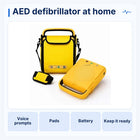
AED Defibrillator: How It Works, Who Can Use It and Where to Place It

Airways

Alcohol Swab: Uses, Safe Use and Disposal Guide

Ambu Bag Full Form: Is There an Official Meaning?

Ambu Bag: Parts, Uses and Safety Guide

Ambu Full Form: What the Name Means and BVM Basics

Ambulance

Anatomy Models
You may also need
FOR YOURecommended for you
Save 39%
Save 14%
Save 41%
Save 37%
Save 44%
Save 17%
Save 14%
Save 24%