
1
Wooden Physiotherapy Staircase with Ramp for Gait Training


Double-tap to zoom · drag to pan · swipe to browse
Wooden Physiotherapy Staircase with Ramp for Gait Training
In Stock
Check delivery
See if we deliver to you and when.
Delivering to
Delivery applicable
Free Shipping
on orders ₹999+
100% Genuine
Products
Dedicated
Support
Secure
Payments
Need help choosing or using this product?
Our team can help with product questions and orders.
Chat with support
Choose options
- First, check the unit: make sure the staircase, ramp and handrails feel stable.
- Next, clear the area: keep the floor around the equipment free from objects.
- Then, select the activity: choose the stairs or ramp according to the therapy plan.
- After that, use the handrails: hold the rails when the therapist recommends support.
Check delivery
See if we deliver to you and when.
Delivering to
Delivery applicable
- First, check the unit: make sure the staircase, ramp and handrails feel stable.
- Next, clear the area: keep the floor around the equipment free from objects.
- Then, select the activity: choose the stairs or ramp according to the therapy plan.
- After that, use the handrails: hold the rails when the therapist recommends support.
Check delivery
See if we deliver to you and when.
Delivering to
Delivery applicable
About this product
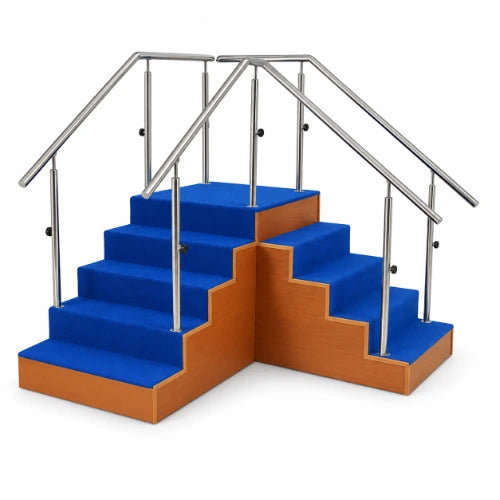
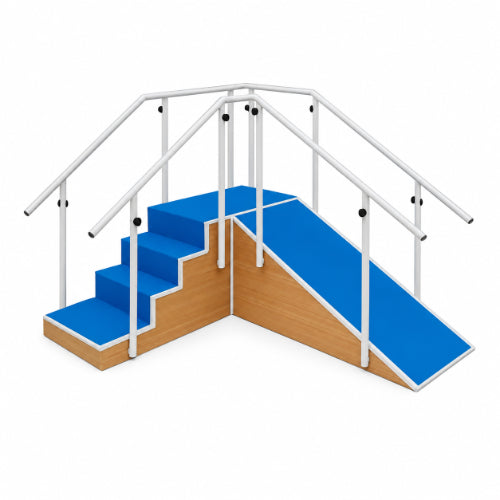
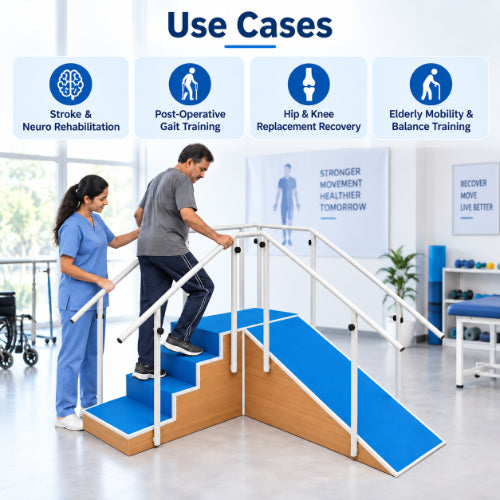
The wooden physiotherapy staircase with ramp gives users a controlled place to practise stairs, ramp walking and everyday mobility tasks under suitable supervision.
Gait training simply means practising the way a person walks. Therefore, physiotherapists may use this unit during selected walking, stair-climbing and mobility exercises.
In addition, the unit combines five graduated steps, a ramp and a central platform. Adjustable handrails also provide extra support during suitable activities.
However, the equipment itself does not guarantee faster recovery or better balance. Instead, a therapist should choose the exercise according to the person's ability and treatment plan.
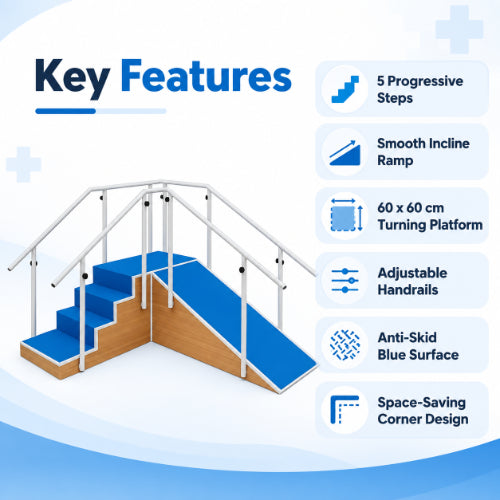
Wooden Physiotherapy Staircase with Ramp – Key Features
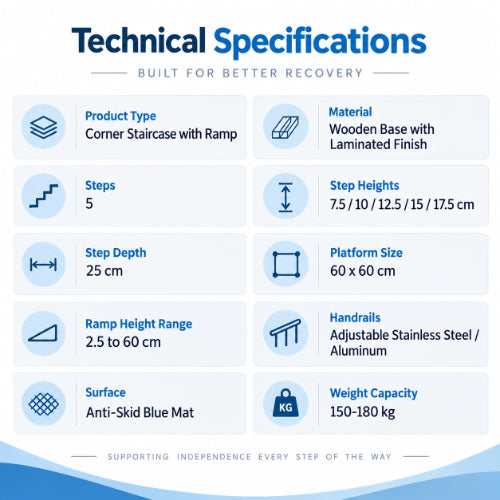
5 Graduated Steps Five different step heights allow therapists to select suitable stair-practice activities.
Inclined Ramp The ramp rises from approximately 2.5 cm to 60 cm for supervised incline-walking practice.
60 × 60 cm Platform A flat central platform connects the stairs and ramp and provides space for turning.
Adjustable Handrails Adjustable metal rails provide hand support and can suit different user heights.
Anti-Skid Surface Blue anti-skid covering appears on the steps, ramp and platform to improve grip.
Corner Layout The staircase-and-ramp design helps clinics use treatment-room space efficiently.
Gait Training Staircase with Ramp for Walking Practice
A gait training staircase with ramp helps users practise common walking tasks in a controlled therapy environment.
For example, a physiotherapist may guide a person while stepping up, stepping down or walking on an incline. Next, the user may practise turning on the central platform.
As a result, one unit can support several functional movement activities. However, the therapist should decide which task and level suit the user.
Physiotherapy Exercise Staircase with Graduated Steps
The physiotherapy exercise staircase includes five steps with increasing heights.
Specifically, the listed heights are 7.5 cm, 10 cm, 12.5 cm, 15 cm and 17.5 cm. In addition, each step has a depth of approximately 25 cm.
Therefore, the therapist has several step levels available during stair-practice sessions. Meanwhile, the correct starting point should depend on the user's mobility and therapy plan.
Rehabilitation Stairs with Ramp for Incline Training
The rehabilitation stairs with ramp combine stair practice with an inclined walking surface.
The ramp rises gradually from about 2.5 cm to 60 cm. Therefore, users can practise moving on a slope when that activity forms part of their rehabilitation program.
However, incline walking should not be introduced simply because the ramp is available. Instead, a trained professional should decide when it is appropriate.
Wooden Physiotherapy Staircase with Ramp – Specifications
| Product Type | Physiotherapy Staircase with Ramp |
|---|---|
| Base Construction | Heavy-Duty Wooden Base |
| Finish | Laminated Finish |
| Number of Steps | 5 |
| Step Heights | 7.5 cm, 10 cm, 12.5 cm, 15 cm and 17.5 cm |
| Step Depth | 25 cm Each |
| Ramp Rise | Approximately 2.5 cm to 60 cm |
| Central Platform | 60 × 60 cm |
| Handrails | Adjustable Metal Handrails, Listed as Stainless Steel or Aluminium |
| Walking Surface | Blue Anti-Skid Covering on Steps, Ramp and Platform |
| Listed Weight Capacity | Approximately 150–180 kg; confirm the exact supplied-unit rating before use |
| Assembly | Semi-Assembled |
Mobility Training Staircase for Home and Clinic Rehab
A mobility training staircase mainly suits physiotherapy clinics, hospitals and rehabilitation centres.
However, some families may also install professional rehabilitation equipment at home. In that case, first make sure the room has enough space and a stable floor.
More importantly, a person with poor balance, recent surgery or limited mobility should practise only with suitable supervision.
Wooden Rehab Staircase for Functional Mobility Practice
A wooden rehab staircase lets therapists practise tasks that resemble everyday movement.
For example, the user may practise lifting one foot onto a step, climbing several steps, holding a handrail, walking down or turning on the platform.
Meanwhile, the ramp provides another surface for controlled incline walking. Therefore, the unit can support different therapist-guided mobility tasks.
Stair and Ramp Therapy Equipment for Rehabilitation
This stair and ramp therapy equipment may fit into neurological, orthopaedic and post-operative rehabilitation programs when a professional considers stair or ramp practice suitable.
For example, clinicians may include task-based walking practice during selected rehabilitation programs. However, results depend on the full rehabilitation plan rather than this equipment alone.
Therefore, the staircase should not be described as automatically restoring balance, correcting gait or preventing falls.
Gait Training Staircase Safety and Setup
- First, check the unit: make sure the staircase, ramp and handrails feel stable.
- Next, clear the area: keep the floor around the equipment free from objects.
- Then, select the activity: choose the stairs or ramp according to the therapy plan.
- After that, use the handrails: hold the rails when the therapist recommends support.
- Meanwhile, move slowly: avoid rushing through steps or turns.
- In addition, monitor the user: watch for loss of balance, dizziness or unusual discomfort.
- Finally, stop when needed: do not continue if the person becomes unstable or develops increasing pain.
Rehabilitation Stairs with Ramp – Safety Guidance
- First, use the equipment under suitable supervision when the user has reduced balance or mobility.
- Next, check that the staircase sits firmly on a level floor.
- In addition, inspect the handrails and fittings before use.
- Also, keep the anti-skid surfaces clean and dry.
- Meanwhile, use suitable footwear during walking practice.
- Moreover, do not exceed the confirmed rated capacity of the supplied unit.
- However, do not choose a harder step or ramp activity simply to progress faster.
- Therefore, follow the physiotherapist's instructions after surgery, stroke or significant injury.
- Finally, stop the session if the user feels dizzy, unstable or unusually uncomfortable.
Wooden Physiotherapy Staircase with Ramp FAQs
What Is a Wooden Physiotherapy Staircase with Ramp Used For?
It provides a controlled area for supervised stair climbing, ramp walking, turning and gait or mobility-training activities.
What Does Gait Training Mean?
Gait training simply means practising walking-related movements. Therefore, a therapist may select different exercises according to the person's needs.
How Many Steps Does the Physiotherapy Exercise Staircase Have?
It has five graduated steps with listed heights of 7.5, 10, 12.5, 15 and 17.5 cm.
How Deep Are the Rehabilitation Stair Steps?
Each step has a listed depth of approximately 25 cm.
What Is the Gait Training Platform Size?
The platform connecting the stairs and ramp measures approximately 60 × 60 cm.
Does This Rehabilitation Staircase Include a Ramp?
Yes. The ramp rises from approximately 2.5 cm to 60 cm for suitable incline-walking practice.
Are the Mobility Training Handrails Adjustable?
Yes. The current product specification lists adjustable metal handrails for user support.
Does the Stair and Ramp Therapy Equipment Have an Anti-Skid Surface?
Yes. Blue anti-skid covering is listed on the steps, ramp and central platform.
Can Older Adults Use the Gait Training Staircase?
It may be used during professionally guided mobility training when the activity suits the person's strength, balance and medical condition.
Can the Wooden Rehab Staircase Be Used at Home?
It may fit into a suitable home rehabilitation setup. However, people with mobility or balance problems should use it with appropriate supervision.
Need Help with the Wooden Physiotherapy Staircase with Ramp?
Contact Meddey to confirm current dimensions, exact handrail material, rated capacity, installation requirements and availability before ordering.
Meddey Technologies Pvt. Ltd.
C-75, First Floor, DDA Sheds
Industrial Area, Phase 1
Okhla, New Delhi – 110020
Call / WhatsApp: +91 8586-012345
You may also need
FOR YOURecommended for you
Save 55%

Save 39%

Save 8%



Save 37%

Save 50%

Save 50%
Save 50%
Save 27%