


Featured ChoiceSave 26%


Save 28%


Save 20%

Sold out

About this collection
Defibrillators: Types, AED Use, Cost and Buying Guide for Healthcare Professionals
This guide explains what defibrillators are used for and the two main types. It also covers how to use an AED in CPR, which patients need a defibrillator, how long these devices last, the risks and what they cost.
Key Takeaways
- First, defibrillators deliver an electric shock that can stop a life-threatening heart rhythm, and they work best together with high-quality CPR.
- The two main types are external defibrillators, such as an AED, and implantable defibrillators, called ICDs, that sit under the skin.
- According to the 2025 AHA guidelines, rescuers may adjust a bra instead of removing it, and pad placement does not need to be perfect.
- In practice, an AED lasts about 8 to 10 years, while its pads and battery need replacement every 2 to 5 years.
- Finally, choose a defibrillator by its type, energy, waveform, battery life, training and service, and not by price alone.
Contents
- Defibrillators explained
- Main uses of defibrillators
- The two types of defibrillators
- Comparing AED, manual and monitor devices
- How AED in CPR fits together
- Steps for AED to use and defib use
- Patients who need a defibrillator
- Negatives of a defibrillator
- Lifespan of defibrillators
- Defibrillator cost
- Products available at Meddey
- AED defib care and placement
- Buying checklist
- Frequently asked questions
Every minute without defibrillation reduces the chance of survival in sudden cardiac arrest. Therefore, defibrillators are among the most important devices in any hospital, clinic or public building. However, many students and staff feel unsure about the types, the settings and the correct steps.
This guide is for doctors, nurses, paramedics, medical students and buyers of hospital equipment. In addition, it uses simple words and answers the most common questions. Many people also search for these devices as defibrilators, a defibulator or an automatic defibulator, and all of these mean a defibrillator. To see products, you can visit the defibrilators collection at Meddey.
Latest guideline note: The American Heart Association released its 2025 Guidelines for CPR and Emergency Cardiovascular Care in October 2025. They use a single Chain of Survival for adults and children, encourage real-time CPR feedback devices, and say it may be reasonable to adjust a bra rather than remove it when placing pads. Therefore, every AED training course should now reflect these updates.
What Are Defibrillators?
A defibrillator is a medical device that sends a controlled electric shock through the chest to the heart. The shock briefly stops chaotic electrical activity, so the heart's own pacemaker can restart a normal rhythm. As a result, the device can rescue a person in ventricular fibrillation or pulseless ventricular tachycardia.
Most modern devices use a biphasic waveform, which means the current flows in one direction and then the other. Meanwhile, the device adjusts the shock to the patient's chest resistance, called impedance. This helps deliver an effective dose with less risk.
For students, one line is enough. A defibrillator delivers a shock to reset a dangerous heart rhythm, and it does not restart a heart that has stopped completely.

What Are Defibrillators Used For?
Defibrillators are used to treat certain life-threatening heart rhythms. Below are the main uses.
Sudden cardiac arrest An AED analyses the rhythm and delivers a shock if the rhythm is shockable.
Ventricular fibrillation and pulseless VT These are the classic shockable rhythms in which defibrillation is the key treatment.
Hospital resuscitation Also, manual defibrillators and defibrillator monitors are used by trained teams in emergency rooms, ICUs and wards.
Public and workplace safety In addition, AEDs in offices, gyms, schools and airports let non-experts act before help arrives.
Cardioversion Moreover, a synchronised shock can convert some fast rhythms, such as unstable atrial fibrillation, in trained hands.
Long-term protection Finally, an implantable device protects high-risk patients by shocking them automatically.
However, a defibrillator does not treat every cardiac arrest. For rhythms such as asystole and pulseless electrical activity, the team focuses on CPR, drugs and finding the cause.
What Are the Two Types of Defibrillators?
The two main types are external defibrillators and implantable defibrillators. They serve different needs, but both aim to stop a dangerous rhythm.
1. External defibrillators
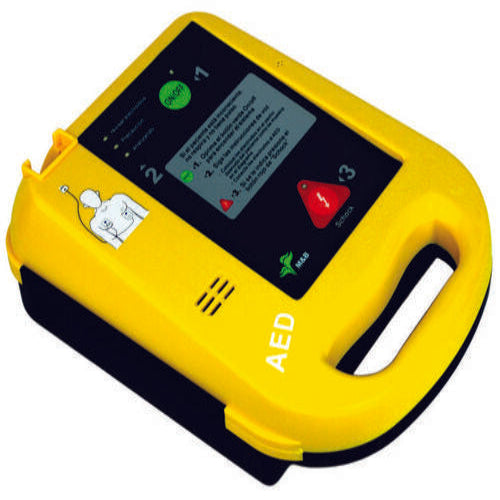
External defibrillators deliver the shock through pads placed on the chest. They include the automated external defibrillator (AED) and the manual defibrillator, often built into a defibrillator monitor. Therefore, they are used in emergencies by lay rescuers and by trained professionals.
2. Implantable defibrillators (ICDs)
An implantable cardioverter-defibrillator (ICD) sits under the skin of the chest, and its leads connect to the heart. It watches the heart rhythm all the time and delivers a shock when needed. As a result, it protects patients who are at high risk of sudden cardiac death.
Tip: Some sources also list subcutaneous ICDs and wearable defibrillators, but the simplest split for students is external versus implantable.
AED vs Manual Defibrillator vs Defibrillator Monitor
Inside the external group, the devices differ in who uses them and what they can do.
| Feature | AED (automated external defibrillator) | Manual defibrillator or defibrillator monitor |
|---|---|---|
| User | Trained or untrained rescuers | Trained clinicians only |
| Rhythm analysis | Automatic, with voice prompts | Clinician reads the ECG |
| Shock control | Device advises, user presses shock (or it delivers automatically) | Clinician selects energy and delivers the shock |
| Extra functions | Basic, sometimes CPR feedback | Pacing, monitoring, cardioversion, 12-lead options |
| Best for | Public places, clinics, general wards | Emergency rooms, ICUs, ambulances, theatres |
Therefore, a busy hospital may need both, while a small clinic or public building often does well with an AED. In short, an automatic defibulator, more correctly called an automated external defibrillator, is the simplest option for non-expert users.
AED in CPR: How Do They Fit Together?
CPR and AED use work as a team. First, high-quality chest compressions keep blood moving to the brain and heart. Then, the AED delivers a shock if the rhythm is shockable. Therefore, rescuers should start CPR at once and use the AED as soon as it arrives.
What the 2025 AHA guidelines add
- First, a single Chain of Survival now applies to adults and children.
- Second, real-time CPR feedback devices are encouraged during resuscitation.
- Third, it may be reasonable to adjust a bra rather than remove it, since the need to expose the chest may lower AED use in some people.
- In addition, pad placement does not need to be perfect for defibrillation to work.
- Finally, only about 1.4% of the 760 recommendations rest on the highest level of evidence, so research in resuscitation remains an active field.
In practice, the aim is to shorten the time to the first shock while keeping pauses in CPR as short as possible.
AED to Use: Steps for Defib Use
The steps below give a general idea. However, always follow the device prompts, your local protocol and your training.
1. Check safety and response
First, make sure the scene is safe. Then, check if the person responds and breathes normally.
2. Call for help and get the AED
Next, call the emergency number (112 in India) and ask someone to bring the AED. Start chest compressions right away.
3. Turn on the AED
After that, switch on the AED and follow the voice prompts. Also, use the child mode or child pads for a child, if the device has them.
4. Attach the pads
Then, dry the chest, and place one pad on the upper right chest and the other on the lower left side. If a bra is in the way, adjust it, as the 2025 guidelines allow.
5. Let the AED analyse
Meanwhile, stop touching the person while the AED checks the rhythm. Say "clear" so that nobody is in contact.
6. Deliver the shock if advised
If the AED advises a shock, make sure everyone is clear and press the shock button. A fully automatic model delivers the shock by itself.
7. Resume CPR
Finally, restart chest compressions immediately, and follow the AED prompts until trained help takes over.
Which Patients Need a Defibrillator?
External defibrillators (AED)
Any person in sudden cardiac arrest may need an AED, because the device checks the rhythm and shocks only when it is shockable. Therefore, rescuers should attach an AED to anyone who is unresponsive and not breathing normally.
Implantable defibrillators (ICD)
Doctors recommend an ICD for selected patients at high risk of dangerous ventricular rhythms. Common examples from guideline summaries include:
- Survivors of cardiac arrest from ventricular fibrillation or sustained ventricular tachycardia, without a reversible cause.
- Patients with an ejection fraction of 35% or less at least 40 days after a heart attack, who have symptoms of heart failure.
- Patients with non-ischaemic dilated cardiomyopathy and an ejection fraction of 35% or less.
- Some patients with inherited rhythm or heart muscle conditions, chosen by a specialist.
Trials such as AVID, CIDS and CASH showed that ICDs reduced deaths compared with amiodarone in patients with sustained VT or VF. However, the decision is individual, so a cardiologist must assess each patient.
What Are the Negatives of a Defibrillator?
Defibrillators save lives, but they have limits and risks.
External defibrillators
- They treat only shockable rhythms, so they do not help in asystole or pulseless electrical activity.
- Poor CPR, long pauses or wrong pad placement can reduce success.
- Pads and batteries expire, and a neglected AED may fail when needed.
- Shocks can cause skin burns or muscle pain, and touching the patient during a shock is dangerous.
- Cost and training needs can be a barrier for small facilities.
Implantable defibrillators
- Inappropriate shocks can occur, for example when the device mistakes a fast atrial rhythm for a dangerous one.
- Shocks can be painful and cause fear and anxiety.
- Surgery risks include infection, bleeding and lead problems such as fracture or dislodgement.
- The generator needs replacement when the battery runs low, which means another procedure.
Safety point: Never touch a patient while a shock is delivered, and keep pads away from water, medication patches and implanted devices as your training advises.
How Long Do Defibrillators Last?
The answer depends on the type and the part.
| Item | Typical life | Notes |
|---|---|---|
| AED unit | About 8 to 10 years | Check the manufacturer date and warranty |
| AED electrode pads | About 2 to 4 years | Gel dries out; replace after every use |
| AED battery | About 2 to 5 years | Depends on the model; replace after use if advised |
| ICD generator battery | About 5 to 10 years | Depends on shocks and pacing; replaced by surgery |
| ICD leads | Often 5 to 10 years or more | Can fail earlier; checked at follow-up |
Therefore, an AED needs regular checks. Most modern models run a daily self-test and show a status light. In addition, staff should inspect the device every month and record pad and battery expiry dates. For example, Meddey lists the i3 AED with a battery that may last up to 5 years.
How Much Does a Defibrillator Cost?
The cost of a defibrillator depends on the type, features and brand. Therefore, an AED for public use costs far less than a defibrillator monitor for an ICU or ambulance. At Meddey, the i3 AED is listed at ₹62,200, the AED View at ₹91,999 and the i6 Defibrillator Monitor at ₹3,43,420, as of 29 September 2026.
What pushes the price up?
- First, manual mode, pacing and monitoring add a lot to the cost.
- Second, a wider energy range, such as 1 J to 360 J, needs more advanced design.
- Third, features such as a colour display, CPR feedback and data storage raise the price.
- In addition, adult and paediatric options, long battery life and connectivity add value.
- Finally, brand, warranty and service support also affect the final cost.
Think about running costs
Besides the device, plan for spare pads, batteries, a wall cabinet, training and a maintenance plan. Also, an AED training device, such as the PRESTAN AED UltraTrainer, helps staff practise without a real shock.
Price note: Prices and offers change often. Therefore, please check the live listing, or contact Meddey for help.
Defibrillators Available at Meddey
Meddey lists AEDs, a defibrillator monitor and related emergency products. The table below shows the products and their prices as listed on Meddey on 29 September 2026. However, prices and stock can change, so please check the live product page before you order. You can also browse the defibrilators collection.
| Product | Type | Key detail | Meddey price |
|---|---|---|---|
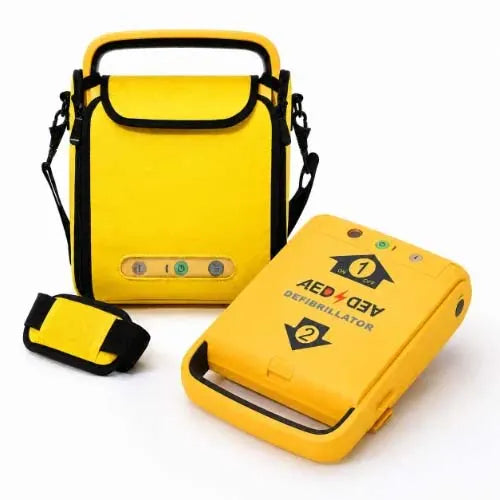
| i3 Automated External Defibrillator | AED | Biphasic, up to 200 J adult and 50 J paediatric, daily self-test, battery up to 5 years | ₹62,200 |
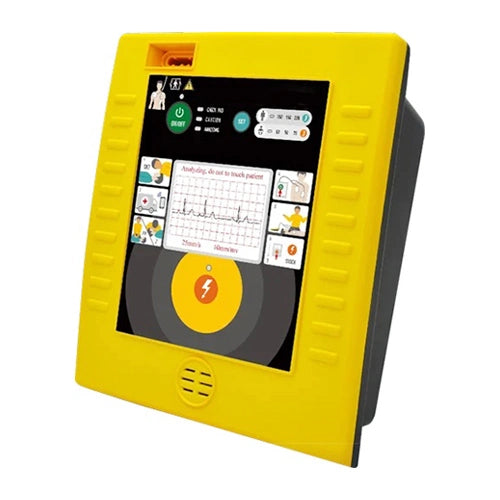
| AED View Automatic External Defibrillator | AED | Adult and paediatric models, 3.5-inch colour LCD, multilingual voice prompts | ₹91,999 |
| i6 Defibrillator Monitor | Defibrillator monitor | Manual and AED modes, pacing, 1 J to 360 J, 7-inch display, about 5.2 kg | ₹3,43,420 |
| PRESTAN AED UltraTrainer | Training device | Five scenarios, adult and child, no real shock | ₹16,100 |
| ABS Emergency Crash Cart Trolley | Crash cart | 5 drawers, CPR board, lockable | ₹42,499 |
| Adult Resuscitation Kit | Airway kit | Emergency airway care | ₹5,749 |
The PRESTAN trainer is for training only and cannot treat a patient. Always read the product page for the full specification before you choose.
AED Defib Care and Placement
An AED defib only saves a life if it is ready and easy to reach. Therefore, every facility needs a simple plan for placement and care. In many public places, teams aim to place the AED so that a rescuer can bring it to a patient within about a minute or two. Also, a clear sign and a wall cabinet help people find it fast.
Placement tips
- First, keep the AED near areas with many people, such as reception, corridors and waiting areas.
- Second, put up clear signs, and tell all staff where the device is.
- Third, avoid extreme heat, cold and damp, since they can harm pads and batteries.
- In addition, keep spare pads next to the AED, and add a small kit with a razor, towel and scissors.
Monthly care checklist
- Check the status light or indicator on the device.
- Look at the expiry dates of the pads and the battery, and record them in a log.
- Inspect the case, cables and cabinet for damage.
- Replace pads after every use, and check the battery after every rescue.
- Run a short drill with staff, using a trainer device, so that everyone remembers the steps.
As a result, the team can trust the AED defib on the day it is needed. Meanwhile, the daily self-test on modern devices adds another layer of safety, but it does not replace the monthly check.
Buying Checklist for Defibrillators
Define the use First, decide if you need an AED for public use or a defibrillator monitor for clinical teams.
Waveform and energy Next, check the waveform, the maximum energy and the paediatric option.
Ease of use Also, look for clear voice prompts, a display and simple buttons.
Battery and pads In addition, check battery life, pad shelf life and the cost of spares.
Self-test and data Since readiness matters, look for daily self-tests and event or ECG storage.
Training and service Finally, confirm staff training, warranty and after-sales support.
As a simple rule, place the AED where it can be reached within about a minute or two, and train staff to use it. Then, keep a monthly check log.
Frequently Asked Questions About Defibrillators
What are defibrillators used for?
They deliver a shock to stop life-threatening rhythms such as ventricular fibrillation. In addition, some devices provide cardioversion, pacing and monitoring in hospital care.
How much does a defibrillator cost?
The cost depends on the type and features. At Meddey, the i3 AED is listed at ₹62,200, the AED View at ₹91,999 and the i6 Defibrillator Monitor at ₹3,43,420, as of 29 September 2026.
What are the negatives of a defibrillator?
External devices treat only shockable rhythms and need maintenance. Implantable devices can cause inappropriate shocks, infection and lead problems, and they need battery replacement.
Which patients need a defibrillator?
Anyone in sudden cardiac arrest may need an AED. Selected high-risk patients, such as some cardiac arrest survivors and people with a low ejection fraction, may need an ICD, as decided by a cardiologist.
How long do defibrillators last?
An AED lasts about 8 to 10 years, but its pads and battery need replacement every 2 to 5 years. An ICD battery usually lasts about 5 to 10 years.
What are the two types of defibrillators?
The two main types are external defibrillators, such as an AED, and implantable defibrillators, called ICDs.
What is an AED to use in an emergency?
An AED is an automated external defibrillator. Turn it on, follow the voice prompts, attach the pads, let it analyse, and press the shock button if it advises a shock. Then, continue CPR.
Are defibrilators and defibulators the same as AEDs?
Yes, they are common spellings of defibrillators. An AED, or automatic defibrillator, is one type that is made for easy use by non-experts.
Where to Buy Defibrillators Online in India?
Hospitals, clinics and public facilities can buy defibrillators from medical equipment suppliers. Before you buy, compare the type, energy, waveform, battery, training and service. Meddey lists AEDs, a defibrillator monitor and emergency accessories, and its support team can help you choose.
View DefibrilatorsContact MeddeyVisit MeddeyDisclaimer
This article is for general education. Therefore, it does not replace resuscitation training, maker instructions or clinical judgement. Only trained staff should use manual defibrillators, and everyone should follow the device prompts and local protocols. Also, prices and product details may change over time.
Explore Medical Collections
All Categories
Abdominal & Maternity Support

Accessories

Accu-Chek Instant Strips: Use, Compatibility, Price & Blood Sugar Testing Guide
Accu-Chek Instant Strips: Uses, Features & Complete Guide

Accupressure Products for Pressure Point Therapy, Pain Relief & Wellness

accupuncture

Acupuncture Needles & Supplies

Advanced Physiotherapy Machines & Lumbar Physiotherapy

Airways

Ambulance

Anatomy Models
Anesthesia Machine

Anesthesia Products
Ankle Support, Braces & Walker Boots for Recovery
Ankle Weights & Exercise Weights for Home & Rehab
You may also need
FOR YOURecommended for you
Save 26%
Save 28%
Save 20%