


Featured Choice
Save 16%

Save 17%


What customers say
★★★★★ 5.0 · 3 reviews
flexbar: exercises, uses, results and buying guide for india
Flexbar: Exercises, Uses, Results and Buying Guide for Physiotherapy
This guide explains what a Flexbar does, what Flexbar exercise involves and who it helps. It also answers how long it takes to work, how much a Flexbar costs and which exercises you can do, with the latest research.
Key Takeaways
- First, a Flexbar is a flexible rubber bar that you bend and twist, and it trains the forearm, wrist and hand with controlled, graded resistance.
- It is best known for the Tyler Twist, an eccentric wrist exercise used in tennis elbow and golfer's elbow programmes.
- In the original randomised study of 21 people, the Flexbar group did 3 sets of 15 repetitions daily, and the programme ran for 7 weeks alongside standard physiotherapy.
- However, the evidence is still limited, so a Flexbar works best as part of a full rehabilitation plan and not as a stand-alone cure.
- Finally, Meddey lists the Theraband FlexBar from ₹2,320 to ₹3,749, as of 1 October 2026, depending on the resistance colour.
Pain on the outside or inside of the elbow can limit work, sport and daily tasks. Therefore, physiotherapists often prescribe a simple Flexbar, because it is cheap, small and easy to use at home. However, many people are unsure how it works, how long it takes and which exercises to do.
This guide is for doctors, physiotherapists, healthcare professionals, medical students and buyers of physiotherapy supplies. In addition, it uses simple words and answers the questions people search for most. To see Meddey's range, you can visit the Flexbar collection at Meddey.
Latest evidence note: A 2024 randomised trial from Rawalpindi compared Tyler Twist exercises plus usual physiotherapy against usual physiotherapy alone in 52 people with tennis elbow. The added Flexbar group had a statistically significant difference in pain, disability and grip strength. Meanwhile, a trial record from 2023 notes that an earlier systematic review found only limited evidence for adding eccentric strengthening to standard physiotherapy. Therefore, results look promising, but larger trials are still needed.
What Does a Flexbar Do?
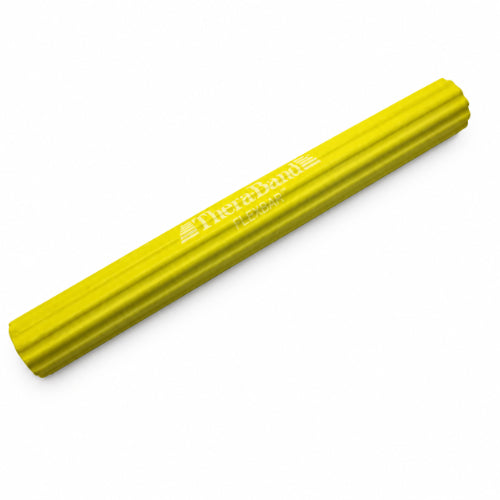
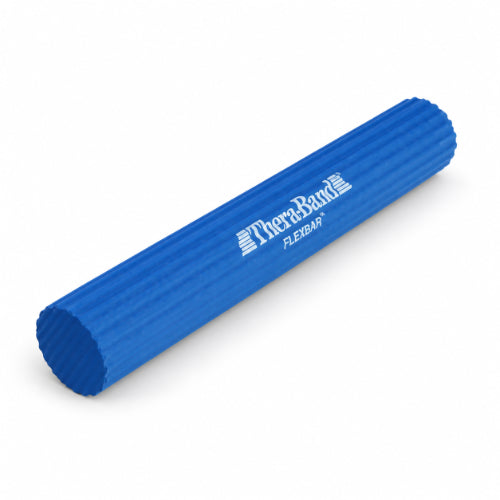
A Flexbar is a flexible, high-density rubber bar, about 12 to 14 inches long. The user holds one end in each hand, bends the bar and twists it. As a result, the wrist and forearm muscles must work against the springy resistance of the bar.
The twisting motion is the key feature. Instead of lifting a fixed weight, the user controls the bar while it untwists, and this loads the muscles as they lengthen. This is called eccentric loading, and it is widely used in tendon rehabilitation.
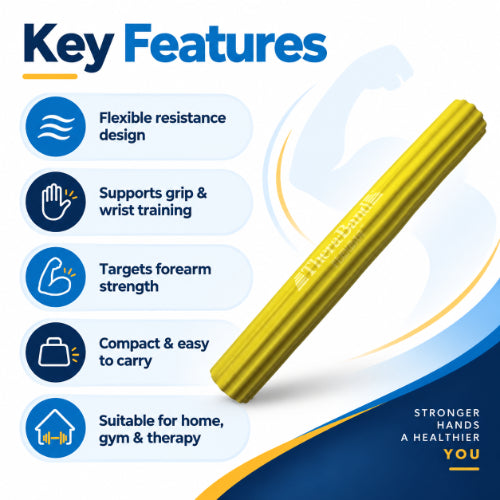
- Forearm strength First, it trains the muscles that move the wrist and fingers.
- Grip strength Next, gripping the bar builds hand endurance.
- Tendon loading Also, eccentric twisting loads the tendons at the elbow.
- Wrist control In addition, it improves wrist stability and coordination.
- Flexibility Moreover, it works the joints through a smooth range of motion.
- Portability Finally, it is light, compact and easy to carry.


How a Flexbar Works
The bar bends easily at first, but it gets harder to twist as you twist it further. Because the resistance rises smoothly, the user can control the speed of the movement. Therefore, the exercise suits both gentle rehabilitation and stronger training.
- Bend: The user holds the bar and bends it into a slight arch.
- Twist: The hands turn in opposite directions to twist the bar.
- Hold: The bar stays in the twisted position for a moment.
- Release slowly: The affected wrist untwists the bar under control, which creates the eccentric load.
Releasing slowly is the most important step. If the bar snaps back, the benefit is lost, and the risk of strain rises. In addition, the user should keep the elbow straight and the wrist in slight extension during the first stage.
What Are Flexbars Good For?
Flexbars are most often used for overuse problems of the elbow and forearm. They also help with general hand and wrist strengthening.
| Use | How a Flexbar helps |
|---|---|
| Tennis elbow (lateral epicondylalgia) | Eccentric loading of the wrist extensors, using the Tyler Twist |
| Golfer's elbow (medial epicondylalgia) | Eccentric loading of the wrist flexors, with a reversed twist |
| Repetitive strain in the forearm | Graded strengthening of overworked muscles |
| Grip and wrist weakness | Builds hand endurance and wrist control |
| Return to sport or work | Prepares the forearm for gripping and swinging tasks |
| Hand therapy after injury | Adds controlled resistance once a therapist agrees |
People at risk include racquet sport players, golfers, keyboard and mouse users, tradespeople and musicians. In addition, anyone who grips or twists for long hours may develop forearm strain.
Flexbar Resistance Bar: Colours and Levels
A Flexbar resistance bar comes in several colours, and each colour has a different stiffness. Therefore, users can start with a light bar and move up as they get stronger. Meddey's listing explains the colour order.
| Colour | Resistance level | Who it suits |
|---|---|---|
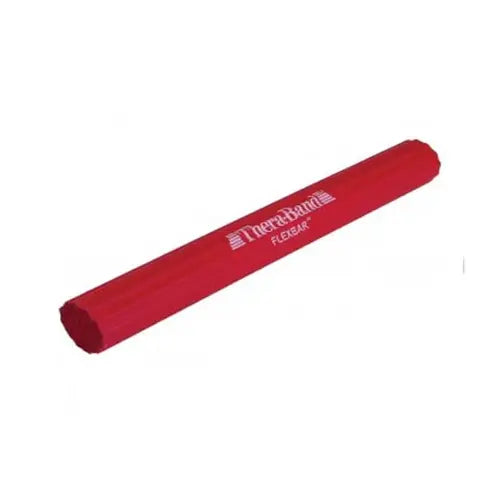
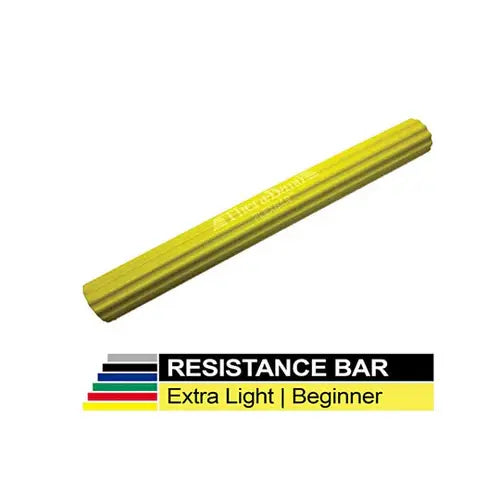
| Yellow | Lightest | Beginners, painful or recently injured arms |
| Red | Light to medium | Early strengthening |
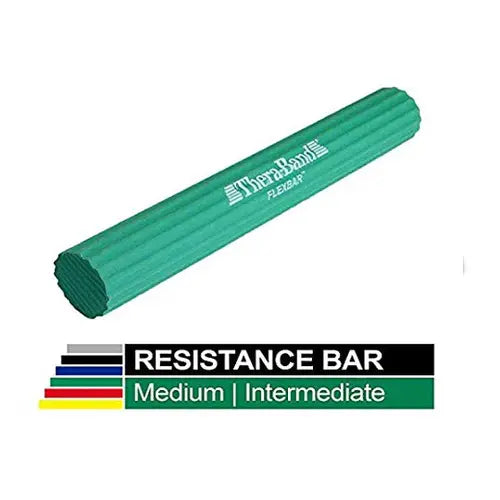
| Green | Heavier | Mid-stage rehabilitation |
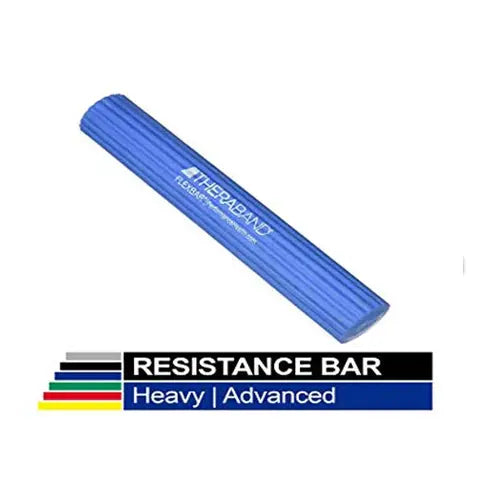
| Blue | Firmest in the Meddey range | Advanced training |
However, the graded approach matters because irritated tendons respond better to slow, step-by-step loading than to heavy resistance from day one. The same twist is used with every colour, so only the load changes and the person does not have to learn a new movement.
What Exercises Can I Do With a Flexbar?
First, the Tyler Twist is the best-known Flexbar exercise. In addition, a few simple variations train other wrist movements. A physiotherapist should confirm the plan before you start.
Tyler Twist for tennis elbow
- Hold the bar. First, hold the Flexbar in both hands, with the affected arm out in front, the elbow straight and the wrist slightly extended.
- Twist with the other hand. Next, use the unaffected hand to twist the bar into a taut position, while the affected hand resists.
- Extend the arms. Then, hold the twisted bar out in front of you.
- Untwist slowly. Also, let the affected wrist slowly bend and untwist the bar in a controlled way.
- Repeat. Finally, repeat for the set number of repetitions, then rest.
Other Flexbar exercises
| Exercise | Target | Notes |
|---|---|---|
| Reverse Tyler Twist | Wrist flexors, for golfer's elbow | Twist the opposite way, with guidance |
| Bar bend | Grip and forearm strength | Bend the bar slowly and hold |
| Wrist flexion and extension | Wrist muscles | Use a vertical bar with the forearm supported |
| Pronation and supination | Forearm rotation | Rotate the bar slowly in both directions |
| Overhead or shoulder holds | Shoulder and arm control | Use only if the therapist advises |
Typical dose
In the original Tyler study, people did 3 sets of 15 repetitions every day, and they moved up through three resistance levels over the treatment period. However, the dose should match the person's pain, strength and goals. In addition, stop if pain rises sharply, and ask your therapist to adjust the plan.
Control matters more than speed. Slow, smooth movement gives the best loading. Therefore, avoid fast jerks, and never let the bar snap back.
How Long Does It Take for a Flexbar to Work?
There is no fixed time, because tendons heal slowly and each person differs. However, the main study gives a useful guide. The original randomised study ran for 7 weeks, and the Flexbar group showed greater gains in strength and pain than the control group by the end of the programme.
- First 1 to 2 weeks: Many people feel the exercise is hard, and mild soreness can occur. Pain relief may be small at this stage.
- Weeks 3 to 6: Strength and control often improve, and pain may start to settle with steady practice.
- Weeks 6 to 12: Many programmes continue to this point, and a longer course may be needed for long-standing problems.
- Beyond: Some people need maintenance work to prevent a return of pain.
Consistency matters more than force. As a result, a daily home programme with a gradual increase in resistance usually works better than occasional hard sessions. In addition, a person who sees no change after several weeks should return to the clinician for a review.
What the Latest Evidence Says
Research on the Flexbar is promising, but it is not strong enough to call it a proven cure. Therefore, healthcare professionals should present it as one useful exercise tool.
- Original randomised trial (Tyler and colleagues): It included 21 people with tennis elbow symptoms for at least 6 weeks. Everyone received standard physiotherapy for 7 weeks, and one group added Tyler Twist exercises. The Flexbar group had greater improvements in strength and pain. You can read a summary on MASSAGE Magazine.
- 2024 randomised trial: The trial included 52 people and found that adding Tyler Twist exercises to conventional physiotherapy gave a statistically significant difference in pain, disability and grip strength. You can read the abstract in the Journal of Riphah College of Rehabilitation Sciences.
- Limits: Both studies were small. A 2023 trial record notes that proper evidence behind Tyler Twist exercises is sparse, and that a 2018 systematic review found limited evidence for adding eccentric strengthening to standard physiotherapy. You can see it on ClinicalTrials.gov.
- Newer trials: Registered studies are now comparing the Tyler Twist with traditional eccentric dumbbell exercises.
What this means in practice. A Flexbar is a low-cost, home-friendly way to apply eccentric loading. Use it with a full plan that includes load management, strengthening and review, and do not promise a cure.
Flexbar for Physiotherapy: How Clinicians Use It
Flexbar for physiotherapy is common because it fits both clinic and home programmes. In addition, it lets the therapist teach the movement once and then let the person practise daily.
- Assess. First, confirm the diagnosis, and check the pain, strength and function.
- Teach the technique. Next, show the bend, twist and slow release, and watch the person do it.
- Choose the colour. Then, start with a bar the person can control without sharp pain.
- Set the dose. Also, agree on sets, repetitions and rest.
- Progress. In addition, move to a firmer bar when the movement feels easy.
- Review. Finally, re-test pain, strength and function after several weeks.
Many therapists also add stretching, load advice, grip work and a plan to return to sport or work. As a result, the Flexbar becomes one part of a broader programme.
A Simple Weekly Therapy Plan
Flexbar therapy works best when it follows a clear plan. Therefore, the example below shows how a therapist may structure the first weeks. It is only an example, and each person needs an individual plan.
| Stage | Bar and focus | Typical goal |
|---|---|---|
| Weeks 1 to 2 | Lightest bar, slow release, short sets | Learn the technique without sharp pain |
| Weeks 3 to 4 | Same or next bar, more repetitions | Build control and tolerance |
| Weeks 5 to 6 | Firmer bar if the movement is easy | Raise strength |
| Weeks 7 and later | Mixed grips and work or sport tasks | Return to full activity and prevent a relapse |
In addition, the person should keep a simple log of pain, repetitions and bar colour. As a result, the therapist can see progress at each review.
Preventing Forearm Strain at Work and in Sport
Exercise helps, but daily habits matter too. Therefore, pair Flexbar exercise with simple changes that lower the load on the forearm.
- Check your grip: Avoid gripping tools or rackets harder than needed.
- Adjust equipment: Use the right racket size, handle size and keyboard position.
- Take micro-breaks: Rest the hands for a short time during repetitive work.
- Warm up: Prepare the forearm before sport or heavy tasks.
- Build gradually: Increase training loads slowly.
- Use a support if advised: A tennis elbow support may help some people during activity.
Safety, Cautions and Who Should Avoid It
A Flexbar is simple, but it should still be used with care. Therefore, check the points below.
- Get a diagnosis: Elbow pain can come from the neck, nerves or joints, so check the cause first.
- Recent injury or surgery: Avoid it unless the surgeon or therapist allows it.
- Sharp or rising pain: Stop the exercise and ask for advice.
- Numbness or tingling: Seek assessment, because nerve problems need a different plan.
- Bar snap-back: Always release slowly, and keep the bar away from the face.
- Material allergy: Stop if you notice a skin reaction.
Seek medical care for these signs. See a doctor for sudden severe pain, swelling, weakness, a loss of feeling in the hand, or elbow pain after a fall or injury.
How Much Does a Flexbar Cost?
The Flexbar cost depends on the resistance colour, the brand and the supplier. Therefore, compare the colour and the maker, and not only the price.
- Resistance colour: First, firmer bars often cost more than lighter ones.
- Brand: Next, original brand bars may cost more than generic rubber bars.
- Pack: Also, sets of several colours cost more than a single bar.
- Supplier: In addition, check the warranty and return terms.
As of 1 October 2026, Meddey lists the Theraband FlexBar at ₹2,320 for yellow, ₹2,499 for red, ₹2,999 for green and ₹3,720 for blue. In addition, Meddey lists a separate yellow resistance bar at ₹2,330 and a blue resistance bar at ₹3,749.
What about the Flexbar touch bar cost?
Meddey does not list a product named "Flexbar touch bar". The Theraband FlexBar prices above are the Flexbar prices that Meddey lists. Therefore, please contact Meddey if you are looking for a specific model.
Meddey Flexbar Products and Price
Meddey lists Flexbar products in its Flexbar collection. The table shows prices as listed on 1 October 2026. However, prices and stock can change, so please check the live product page before you order.
| Product | Colour and level | Meddey price |
|---|---|---|
| Theraband FlexBar (Yellow) | Yellow, lightest resistance | ₹2,320 |
| Theraband FlexBar Resistance Bar Yellow | Yellow, light resistance | ₹2,330 |
| Theraband FlexBar (Red) | Red, light to medium | ₹2,499 |
| Theraband FlexBar (Green) | Green, heavier | ₹2,999 |
| Theraband FlexBar (Blue) | Blue, firmest | ₹3,720 |
| Theraband FlexBar Resistance Bar Blue | Blue, firmest | ₹3,749 |
Related products at Meddey
Meddey also lists products that support hand and elbow care, such as the Velpeau Epi Comfort Elbow Support for tennis and golfer's elbow at ₹3,689, the Theraputty Combo for hand therapy at ₹2,999 and the Theraband Set of 3 Resistance Bands at ₹2,299.
For more hand and rehab tools, browse our Therapy Putty, Hand Exercise Equipment and Theraband Resistance Bands collections.


Price note: Prices and offers change often. For bulk orders for a clinic or hospital, please contact Meddey for a quote.
How to Choose the Right Flexbar
| Question | What to consider |
|---|---|
| Is the arm painful or recently injured? | Start with the lightest bar, and move up slowly |
| Can the person twist the bar with control? | If not, choose a lighter bar |
| Is it for a clinic or for home? | Clinics may stock several colours, and home users may need two |
| Is the goal rehabilitation or training? | Rehabilitation starts light, and training can use firmer bars |
| Is the maker clear? | Check brand, material and support |
A good rule is to choose the bar that allows slow, controlled movement without sharp pain. In addition, buy the next level only when the first feels easy.
Buying Checklist for a Flexbar
- Resistance First, pick the colour that suits the stage of recovery.
- Brand and material Next, check the maker and the quality of the rubber.
- Grip Also, look for a textured, non-slip surface.
- Guidance In addition, ask a physiotherapist to teach the technique.
- Progression Since strength improves, plan the next resistance level.
- Supplier Finally, confirm warranty, support and return policy.
Frequently Asked Questions About the Flexbar
What does a FlexBar do?
A Flexbar is a flexible rubber bar that you bend and twist to strengthen the wrist, forearm and hand. It is best known for the Tyler Twist, which loads the muscles eccentrically in tennis elbow programmes.
How long does it take for FlexBar to work?
There is no fixed time. The original study ran for 7 weeks, and many programmes continue for 6 to 12 weeks. Consistent daily practice and slow progression matter most.
How much does the FlexBar touch bar cost?
Meddey does not list a product named "Flexbar touch bar". The Theraband FlexBar is listed from ₹2,320 to ₹3,749, as of 1 October 2026. Please contact Meddey for a specific model.
How much does a FlexBar cost?
At Meddey, the Theraband FlexBar costs ₹2,320 for yellow, ₹2,499 for red, ₹2,999 for green and ₹3,720 for blue. Please check the live listing for the latest price.
What are flex bars good for?
They are good for tennis elbow, golfer's elbow, forearm strain, grip and wrist strengthening and return to sport or work, as part of a therapist's plan.
What exercises can I do with a FlexBar?
The main one is the Tyler Twist. Others include the reverse Tyler Twist, bar bends, wrist flexion and extension, and forearm rotation, with guidance from a physiotherapist.
Is a Flexbar safe for everyone?
Most people can use it, but not after a recent injury or surgery unless a clinician agrees. Stop if pain rises sharply or if you feel numbness.
Where to Buy a Flexbar Online in India?
Physiotherapists, clinics, hospitals and individuals can buy a Flexbar from medical equipment suppliers. Before you buy, compare the resistance colour, brand, material and price. Meddey lists the Theraband FlexBar in several resistance levels, and its support team can help you choose.
Disclaimer
This article is for general education. Therefore, it does not replace the advice of a doctor or physiotherapist. A qualified professional should diagnose elbow pain and set the exercise plan. Also, prices and product details may change over time.
Explore Medical Collections
All Categories
Abdominal & Maternity Support

Accessories

Accu-Chek Instant Strips: Use, Compatibility, Price & Blood Sugar Testing Guide
Accu-Chek Instant Strips: Uses, Features & Complete Guide

accupuncture

Acupuncture Needles & Supplies

Advanced Physiotherapy Machines & Lumbar Physiotherapy

Airways

Ambulance

Anatomy Models
Anesthesia Machine

Anesthesia Products

Ankle Support for Home Use: Braces, Sleeves & Walker Boots

Ankle Weights & Exercise Weights for Home & Rehab

Anti-Bedsore Air Mattresses
You may also need
FOR YOURecommended for you
Save 16%
Save 17%